

Most business owners who regret hiring a painting contractor say the same thing: they did not ask enough questions upfront. Commercial painting in the Lower Mainland is a competitive market, and the gap between a contractor who finishes on schedule without disrupting your operations and one who leaves you with peeling baseboards and a two-week closure is enormous. Whether you own a retail space in Surrey, a warehouse in Abbotsford, or a multi-unit commercial property in Langley, the questions you ask before signing a contract will determine whether this project adds value or creates headaches.
Table of Contents
- Quick Takeaways
- Why Commercial Painting Is Different From Residential Work
- Questions to Ask Any Commercial Painter Before Hiring
- Licensing, Insurance, and WorkSafeBC Compliance
- Scheduling and Minimizing Business Disruption
- Comparing Approaches to Commercial Painting Contracts
- What a Professional Estimate Should Include
- Red Flags to Watch For When Hiring a Painting Contractor
- Frequently Asked Questions
- References
Quick Takeaways
| Key Insight | Explanation |
|---|---|
| Always verify WorkSafeBC registration | Any commercial painter operating in BC must be registered with WorkSafeBC. If they are not, you carry the liability for any on-site injury. |
| After-hours scheduling is a standard ask, not a premium | Established commercial painters in the Lower Mainland routinely schedule work during evenings or weekends to avoid disrupting business operations. If a contractor cannot accommodate this, find one who can. |
| Get product specifications in writing | Specify the exact paint brand, product line, and sheen level in your contract. Contractors who leave this vague often substitute lower-grade products to cut costs. |
| A fixed-price quote protects your budget | Time-and-material contracts expose you to cost overruns. Fixed-price quotes hold the contractor accountable to a defined scope. |
| References from commercial clients carry more weight | A contractor who only offers residential references may not understand the compliance, scheduling, and surface-prep demands of commercial jobs. |
| Surface preparation accounts for 70-80% of a quality result | In practice, most premature paint failures trace back to inadequate prep, not the paint itself. Ask specifically how the crew handles surface cleaning, patching, and priming. |
| Warranty terms should cover both labour and materials | A warranty that only covers materials leaves you unprotected if the application fails. Insist on a written warranty covering both components. |
Why Commercial Painting Is Different From Residential Work
Painting a commercial property is not a scaled-up version of painting a house. The stakes are different, the surfaces are different, and the regulatory environment is different. A retail store in Langley City Centre, for example, may require low-VOC coatings to meet indoor air quality standards while customers are present. A warehouse in Abbotsford may need epoxy floor coatings and industrial-grade wall finishes rated for forklift exhaust and moisture.
Commercial painters Vancouver businesses rely on must also understand how to coordinate with property managers, strata councils, or building owners when the business does not own the space. This adds layers of approval and compliance that residential contractors rarely encounter.
Scope and scale also change the logistics entirely. A seasoned commercial painting contractor brings project managers, not just painters. They track square footage, coordinate multi-crew schedules, and manage materials deliveries to avoid work stoppages. If the contractor you are interviewing cannot describe their project management process, that is a serious gap.

Questions to Ask Any Commercial Painter Before Hiring
The right questions separate contractors who look professional from contractors who perform professionally. Here is what you should be asking directly, before any deposit changes hands.
How Much of Your Work Is Commercial vs. Residential?
This matters more than most business owners realize. A contractor who does 90% residential work and occasionally takes commercial jobs is not a commercial specialist. Ask for the percentage split and ask specifically which commercial sectors they have worked in: retail, hospitality, industrial, healthcare, or multi-unit. Each has different surface, coating, and scheduling requirements.
Who Will Be On-Site Every Day?
On larger commercial jobs, the estimator who sold you the project is rarely the person holding the brush. Ask whether a dedicated site supervisor will be present daily. Unsupervised crews on commercial jobs are a leading cause of quality inconsistency, particularly on detail work around trim, ceilings, and storefront windows.
What Surface Preparation Process Do You Follow?
In practice, the answer to this question tells you almost everything. A contractor who says they will “sand and prime where needed” is giving you a vague non-answer. A contractor who explains that they will pressure-wash exterior masonry, allow a specific dry time, apply a bonding primer on previously painted metal surfaces, and fill cracks with a specific caulk product is describing a real process. That specificity is what you are looking for.
What Coatings Do You Recommend and Why?
A knowledgeable painting contractor commercial clients can trust will recommend specific products based on your surface type and use case, not based on what is cheapest or most available. For a high-traffic retail floor, they should be recommending a two-part epoxy or polyurethane system. For an office interior with frequent cleaning, a scrubbable eggshell or satin finish is appropriate. Generic answers here are a red flag.
Pro tip: Ask the contractor to name the specific paint manufacturer and product line they plan to use. Then look up that product’s technical data sheet yourself. If the product is not rated for your application, you will know before work starts rather than after it fails.
Licensing, Insurance, and WorkSafeBC Compliance
This section is non-negotiable. Any commercial painting contractor working in British Columbia must carry two forms of protection: general liability insurance and WorkSafeBC coverage for all workers on site. Do not accept verbal confirmation. Ask for certificates and verify them.
General liability insurance for commercial painting contractors in BC typically starts at $2 million in coverage. Some commercial property managers and strata corporations require $5 million. Know what your property requires before you evaluate bids, because a contractor carrying $1 million in coverage may need to be disqualified before the conversation goes further.
WorkSafeBC registration can be verified directly through the WorkSafeBC clearance letter system. A reputable contractor will provide this without hesitation. If they hesitate or cannot produce it, walk away. Under BC law, if an unregistered worker is injured on your property, you may be held responsible for costs that should have been covered by the contractor’s WorkSafeBC account.
Beyond insurance, confirm that the contractor holds a valid business licence for the municipality where your property is located. Surrey, Abbotsford, Langley Township, and other Lower Mainland municipalities each have their own licensing requirements. This is a minor check that eliminates a surprising number of fly-by-night operations.
Pro tip: Request a WorkSafeBC clearance letter dated within 30 days of your project start date, not a generic certificate. Clearance letters confirm that the contractor’s account is in good standing at that specific point in time.
Scheduling and Minimizing Business Disruption
For most businesses in the Lower Mainland, shutting down for a paint job is simply not an option. A restaurant cannot close for a week. A dental office cannot turn patients away. The question of scheduling is not a logistical afterthought. It is a central part of the project plan and it should be addressed before you receive a final quote.
Ask the contractor specifically how they have handled similar situations in the past. Have they painted occupied retail spaces in phases? Have they worked overnight shifts in hospitality or healthcare environments? Can they provide references from clients where they maintained business continuity during the project?
Experienced commercial painters serving Abbotsford and the Fraser Valley will build a phased schedule into the proposal itself. Section by section, floor by floor, they move through the building while keeping other areas operational. This requires more planning time upfront and more coordination during the job, but it is what separates a professional commercial operation from a residential contractor taking on a big job.
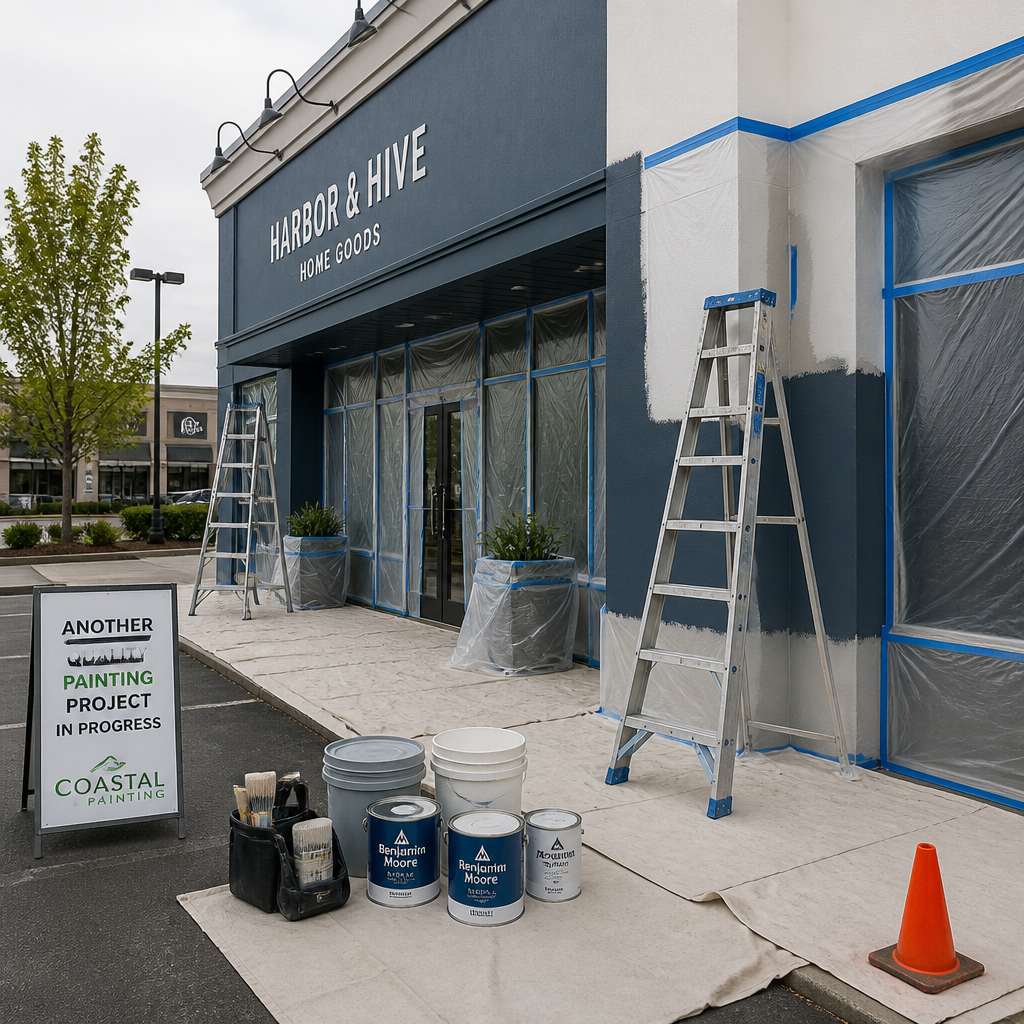
Also ask about odour and VOC management. Low-VOC coatings are not just an environmental preference. They are a practical necessity when painting occupied or semi-occupied commercial spaces. The last thing a business owner needs is customer complaints about paint fumes during a mid-project day.
Comparing Approaches to Commercial Painting Contracts
Not all commercial painting contracts are structured the same way, and the structure affects your risk as a business owner. Here is a direct comparison of the three most common contract types you will encounter when hiring commercial painters in the Lower Mainland.
| Contract Type | How It Works | Best Suited For |
|---|---|---|
| Fixed-Price (Lump Sum) | Contractor quotes a single price for a fully defined scope of work. Cost overruns are the contractor’s responsibility unless the scope changes. | Well-defined interior and exterior commercial projects where surfaces, square footage, and product specs are clearly established upfront. |
| Time and Materials (T&M) | You pay for labour hours plus materials at cost, often with a markup. Final cost is unknown until the job is done. | Emergency touch-up work or projects where scope genuinely cannot be defined. Risky for large commercial projects. |
| Unit Price | Contractor prices by measurable unit, such as per linear metre of trim or per square metre of wall surface. Total cost is calculated by actual measured quantities. | Large commercial buildings or strata complexes where exact quantities are variable but measurements are reliable. |
In practice, fixed-price contracts serve most commercial clients best. They create accountability and make budget planning straightforward. The data consistently shows that cost disputes between contractors and commercial clients are far more common under T&M arrangements, simply because the incentive structure favours the contractor taking longer rather than finishing efficiently.
“The single biggest mistake commercial clients make is accepting a vague scope of work attached to a time-and-material rate. By the time they realize the project has gone over budget, work is already underway and they have little leverage to push back.” – Commercial Contractors Association of BC, industry guidance on project contracting.
What a Professional Estimate Should Include
A professional estimate for commercial painting Lower Mainland projects should read like a contract draft, not a napkin sketch. If the document you receive does not include the following elements, ask for a revised version before you proceed.
Detailed Scope of Work
Every surface to be painted must be itemized. Walls, ceilings, trim, doors, door frames, mechanical room surfaces, exterior soffits, and any specialty surfaces like exposed brick or concrete should each be listed separately. A line that reads “paint interior” is not a scope of work.
Specified Paint Products
The estimate should name the manufacturer, product line, colour reference, and number of coats for every surface. Sherwin-Williams, Benjamin Moore, and Dulux are among the most commonly specified brands for commercial work in BC. If the estimate says only “premium paint,” that is a substitution waiting to happen.
Surface Preparation Details
Prep work should be broken out as its own line item with a description of the process. This includes cleaning methods, patching, sanding, priming, and any special treatment for previously painted or damaged surfaces. A contractor who bundles prep into a general labour line is hiding the real cost of doing the job properly.
Payment Schedule
A standard commercial painting payment schedule in BC typically breaks into three stages: a deposit upon contract signing (usually 10-25%), a progress payment at the midpoint, and a final payment upon completion and client sign-off. Be cautious of any contractor requesting more than 30% upfront for a job that has not yet started.
Warranty Terms
The warranty should state the duration, what it covers (both materials and application), and what voids it. A two-year warranty on labour and materials is reasonable for most commercial interior work. Exterior commercial work should carry at least three to five years given the exposure conditions in the Lower Mainland’s wet climate.
Red Flags to Watch For When Hiring a Painting Contractor
After more than three decades in the Lower Mainland painting industry, the same warning signs appear consistently before a project goes wrong. These are not minor concerns. Any one of them should give you serious pause.
No fixed business address. A contractor operating from a mobile phone with no verifiable office location is difficult to reach if problems arise after the job. Look for a business with a physical presence in the region they claim to serve.
Unusually low bids deserve scrutiny, not celebration. If one bid is 40% below the others, the contractor is either planning to cut corners on prep and materials, will add costs mid-project through change orders, or has underestimated the job and will rush to finish. None of these outcomes serves you well.
Reluctance to provide references from commercial clients specifically is a significant red flag. Residential painting references do not demonstrate the ability to manage a commercial project. Ask for two or three commercial references and call them. Ask specifically about schedule adherence, crew professionalism, and how the contractor handled problems when they arose.
A contractor who cannot describe their primer selection process or explain why they choose one primer over another for a specific substrate does not have the technical knowledge to handle commercial surfaces reliably. Surface preparation and primer selection are skills that require genuine expertise, particularly in older Lower Mainland commercial buildings where you may encounter multiple layers of old paint, moisture damage, or lead-containing coatings.
Pro tip: Ask the contractor directly: “Have you ever encountered lead paint on a commercial job, and how did you handle it?” Their answer tells you whether they understand BC occupational health regulations and whether they have the training to handle hazardous materials safely. For buildings constructed before 1990 in the Fraser Valley and Lower Mainland, lead-containing paint is a real possibility.
Frequently Asked Questions
How long does a typical commercial painting project take in the Lower Mainland?
Project duration depends heavily on square footage, surface complexity, and whether the work is phased around business hours. A 5,000 square foot retail interior with standard walls and trim typically takes a professional commercial crew five to ten business days. An exterior repaint of a multi-storey commercial building can take three to six weeks depending on weather and scaffold requirements in BC’s climate.
Is it worth paying more for a commercial painting specialist versus a general contractor who also paints?
Yes, without qualification. A general contractor who subcontracts painting to the lowest available crew has no specialized accountability for the quality of the paint work. A dedicated commercial painting company’s entire reputation depends on painting outcomes, which creates a fundamentally different incentive structure. For any project over 2,000 square feet or any job requiring specific coating systems, use a specialist.
What is the best time of year to schedule commercial exterior painting in the Lower Mainland?
The Lower Mainland’s wet climate means exterior painting windows are most reliable between late May and early October. Most quality commercial coatings require application temperatures above 10 degrees Celsius and surfaces that have been dry for at least 48 hours. Spring and early summer are ideal because humidity levels are moderate and temperatures are consistent. Scheduling in November or February significantly increases the risk of application failure.
Do I need to vacate my commercial space during painting?
Not necessarily, but it depends on the coating systems being used and the ventilation capacity of the space. For standard latex interior coatings with low-VOC formulations, partial occupancy is often manageable with proper ventilation and phased scheduling. For epoxy floor coatings, two-part urethane systems, or any oil-based products, full evacuation of the painted zone is required during application and curing. A professional commercial painter will advise you specifically based on the products in your project spec.
How do I verify that a commercial painter is properly registered in BC?
Request a WorkSafeBC clearance letter directly from the contractor, and verify the contractor’s business licence through the municipality where your property is located. You can also ask for proof of general liability insurance from their broker, not just a certificate the contractor printed themselves. WorkSafeBC’s website allows you to search for registered employers by name, which provides an additional verification step that takes under two minutes.
What should a warranty for commercial painting cover?
A legitimate warranty for commercial painting should cover both the labour (application) and the materials (paint and primer) for a defined period. For interior work, two years is a reasonable baseline. For exterior commercial work in the Lower Mainland, three to five years reflects the exposure conditions and the expected performance of quality coating systems. The warranty should also specify what maintenance requirements, if any, the client must follow to keep it valid.
If you are currently evaluating commercial painting contractors in the Lower Mainland and have run into situations these questions do not address, share your experience below so other business owners can benefit from what you have encountered.
References
- WorkSafeBC official site, where you can verify contractor registration and access BC occupational health regulations for painting and surface coating work
- National Research Council of Canada, source of building science standards and coating performance research applicable to commercial construction in BC
- Statista, for industry statistics on the commercial painting and building services market in Canada
- Forbes, for business guidance on contractor hiring, commercial renovation budgeting, and vendor due diligence practices
- Government of Canada, for federal occupational health and safety standards covering hazardous materials including lead paint in commercial buildings

