
Most homeowners in the Fraser Valley assume exterior paint lasts as long as the can says. It does not. In BC’s climate, where Abbotsford alone averages over 1,500 mm of rain annually, exterior paint faces moisture stress that simply does not exist in drier provinces. The honest answer for exterior painting Fraser Valley is this: a quality paint job on a properly prepared surface lasts 7 to 10 years. A rushed job with no primer, wrong paint type, or poor application technique? You are looking at 3 to 5 years before peeling and cracking show up. Knowing the difference saves you thousands.
Table of Contents
- Quick Takeaways
- How Long Exterior Paint Actually Lasts in BC
- Why Fraser Valley Climate Is Harder on Paint Than Most Places
- Factors That Shorten Paint Lifespan on BC Homes
- Surface Preparation: The Real Difference Maker
- Paint Types and Their Performance in Wet Climates
- Comparing Paint Approaches for BC’s Exterior Climate
- House Painting Maintenance in BC: What to Do Between Paint Jobs
- Warning Signs Your Exterior Paint Is Failing
- Frequently Asked Questions
- References
Quick Takeaways
| Key Insight | Explanation |
|---|---|
| Average lifespan in BC is 7 to 10 years | Properly prepared surfaces with quality paint and professional application reach the upper end of this range even in wet climates. |
| Poor prep cuts lifespan nearly in half | Skipping pressure washing, priming, or caulking before painting is the single biggest cause of premature paint failure in the Lower Mainland. |
| North and east-facing walls fail first | These walls stay damp longer because they get less sun exposure, accelerating mold, mildew, and paint breakdown. |
| 100% acrylic latex outperforms oil-based paint in wet climates | Acrylic paint expands and contracts with temperature changes and resists moisture far better than oil-based alternatives on BC exteriors. |
| Annual inspections extend the life of any paint job | Catching small cracks or failing caulk early and addressing them costs almost nothing compared to a full repaint done years ahead of schedule. |
| Stucco and wood siding need different maintenance schedules | Wood siding typically needs repainting every 5 to 7 years in the Fraser Valley, while stucco can stretch to 10 years with the right paint system. |
| Painting in the wrong season accelerates failure | Applying exterior paint below 10 degrees Celsius or on wet surfaces leads to poor adhesion and dramatically shorter paint life, regardless of paint quality. |
How Long Exterior Paint Actually Lasts in BC

The paint manufacturer’s stated lifespan is measured in ideal conditions. BC’s Lower Mainland and Fraser Valley are not ideal conditions. The combination of high annual rainfall, freeze-thaw cycles in winter, and prolonged humidity means paint here degrades faster than it would in, say, Calgary or Toronto.
In practice, the breakdown looks like this. On wood siding with thorough surface preparation and two coats of premium 100% acrylic latex, you can realistically expect 7 to 10 years. On stucco with a proper elastomeric or acrylic top coat, that range extends toward 10 to 12 years. Trim and doors, which take more direct contact and moisture, typically need attention every 4 to 6 years.
Budget paints applied by inexperienced painters routinely fail within 3 to 5 years in this region. The upfront savings evaporate quickly when you factor in the cost of another full paint job just a few years later. The data consistently shows that spending more per litre on exterior paint and paying for proper preparation is the lower-cost option over a 15-year horizon.
Why Fraser Valley Climate Is Harder on Paint Than Most Places
Abbotsford receives roughly 1,540 mm of precipitation annually, and Langley and Surrey are not far behind. Compare that to Vancouver’s already-wet 1,150 mm or the Canadian average closer to 500 to 600 mm, and you start to understand the challenge. The Fraser Valley sits in a geographic funnel that traps moisture coming off the Pacific.
The problem is not just the rain itself. It is the sustained humidity between rain events. Paint that never fully dries between wet periods begins to trap moisture underneath the film, which causes blistering, peeling, and wood rot beneath the surface. This is especially common on homes with mature trees nearby that block airflow and sunlight.
Winter frost cycles add another layer of stress. When moisture penetrates a hairline crack in the paint film and then freezes, it expands and forces the paint to lift. A small crack in October becomes a peeling section by March. Homes in Abbotsford and Langley that experience colder inland temperatures see this pattern repeatedly.
“Moisture is the number one enemy of exterior paint in coastal and near-coastal BC. The homes that hold their paint longest are the ones where every entry point for water, every gap, every failed caulk joint, was addressed before a single drop of paint was applied.” – Dreamscape Painting Ltd., field experience from over 35 years of exterior painting in the Lower Mainland
Factors That Shorten Paint Lifespan on BC Homes
Inadequate Surface Cleaning Before Painting
Mold and mildew spores are present on nearly every exterior surface in the Fraser Valley. Painting directly over them does not seal them out. It seals them in, and they continue growing under the new paint film. Within a year or two, you see dark staining and paint adhesion failure starting from beneath the surface.
A proper exterior wash, including a diluted bleach or commercial mildewcide solution applied before pressure washing, eliminates active spores. Skipping this step is one of the most common mistakes made by homeowners attempting DIY repaints and by painters who prioritize speed over quality.
Failed Caulking and Unsealed Gaps
Caulking around window frames, door casings, and trim pieces is not cosmetic. It is the primary barrier preventing water from wicking into the wall assembly. In the Fraser Valley, old caulk becomes brittle and shrinks within 5 to 8 years, even with good quality polyurethane or paintable acrylic caulk.
A common mistake is painting over failed caulk without replacing it. The new paint bridges the gap visually for a season, but water continues to enter the wall cavity, and within two years the paint directly above the gap starts to peel and bubble.
Wrong Application Temperature
Most quality exterior latex paints require a minimum ambient and surface temperature of 10 degrees Celsius to cure properly. Applying paint in early spring or late fall in the Lower Mainland, when nights drop below that threshold, disrupts the curing process. The result is a soft, chalky film that lacks adhesion and fails in its first winter.
Pro tip: Always check the 72-hour weather forecast before starting any exterior painting project in BC. You need at least three consecutive days above 10 degrees Celsius with no rain in the forecast for paint to cure correctly.
Surface Preparation: The Real Difference Maker
After 35 years of exterior painting in the Fraser Valley and Lower Mainland, the pattern is clear: paint jobs that fail early almost always come down to preparation shortcuts, not paint quality. You can apply the most expensive exterior paint on the market and still see it peel in three years if the substrate was not properly prepared.
The preparation checklist for a long-lasting exterior paint job in BC includes pressure washing with a mildewcide solution, scraping all loose and flaking paint, sanding rough edges to a feathered transition, spot-priming bare wood or stucco before full priming, replacing failed caulk at all penetrations and joints, and allowing full drying time before any primer coat is applied. This process takes time. On a standard two-storey home in Abbotsford or Langley, thorough preparation alone can take one to two full days before a brush or roller touches fresh paint.
Homeowners often receive quotes that seem significantly lower than others, and the difference is almost always in preparation labour. A fast quote almost always means fast prep, which means a shorter-lasting paint job.
Pro tip: Ask any painting contractor for a written breakdown of their surface preparation steps before you accept a quote. If the quote does not specify pressure washing, spot priming, and caulk replacement as separate line items or described steps, you are likely getting a paint-over-problems approach that will cost you more in the long run.

Paint Types and Their Performance in Wet Climates
100% Acrylic Latex: The Right Choice for BC Exteriors
100% acrylic latex paint is the standard for exterior work in wet BC climates, and for good reason. It remains flexible after curing, which allows it to expand and contract with the wood substrate through seasonal temperature changes without cracking. It is also breathable, meaning trapped moisture vapour can escape through the paint film rather than building up pressure underneath it.
Premium acrylic exterior paints from brands like Sherwin-Williams Duration, Benjamin Moore Aura Exterior, or PPG Timeless consistently outperform standard latex in adhesion, mildew resistance, and UV stability. In the Fraser Valley specifically, mildew resistance is not optional. It is a non-negotiable product feature.
Elastomeric Paint for Stucco and Masonry
Homes with stucco exteriors in Abbotsford, Surrey, and Langley benefit significantly from elastomeric coatings. These thick, rubber-like paint films bridge hairline cracks in stucco, which are virtually unavoidable as stucco ages and the building settles. Standard paint simply cracks along with the stucco, but elastomeric coatings stretch up to 300% without breaking, maintaining a waterproof barrier.
The tradeoff is cost and application difficulty. Elastomeric coatings are significantly thicker and require proper back-rolling to achieve full coverage without voids. Applied correctly, they extend the life of a stucco exterior paint job to 10 to 15 years in BC conditions.
Oil-Based Paint: Why It Underperforms in This Region
Oil-based exterior paint was once standard, but it is a poor choice for BC’s wet climate. It loses flexibility as it ages, becoming brittle and prone to cracking. It also does not breathe, so moisture trapped in wood siding has nowhere to go and accelerates rot. For trim and doors where a hard, glossy finish is desired, oil-based alkyd paints still have a role, but on broad siding surfaces in the Fraser Valley, acrylic latex is the clear winner.
Comparing Paint Approaches for BC’s Exterior Climate
| Paint Approach | Expected Lifespan in Fraser Valley | Best Application |
|---|---|---|
| Premium 100% Acrylic Latex (e.g., Benjamin Moore Aura, Sherwin-Williams Duration) | 8 to 10 years on wood siding with full prep | Wood siding, fiber cement, primed metal trim |
| Elastomeric Acrylic Coating | 10 to 15 years on stucco with proper application | Stucco, masonry, concrete block, older cracked surfaces |
| Standard Latex or Budget Exterior Paint | 3 to 5 years before visible failure in BC conditions | Not recommended for Fraser Valley exteriors given the cost-per-year value |
House Painting Maintenance in BC: What to Do Between Paint Jobs
The gap between paint jobs should not be passive. House painting maintenance in BC is an active process if you want to reach the 8 to 10 year mark on your exterior. The maintenance routine is simple but it requires consistency.
Every spring, walk the full perimeter of your home and look specifically at caulk joints around windows, doors, and trim. Any gap, crack, or section where the caulk has pulled away from the surface needs to be replaced immediately. This one task alone prevents the majority of moisture intrusion that leads to early paint failure.
In late fall, after leaves have dropped, look at the north and east-facing walls. These are the walls that stay damp the longest. If you see dark staining beginning on the paint surface, clean it with a diluted bleach solution (one part bleach to four parts water) to kill mildew before it advances. Do not paint over it.
A soft wash or gentle pressure wash of the entire home every two to three years removes surface contaminants, algae, and airborne pollutants that degrade paint film over time. This is particularly relevant for homes near agricultural areas in Abbotsford and Langley, where dust and organic matter accumulate quickly on exterior surfaces.
Warning Signs Your Exterior Paint Is Failing
Catching paint failure early is the difference between a spot repair costing a few hundred dollars and a full repaint costing several thousand. How long does exterior paint last on any given home depends partly on how quickly the homeowner responds to early warning signs.
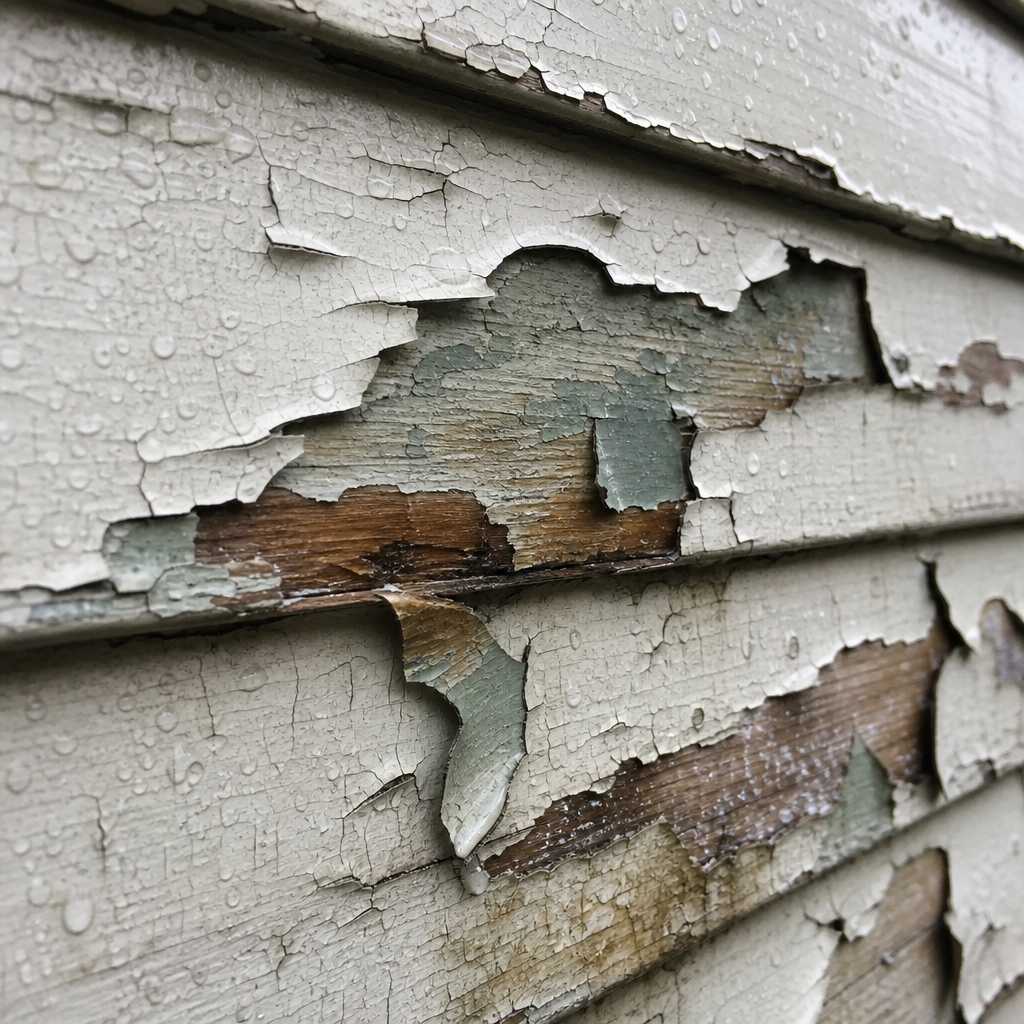
Peeling or bubbling paint, particularly on the lower sections of walls or around windows, indicates moisture is getting behind the paint film. This needs to be addressed immediately, as the underlying wood is likely already beginning to soften. Chalking, which is a powdery residue that comes off on your hand when you touch the wall surface, indicates UV degradation of the paint binder. The paint is nearing the end of its protective life and should be repainted within one to two seasons.
Hairline cracking across a broad surface, sometimes called alligatoring because of the pattern it creates, indicates either the paint has become too brittle or incompatible paint layers have been applied over each other. This cannot be painted over. The cracked paint must be fully removed and the surface reprimed before new paint will adhere and perform correctly.
Fading and colour loss are cosmetic concerns, but they also signal that the paint’s UV-blocking pigments are exhausted. Once the pigment breaks down, the binder protecting the substrate degrades rapidly. Significant fading is a signal to plan your next paint job within two to three years, not in five.
Frequently Asked Questions
How often should I repaint the exterior of my house in the Fraser Valley?
On wood siding with a quality paint job and proper preparation, plan for repainting every 7 to 10 years. Stucco exteriors with elastomeric coatings can stretch to 10 to 12 years. Trim, doors, and window frames typically need attention every 4 to 6 years due to higher direct exposure and physical wear. These timelines assume annual maintenance checks and prompt caulk repairs.
Does the direction my house faces affect how long exterior paint lasts?
Yes, and it matters more in the Fraser Valley than in drier climates. North-facing walls receive minimal direct sunlight, so they stay damp for extended periods after rain, which accelerates mildew growth and paint breakdown. South and west-facing walls get more UV exposure, which fades paint faster but actually dries moisture more effectively. In practice, north and east-facing walls on a Fraser Valley home typically show failure 1 to 2 years earlier than south-facing walls painted at the same time.
What is the best time of year to paint the exterior of a house in BC?
Late May through early September is the optimal window for exterior painting in the Lower Mainland and Fraser Valley. This period offers the most consistent temperatures above 10 degrees Celsius and the lowest probability of extended rain events. Early spring and fall painting is possible but carries more risk of temperature-related adhesion failure. Avoid any exterior painting from November through March unless weather conditions are unusually warm and dry.
Can I paint over peeling exterior paint or do I need to remove it first?
You cannot paint effectively over peeling paint. Applying new paint over a compromised surface adds weight to an already-failing bond and accelerates the peeling. All peeling sections must be fully scraped and sanded back to a firm edge, the bare substrate must be spot-primed, and then the full surface can be primed and painted. Painting over peeling paint is the most common reason homeowners call for a repaint only two or three years after their previous job.
Is it worth hiring a professional painter in Abbotsford or Langley versus doing it myself?
For a full exterior repaint, professional results consistently outlast DIY results by 2 to 4 years, primarily because of preparation quality, product selection, and application technique. A professional crew has the equipment to pressure wash properly, the experience to identify substrate problems before painting, and access to trade-grade products. Over the lifespan of a paint job, the cost difference between DIY and professional is often smaller than homeowners expect when measured per year of protection.
Why does exterior paint peel so quickly on newer homes in the Fraser Valley?
Newer homes sometimes have moisture still releasing from green lumber in the framing. This outgassing creates vapour pressure that pushes paint off the surface from the inside out, a problem called vapor-driven delamination. It is most visible on the lower sections of walls and on soffits. The solution is to use a breathable, high-permeance acrylic primer that allows moisture vapour to escape rather than building up pressure behind the paint film. Many production builders use low-cost primers that trap this moisture.
Have you recently had an exterior paint job done on your Fraser Valley home? Share how long it lasted and what you think made the difference in the comments below.
References
- National Research Council of Canada: building envelope and moisture research for Canadian climate conditions
- Environment and Climate Change Canada: precipitation and climate data for BC and Fraser Valley regions
- PaintInfo: technical data and performance comparisons for exterior coatings in Canadian climates
- Painting and Decorating Contractors of America: professional standards for exterior paint preparation and application
- ENERGY STAR and the US EPA: guidance on moisture management and exterior coating performance for residential buildings

