


Most homeowners in the Fraser Valley and Lower Mainland hire a painting contractor once every five to ten years. That infrequency makes the hiring decision genuinely high-stakes. A bad choice means peeling paint, missed prep work, and a contractor who disappears before the second coat dries. When you are hiring painters in the Lower Mainland, asking the right questions upfront separates a professional result from an expensive mistake. This guide gives you the exact questions to ask, what good answers sound like, and the red flags that should send you walking.
Table of Contents
- Quick Takeaways
- Why These Questions Matter More Than Price
- Comparing Contractor Types: What to Expect
- Frequently Asked Questions
- References
Quick Takeaways
| Key Insight | Explanation |
|---|---|
| Licensing and WCB coverage are non-negotiable in BC | Any contractor working in BC must carry WorkSafeBC coverage and hold a valid business licence. Ask for the WCB account number before signing anything. |
| Prep work determines 80 percent of a paint job’s lifespan | Contractors who skip sanding, priming, and caulking save time at your expense. Exterior paint in the Fraser Valley’s wet climate will fail within two years without proper prep. |
| Subcontracting is common and worth clarifying upfront | Some companies win the bid, then hand the job to unlicensed day labourers. Ask directly whether the crew who shows up is employed by the company. |
| A written, itemized quote protects you legally | Verbal estimates are unenforceable. A proper quote should list the number of coats, product names, areas covered, and exclusions. |
| Local references reveal weather-specific performance | A contractor with ten years of work in Abbotsford or Langley understands Lower Mainland humidity, temperature swings, and exterior paint behaviour in ways an out-of-region company simply does not. |
| Payment terms signal professionalism | Reputable contractors typically ask for a small deposit of 10 to 20 percent upfront, with the balance due on completion. Demanding 50 percent or more before work starts is a warning sign. |
| A workmanship warranty should cover at least two years | Quality painters stand behind their work. A warranty shorter than two years on interior work or three years on exterior work suggests low confidence in the finished product. |
Why These Questions Matter More Than Price
The single biggest mistake homeowners make when choosing a painting company is treating price as the primary filter. In practice, the cheapest quote almost always reflects something missing: fewer coats, cheaper paint, no prep, or an uninsured crew. The BC Consumer Protection Act gives you recourse after the fact, but recovering money from a vanishing contractor is slow and frustrating.
Asking targeted questions before you sign a contract shifts the power dynamic. It signals to the contractor that you are an informed buyer, which tends to attract better contractors and filter out the ones who rely on low bids and vague scopes.
The ten questions below are not a checklist to skim. They are a structured interview. Use them in sequence and pay attention to how a contractor responds to the harder ones, because hesitation and vagueness are as informative as the answers themselves.

How Long Have You Been Operating in BC?
Longevity in a local market is a meaningful signal. A company that has been operating in the Lower Mainland for over a decade has survived economic downturns, handled warranty claims, and built a reputation that is visible and searchable. A company that launched last spring has none of that track record.
What a strong answer looks like
A contractor who can name specific neighbourhoods they have worked in, reference local landmark projects, or discuss how their methods have adapted to Fraser Valley weather patterns is demonstrating genuine regional experience. For example, a company like Dreamscape Painting Ltd., which has been serving the Lower Mainland since 1990, brings over 35 years of direct experience with local conditions including the humidity swings between Abbotsford and the coast.
A common mistake is accepting a vague answer like “we have been in business for years” without pressing for specifics. Ask for the year they registered in BC and whether they have worked consistently in your specific city.
Are You Licensed and Insured in British Columbia?
This is not a polite formality. It is a legal and financial protection question. In BC, any contractor performing work on your property must carry WorkSafeBC coverage. If they do not and a worker is injured on your property, the liability can fall on you as the homeowner.
What to ask for specifically
Request the contractor’s WorkSafeBC account number and their Certificate of Insurance showing general liability coverage. A minimum of two million dollars in general liability is standard for residential painting in the Lower Mainland. You can verify WCB status directly through the WorkSafeBC online clearance letter system.
Any contractor who hesitates, says insurance is not necessary for small jobs, or cannot produce documentation within 24 hours should be removed from your shortlist immediately. This is a hard rule, not a suggestion.
Pro tip: Before a single drop of paint goes on your walls, verify the WCB clearance letter is dated for the current quarter. Coverage lapses happen, and a stale certificate from six months ago does not protect you today.
Who Actually Does the Painting?
This question catches more homeowners off guard than any other. A polished sales rep shows up for the estimate, but on day one a completely different crew arrives, and it may not be employees of the company you hired. Subcontracting is legal and sometimes fine, but it needs to be disclosed and the subcontractors need to be covered under the same insurance and quality standards.
Why this matters for quality control
When a company employs its own painters full time, those painters are accountable to a consistent quality standard, trained in the company’s methods, and motivated to maintain the employer’s reputation. A rotating pool of subcontractors has no such alignment.
Ask directly: “Will the crew who does the work be your direct employees?” If the answer is no, ask how quality is monitored and whether the subcontractors carry their own WCB coverage.
What Surface Preparation Do You Include?
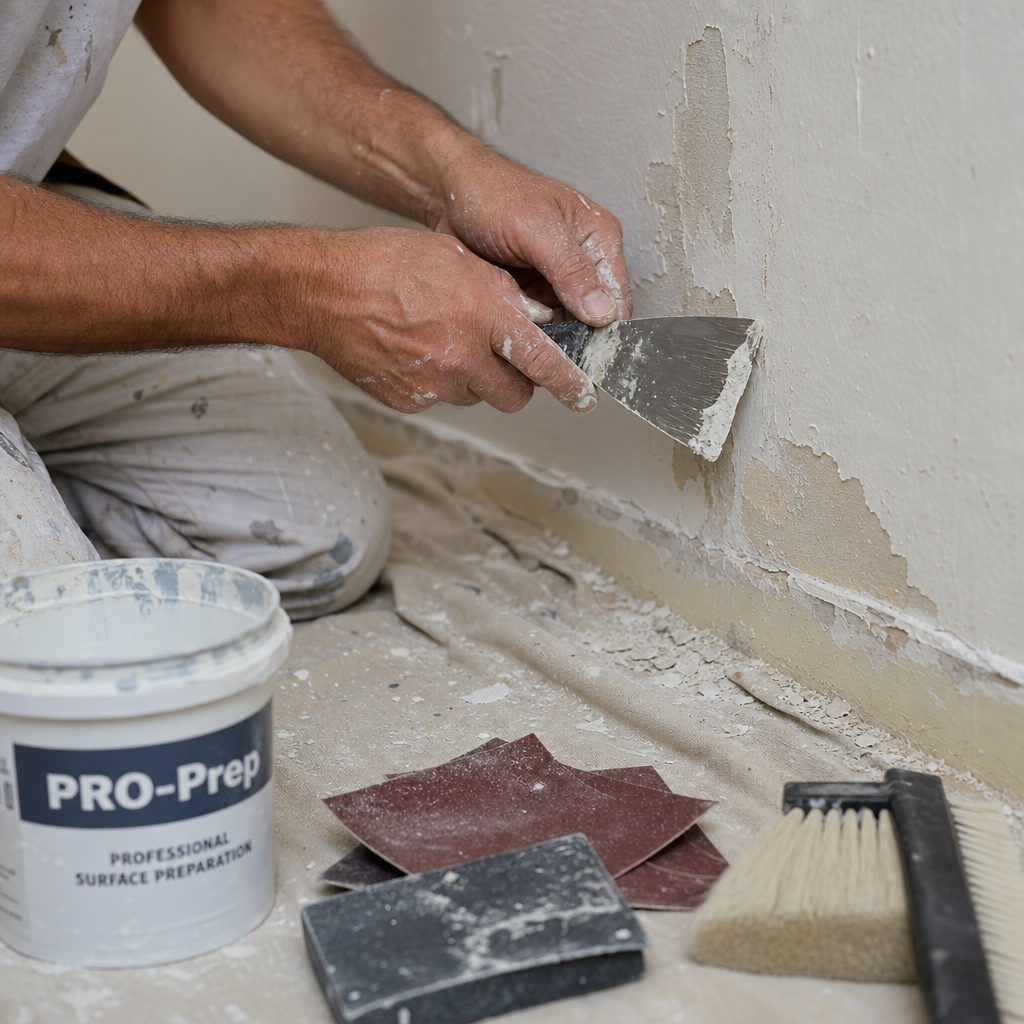
Surface preparation is where professional painters distinguish themselves from weekend warriors and low-bid operations. In practice, prep accounts for the majority of a paint job’s long-term performance. Paint applied over dirty, cracked, or unpainted surfaces will fail regardless of brand.
Interior prep standards
For interior work, a professional contractor should include washing walls, sanding rough patches, filling nail holes and cracks, applying primer to bare drywall or stain-blocking primer over water marks, and protecting floors and furniture with drop cloths and painter’s tape.
Exterior prep standards in the Fraser Valley
Exterior prep in the Lower Mainland demands more. The climate between Abbotsford and the coast includes heavy rain, freeze-thaw cycles, and high humidity that accelerates paint failure. Expect a quality contractor to pressure wash surfaces, scrape loose paint, sand feather edges, spot prime bare wood, and caulk gaps around windows and trim before applying a single coat of finish paint.
If a contractor says prep takes half a day on a full exterior, that is a red flag. Thorough exterior prep on an average Lower Mainland home typically takes a full day or more before painting even begins.
Which Paint Products Do You Use and Why?
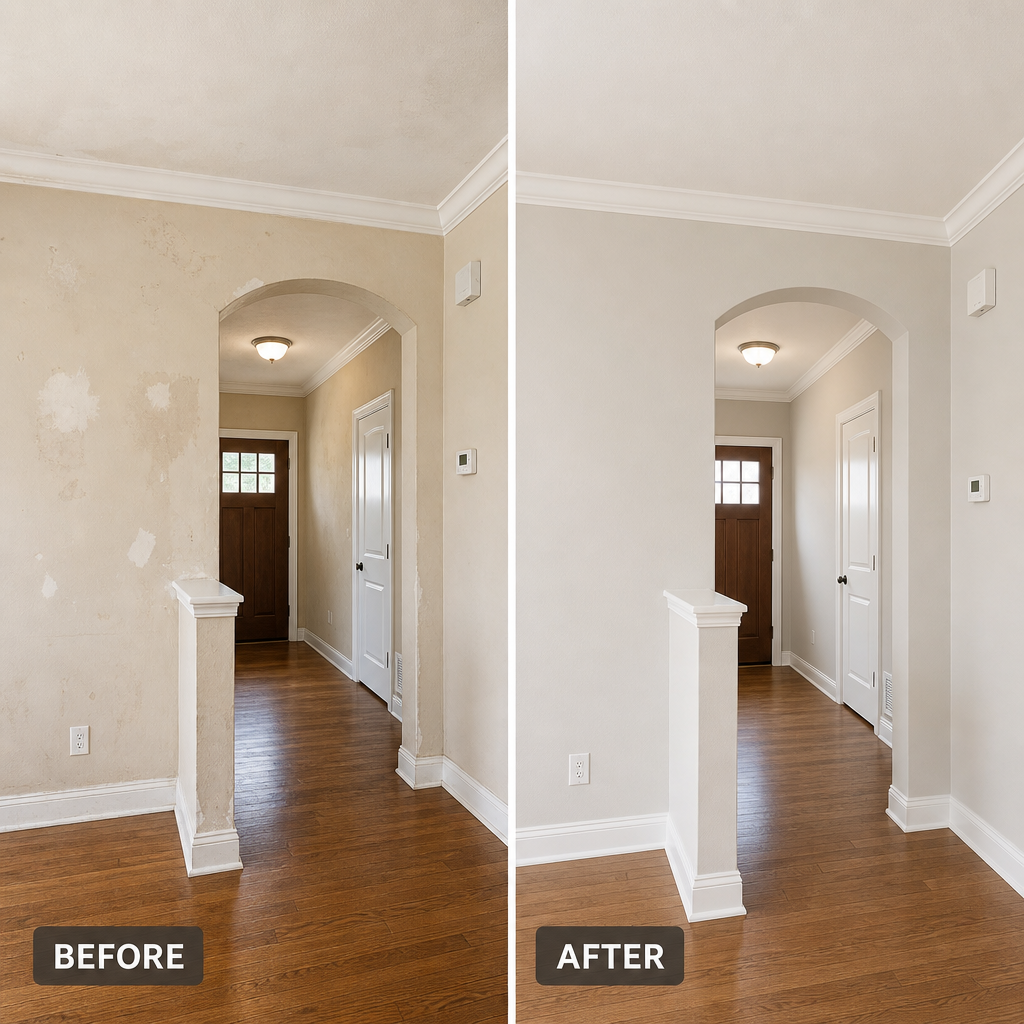
A contractor who cannot name the specific products they use or who says “we use whatever the customer wants” without guidance is telling you they do not have strong product knowledge. Professional painters have preferences built on real-world performance, and they should be able to articulate why.
Ask for specific brand names, product lines, and whether they use a primer coat separate from the finish coat. On exteriors, ask about the paint’s warranty rating and its suitability for BC’s coastal humidity. Products from Benjamin Moore, Sherwin-Williams, and PPG all have professional lines that perform meaningfully better than standard retail grades, and a knowledgeable contractor will know the difference.
Pro tip: Ask the contractor to include the specific paint product names and sheen levels on the written quote. This makes the scope enforceable and gives you a clear benchmark if there is a dispute about what was agreed.
Can You Provide Local References?
References from the same region are far more valuable than generic testimonials. A homeowner in Langley can tell you whether the crew showed up on time, whether the job came in on budget, and whether the paint has held up through two wet winters. That context is specific to your situation in a way that a five-star Google review without detail is not.
How to use references effectively
Ask for two to three references from projects completed in the past 18 months in your area, specifically for the type of work you need, whether that is interior painting, exterior painting, or cabinet refinishing. Call them. Ask four questions: Did the job finish on schedule? Were there surprises in the final invoice? How did the contractor handle any problems? Would you hire them again?
“The quality of a contractor’s references tells you more about their actual performance than their website ever will. A company that has genuinely served a community for decades will have clients who remember them by name.” – HomeStars Industry Report on Contractor Selection
What Does Your Written Quote Include?
An itemized written quote is a legal document. It defines what you are buying. A vague quote that says “paint living room, two coats” leaves you with almost no protection if the contractor cuts corners on prep, uses a lower-grade paint than discussed, or charges extra for work you assumed was included.
What an acceptable written quote must contain
The quote should list every room or surface being painted, the number of coats per surface, the specific paint product and sheen, all prep work included, what is excluded, the total price, and the payment schedule. If trim and ceilings are priced separately, that should be explicit. If the quote does not include these details, ask for a revised version before you sign.
This level of documentation is standard practice among established professional painters in Vancouver and the surrounding Lower Mainland. Contractors who resist providing detail are either inexperienced or planning to inflate the final invoice.
How Do You Handle Cleanup and Site Protection?
Cleanliness is one of the most common differentiators between a professional painting company and a casual operation. Paint overspray on hardwood floors, tape residue on trim, and dust from sanding left on furniture are entirely avoidable with proper preparation, and they are the kinds of problems that generate the most homeowner complaints after a job.
Ask the contractor specifically how they protect furniture and flooring, whether they use hard surface covers or only cloth drop cloths in high-traffic areas, and how they handle daily cleanup at the end of each workday. A company that takes pride in cleanliness will answer this question without hesitation and in detail. That attention to detail is a hallmark of companies like Dreamscape Painting, where site protection and daily cleanup are built into the workflow rather than treated as an afterthought.
What Warranty Do You Offer?
A workmanship warranty is the contractor’s statement of confidence in their own work. The absence of a warranty, or a warranty shorter than two years, suggests either a lack of confidence or a lack of intention to be reachable after the job is done.
What reasonable warranty terms look like
For interior painting, a minimum of two years on workmanship is reasonable. For exterior painting in the Lower Mainland, where weather puts more stress on the finish, three years is a fair benchmark. Cabinet refinishing warranties should cover adhesion and peeling for at least two years.
Ask for the warranty in writing and confirm what it covers. Specifically, ask whether it covers peeling due to adhesion failure versus damage caused by the homeowner. Those are different things, and a clear contractor will explain the distinction without being defensive.
What Is Your Payment Schedule?
Payment terms reveal a contractor’s financial stability and their approach to client relationships. A contractor who demands more than 20 percent upfront before any work starts is either carrying cash flow problems or has learned that a large deposit reduces the homeowner’s leverage if something goes wrong.
Standard practice among reputable painting contractors in BC is a deposit of 10 to 20 percent to schedule and reserve materials, a progress payment at a defined milestone for larger projects, and the balance on satisfactory completion. If a contractor pushes back on this structure without a clear explanation, treat it as a warning sign. Never pay the full amount before the job is done and inspected.
Comparing Contractor Types: What to Expect
Not all painting contractors operate the same way. Understanding the three most common types helps you set the right expectations before you even make a phone call.
| Contractor Type | Typical Strengths | Common Risks |
|---|---|---|
| Established local company (10+ years, own employees) | Consistent quality standards, accountable crew, verifiable local references, clear warranty terms, full insurance coverage | Higher price point than solo operators, may be booked several weeks out |
| Solo operator or small independent | Often lower price, flexible scheduling, direct communication with the person doing the work | Limited capacity for larger jobs, insurance coverage may lapse, no backup if they fall ill, no formal warranty process |
| Franchise or rapid-turnaround company | Fast scheduling, standardized process, often strong marketing presence | Speed-first model may sacrifice prep quality, high staff turnover affects consistency, warranty claims go through corporate process rather than a local owner who cares about reputation |
Frequently Asked Questions
How many quotes should I get before hiring a painting contractor in the Lower Mainland?
Three quotes is the standard recommendation, and it works well for most residential painting projects. Getting fewer than three makes it hard to identify outliers on price or scope. Getting more than four creates diminishing returns and decision fatigue. When comparing quotes, focus on what is included rather than the bottom-line number. Two quotes that appear $500 apart may actually reflect very different scopes of work once you read the details.
Is it worth hiring a painting contractor for BC painting contractor questions or should I DIY?
For small touch-up work or single-room projects with simple surfaces, a confident homeowner can achieve acceptable results. For anything involving high ceilings, exterior surfaces, trim and cabinet work, or multiple rooms with consistent colour matching, professional results require professional tools, trained technique, and the right products. The cost of repainting over a poor DIY job almost always exceeds what a professional would have charged in the first place.
What should I do if a contractor asks for full payment upfront?
Decline and ask why. A legitimate reason might be that the project requires custom-ordered materials with a non-refundable cost, in which case a materials-only deposit before work starts is reasonable. A full labour and materials payment before any work begins has no justification and creates a situation where you have no financial leverage if the work is poor or the contractor disappears. Walk away from any contractor who insists on this as a condition of booking.
How do I verify a painting contractor’s WorkSafeBC coverage in BC?
Ask the contractor for a clearance letter from WorkSafeBC, which is a document they can generate through the WorkSafeBC online portal showing their account is in good standing. The letter should be dated within the last 30 to 60 days for it to be current. You can also call WorkSafeBC directly at their employer services line and provide the contractor’s business name to confirm coverage is active. Do this before signing any contract.
What is the best time of year to hire painters in the Lower Mainland for exterior work?
Late spring through early fall, roughly May through September, gives you the best conditions for exterior painting in the Fraser Valley. Most paint manufacturers specify application in temperatures above 10 degrees Celsius and below 35 degrees Celsius, with low humidity and no rain in the forecast for 24 to 48 hours after application. In practice, the shoulder seasons of April and October can work on warm dry stretches, but summer booking windows fill up fast. If you want exterior work done in July or August, begin getting quotes in March or April.
Does the size of a painting company affect the quality of the work?
Size is less predictive of quality than ownership structure and employee accountability. A mid-sized family-owned company where the owner has a direct stake in every job’s reputation often outperforms both solo operators without backup capacity and large franchise operations where crew turnover is high. What matters most is whether the people doing the work are accountable to a standard and whether someone who cares about the company’s name is checking the results.
If you have recently hired a painting contractor in the Lower Mainland, share what question made the biggest difference in your decision, because your experience helps other homeowners in Abbotsford, Langley, Surrey, and the broader Fraser Valley make better choices.
References
- WorkSafeBC official site covering employer registration, clearance letters, and homeowner liability for contractor injuries in British Columbia
- Consumer Protection BC resource on homeowner rights when hiring contractors and understanding written contract requirements
- Forbes coverage of home improvement contractor selection, warning signs, and pricing benchmarks for residential services
- HomeStars platform research on how Canadian homeowners evaluate and select local service contractors based on verified reviews
- National Research Council of Canada guidance on building envelope performance, paint durability standards, and climate-appropriate coating selection

