

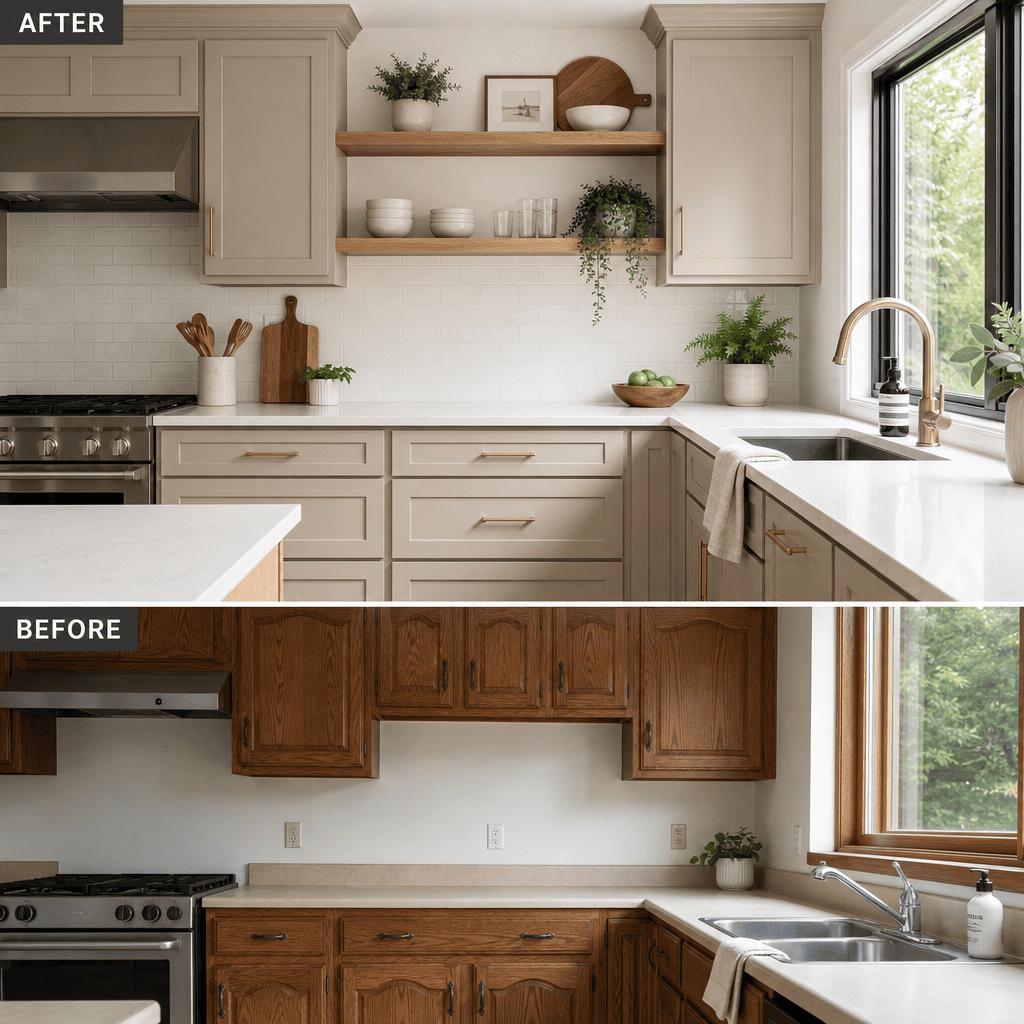
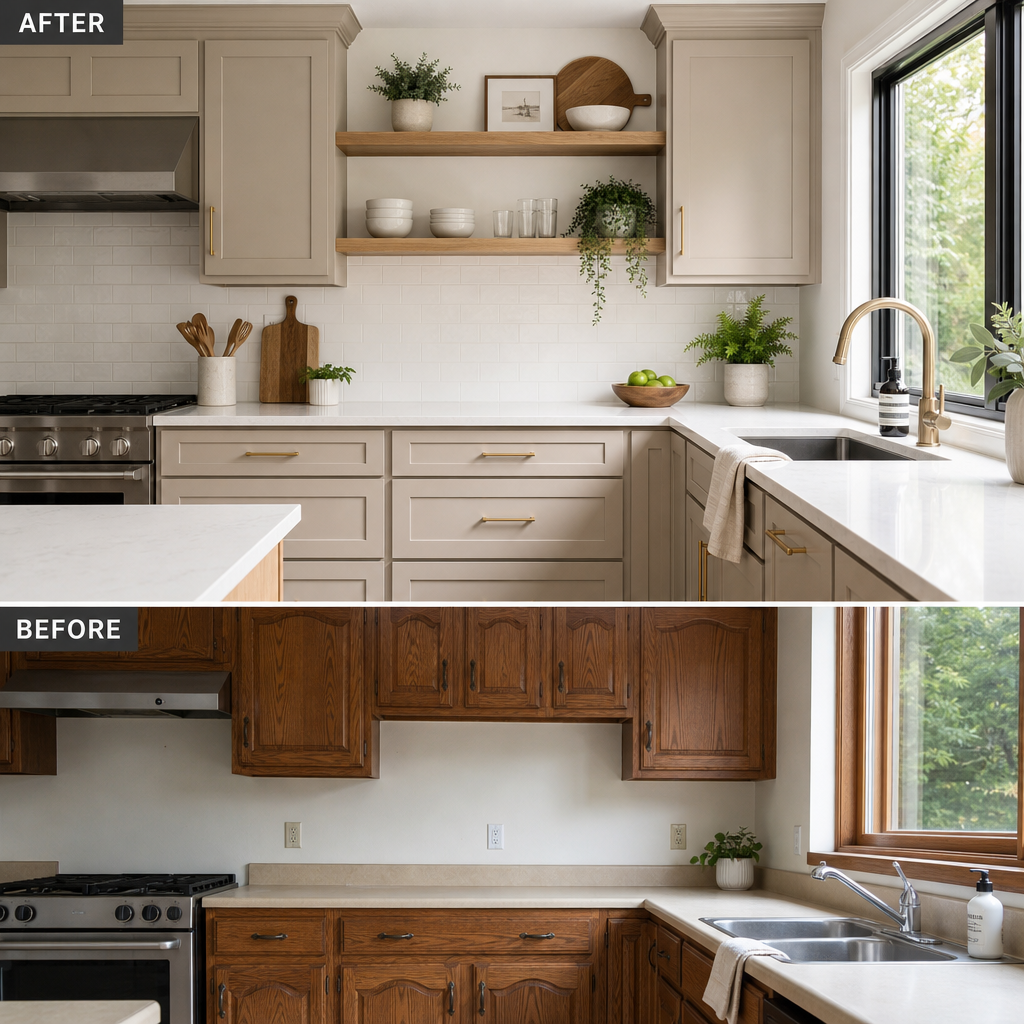
A full kitchen renovation in BC can run anywhere from $30,000 to $80,000 or more depending on scope. Yet in most kitchens, the cabinets are the single biggest visual driver of how the space looks and feels. Professional cabinet refinishing kitchen transformation projects consistently deliver 85 to 90 percent of the visual impact of a full renovation at roughly 10 to 20 percent of the cost. After 35 years working in homes across Abbotsford, Langley, Surrey, and the rest of the Lower Mainland, the team at Dreamscape Painting has seen this firsthand. If your cabinet boxes are structurally sound but your kitchen feels dated, refinishing is almost always the smarter move.
Table of Contents
- Quick Takeaways
- What Cabinet Refinishing Actually Means
- Cabinet Refinishing Cost in BC: What to Expect
- The Refinishing Process Step by Step
- Refinishing vs. Repainting vs. Replacing: A Direct Comparison
- Choosing the Right Professional Cabinet Painters in Vancouver and the Lower Mainland
- Colour and Finish Selection for BC Kitchens
- Common Mistakes Homeowners Make With Cabinet Refinishing
- Frequently Asked Questions
- References
Quick Takeaways
| Key Insight | Explanation |
|---|---|
| Cost savings are substantial | Professional cabinet refinishing in BC typically costs $2,500 to $7,000 for an average kitchen, compared to $15,000 to $30,000 for new cabinet installation. |
| Structural integrity is the deciding factor | If cabinet boxes are solid and hinges are functional, refinishing is the right call. Warped or water-damaged boxes require replacement, not refinishing. |
| Proper prep work determines the final result | Degreasing, sanding, and priming correctly accounts for roughly 70 percent of the quality of the finished surface. Skipping steps causes peeling within months. |
| Spray application outperforms brush and roller | Professional spray equipment delivers a factory-smooth finish that brushes and rollers cannot replicate on cabinet faces and doors. |
| Colour choice affects perceived kitchen size | Light neutrals like warm whites and greige tones visually expand smaller Lower Mainland kitchens, while deep navy or charcoal reads as intentional in larger spaces. |
| Durability depends on the paint product used | Alkyd-hybrid and waterborne urethane paints formulated for cabinetry outperform standard wall paints by a wide margin in chip and scratch resistance. |
| Timeline is dramatically shorter than renovation | Most professional cabinet refinishing projects in the Lower Mainland are completed in 3 to 5 days, versus 4 to 8 weeks for a full kitchen renovation. |
What Cabinet Refinishing Actually Means
There is a lot of confusion between the terms refinishing, repainting, and refacing. Cabinet refinishing refers specifically to the process of stripping or thoroughly sanding the existing finish from cabinet surfaces, applying a high-adhesion primer, and then coating with a durable topcoat product designed for cabinetry. The result is a surface that looks and performs like a factory finish, not a brushed-on coat of wall paint.
Refacing is different. It involves applying a veneer or new door fronts to the existing boxes. Refinishing works with the existing doors, drawer fronts, and frames. When done correctly, you cannot tell the difference in appearance, and the cost savings over refacing are considerable.
In practice, the word “repaint” is sometimes used loosely to describe all three processes. When speaking with any painting contractor, ask specifically what surface preparation process they follow, what primer they use, and what topcoat product they specify. Vague answers to those three questions are a red flag.
Cabinet Refinishing Cost in BC: What to Expect
Cabinet refinishing cost BC homeowners should budget for typically falls between $2,500 and $7,500 for a standard kitchen, depending on door count, existing finish condition, and finish product selected. This price range reflects professional labour, materials, and proper surface preparation. A very small kitchen with 15 to 20 doors might come in closer to $2,500. A larger kitchen with 35 or more doors, glass inserts, or detailed moulding work will push toward the higher end.
What Drives the Price Up
Heavily lacquered or oil-stained cabinets require more aggressive sanding or chemical stripping before primer can bond properly. That adds labour time. Heavily profiled doors with ornate router details take longer to sand by hand and longer to spray evenly. If your cabinets have a factory thermofoil or laminate surface, the cost calculation changes entirely because proper adhesion requires a different approach to surface prep.
What the Cost Avoids
Compare that $2,500 to $7,500 range against what a kitchen renovation actually costs in the Lower Mainland. According to Remodeling Magazine’s Cost vs. Value data, a mid-range kitchen remodel in Canada averages well above $40,000 CAD when you factor in cabinetry, countertops, tile, appliances, and labour. Refinishing sidesteps all of that while delivering the single biggest visual change you can make to the space.
Pro tip: Always get your quote itemized by door count and surface area, not as a flat lump sum. An itemized quote tells you the contractor has actually assessed your kitchen rather than guessing from a photo.
The Refinishing Process Step by Step
A professional cabinet refinishing project is methodical. Rushing any stage compromises adhesion, finish smoothness, or durability. Here is what a properly executed project looks like in sequence.
Stage 1: Removal and Labelling
Every door and drawer front is removed, labelled, and transported to a controlled spray environment or carefully staged within the home. Hardware, hinges, and pulls are bagged and labelled separately. Leaving doors on the cabinets while spraying them is a shortcut that produces runs and uneven coverage on the inside edges.
Stage 2: Degreasing and Sanding
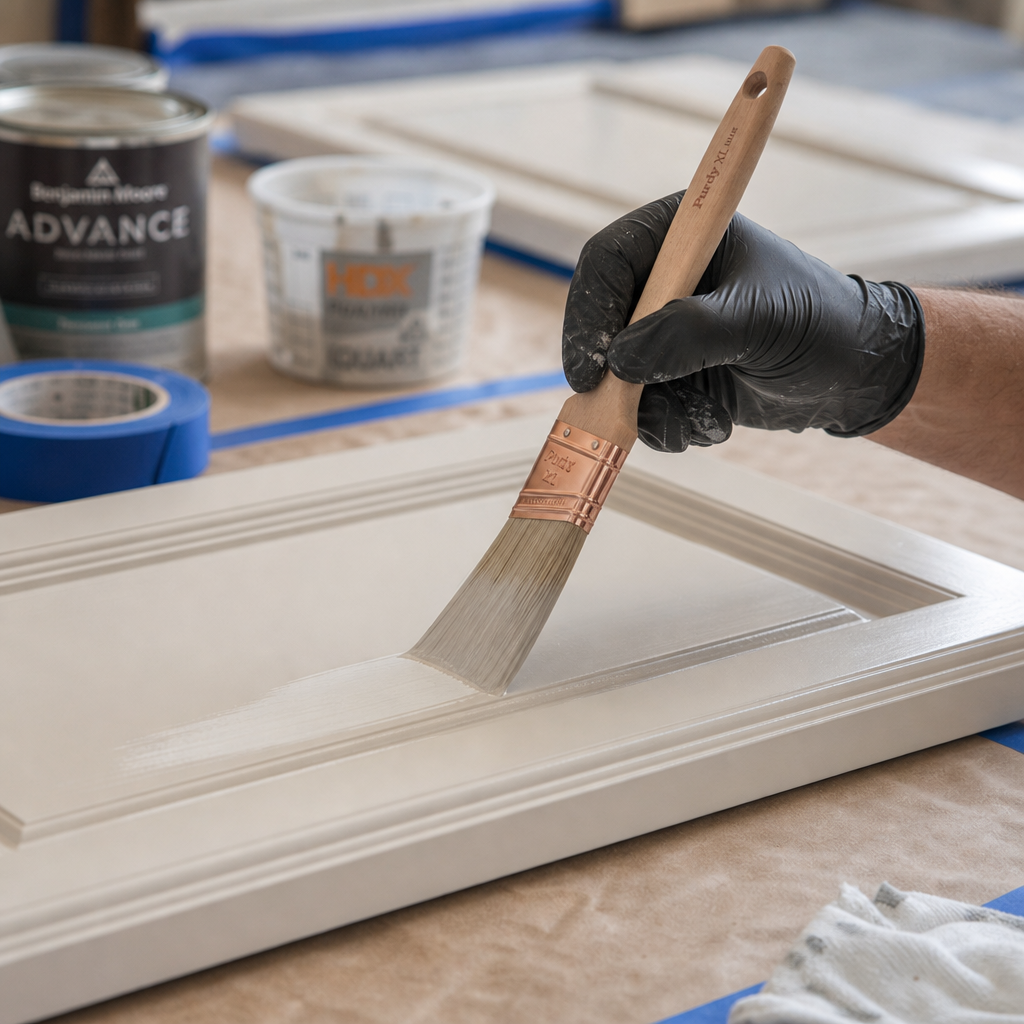
Kitchen cabinets accumulate grease, cooking residue, and cleaning product film over years of use. This layer must be completely removed with a degreaser before any sanding begins. Sanding over contaminated surfaces seals the contamination in and causes adhesion failure within months. After degreasing, surfaces are sanded to provide mechanical tooth for the primer to grip.
Stage 3: Priming
Primer selection is where a lot of amateur or low-bid jobs fail. A bonding primer specifically formulated for cabinetry is non-negotiable. Standard drywall primers do not provide the adhesion strength that cabinet surfaces, which flex with temperature and humidity, actually require. In the Lower Mainland, where seasonal humidity swings are real, this matters even more. See how we handle it on our cabinet painting in New Westminster and cabinet painting in Pitt Meadows pages.
Stage 4: Spray Application of Topcoat
Professional cabinet painters apply topcoat using HVLP or airless spray equipment. This delivers a smooth, even film with no brush marks or roller stipple. Most quality refinishing jobs apply two topcoats with a light sanding between coats to remove any dust nibs or surface imperfections.
Stage 5: Cure Time and Reinstallation
Paint cures differently from drying. Most cabinet-grade topcoats reach full hardness after 7 to 14 days. Doors are reinstalled after the topcoat has dried adequately, but homeowners should treat refinished surfaces gently for the first two weeks. Avoid hanging damp towels on cabinet fronts or scrubbing with abrasives during the cure period.
Pro tip: Ask your contractor whether they return for a post-installation check at the 2-week mark to adjust any door alignment and verify the finish has cured evenly. Dreamscape Painting does this as standard practice because it catches minor issues before they become real problems.
Refinishing vs. Repainting vs. Replacing: A Direct Comparison
Homeowners across Abbotsford, Langley, and Surrey frequently ask which approach makes the most financial and practical sense for their specific situation. The answer depends on cabinet condition, budget, and timeline, but the comparison table below makes the tradeoffs clear.
| Approach | Average Cost (BC, Mid-Size Kitchen) | Timeline |
|---|---|---|
| Professional Cabinet Refinishing | $2,500 to $7,500 CAD | 3 to 5 days |
| Cabinet Refacing (new doors and veneer) | $8,000 to $18,000 CAD | 5 to 10 days |
| Full Cabinet Replacement | $20,000 to $50,000+ CAD | 4 to 8 weeks |
Refinishing wins on cost and speed when cabinet boxes are structurally sound. The only scenario where replacement clearly beats refinishing is when the box itself is failing. Warped frames, water-damaged interiors, or cabinets with severe structural compromise cannot be fixed by a new finish. A good estimator will tell you this honestly during the initial walkthrough, even if it means recommending a different scope of work.
“Homeowners who invest in professional painting and surface refinishing before listing a property consistently recover more than the project cost in final sale price. The kitchen is still the room buyers judge hardest.” – National Association of Realtors, 2023 Remodeling Impact Report
Choosing the Right Professional Cabinet Painters in Vancouver and the Lower Mainland
Not all painting contractors are equipped to do cabinet refinishing properly. General house painters who occasionally take on cabinet jobs often lack the spray equipment, the cabinet-specific primers, or the process discipline that this type of work demands. When evaluating professional cabinet painters Vancouver or Lower Mainland contractors, you need to ask specific questions.
Questions That Reveal Competence
Ask what primer product they use and why. Ask whether doors are removed for spraying or sprayed in place. Ask what topcoat product they specify and whether it is formulated for cabinetry. Ask how many coats are applied and whether sanding occurs between coats. Any contractor who cannot answer these questions specifically and confidently is not the right choice for a cabinet refinishing project.
What Experience Looks Like in Practice
A company like Dreamscape Painting brings 35 years of hands-on refinishing experience in the Lower Mainland to every project. That experience means knowing how the humidity in a Langley home in February affects dry times, how to manage overspray in a tight galley kitchen in Surrey, and how to match the client’s vision to a finish that will still look good five years from now. That kind of operational knowledge does not show up in a quick quote comparison.
Check for a detailed, written quote. Check for proof of insurance and WCB coverage. Check for references from previous cabinet refinishing projects specifically, not just general painting work. A company doing this work at a professional level will have all three readily available.
Colour and Finish Selection for BC Kitchens
Colour selection is where many homeowners get stuck, and where a good painting contractor adds real value beyond just applying product. The right colour choice for a kitchen cabinet refinishing project depends on the amount of natural light the space receives, the existing countertop and backsplash materials, and the overall tone the homeowner wants the kitchen to communicate.
What Consistently Works in Lower Mainland Kitchens
Soft whites in the warm range, specifically colours with yellow or beige undertones rather than stark blue-white, perform well in the overcast light conditions common through BC’s fall and winter months. Colours like Benjamin Moore’s White Dove or Chantilly Lace have remained popular in Abbotsford and Langley kitchens for good reason. They read as clean and bright without looking clinical under natural light.
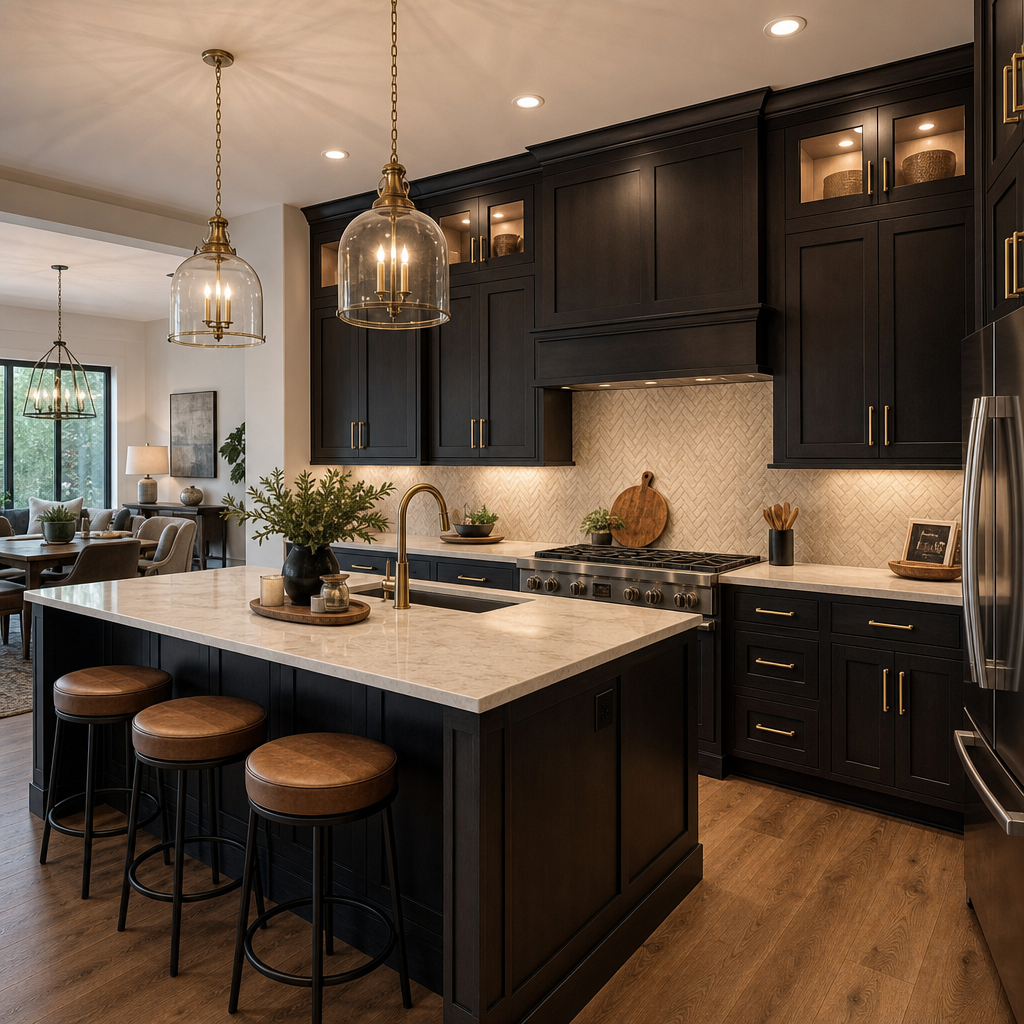
Two-tone kitchens, with upper cabinets in a lighter shade and lower cabinets in a deeper complementary colour, have remained popular through 2024 and show no signs of fading. This approach works particularly well in Fraser Valley homes where kitchens tend to have higher ceilings that can handle a heavier lower cabinet tone without the space feeling closed in.
Finish Sheen and Durability
For cabinetry, a semi-gloss or satin finish is appropriate. Flat and eggshell finishes do not hold up to the wiping and cleaning that kitchen cabinets endure. Semi-gloss provides the best wipe-down durability and the easiest surface to clean. Satin is a reasonable compromise for homeowners who find semi-gloss too reflective under pendant lighting.
Common Mistakes Homeowners Make With Cabinet Refinishing
The most common mistake is attempting cabinet refinishing as a DIY project after watching a tutorial. The prep work alone, done correctly, takes a professional team the better part of a full day on an average kitchen. Homeowners who underestimate this routinely end up with a finish that peels or chips within six months, and then they have to pay a professional to strip and redo the work anyway. The second attempt costs more than doing it professionally the first time.
A second common mistake is choosing a contractor based on price alone. Cabinet refinishing done poorly is worse than cabinet refinishing not done at all, because a failed finish affects every surface in the most-used room in the house. The lowest bid in the Lower Mainland almost always reflects either cheaper materials, less surface preparation, or less experienced labour. In practice, a mid-range quote from a company with verifiable cabinet refinishing references is the right choice, not the cheapest number on the page.
A third mistake is not discussing the cure process with the contractor before the project starts. Homeowners who start scrubbing cabinet faces with cleaning products three days after the job is finished damage a finish that has not fully hardened yet. Clear communication about cure time expectations protects both the homeowner and the result.
Frequently Asked Questions
How long does professional cabinet refinishing last?
When done correctly with cabinet-grade primer and topcoat products, a professional refinishing job should last 8 to 15 years with normal care. The key variables are product quality and surface preparation quality. A properly prepared and primed surface with two coats of alkyd-hybrid or waterborne urethane topcoat will outlast any job done with standard wall paint regardless of brand.
Can any type of cabinet be refinished?
Solid wood and MDF cabinet doors refinish extremely well. Thermofoil cabinets, which have a vinyl film wrapped over MDF, can be refinished but require a different adhesion approach and are more prone to edge peeling if the original film is already lifting. Laminate cabinets can also be refinished with proper scuff sanding and bonding primer, but a professional assessment is important before committing to the process.
How much disruption should I expect during the project?
A professional crew will protect your kitchen workspace, countertops, and appliances with drop cloths and masking during the in-place painting of cabinet frames. Doors are removed and sprayed offsite or in a staged area. Most homeowners in the Lower Mainland can use their kitchen with some limitations during the project, though the 24 to 48 hours immediately after topcoat application require care to avoid dust or contact with fresh surfaces.
Is cabinet refinishing worth it before selling a home?
Yes, consistently. The National Association of Realtors consistently reports that kitchen updates deliver among the highest returns on investment of any pre-sale improvement. In the Fraser Valley and Lower Mainland real estate market, where buyers are making decisions in competitive conditions, a fresh, clean kitchen finish can meaningfully affect both the speed of a sale and the final offer price. The $3,000 to $7,000 spent on cabinet refinishing frequently returns two to three times that value in buyer perception.
How do I know if my cabinets need refinishing versus replacement?
Check the cabinet boxes, not the doors. Open every cabinet and look at the interior frame, the floor of the cabinet, and the joints where the box sides meet. If the structure is solid, square, and free of water damage, refinishing is appropriate. If you see swollen particleboard, sagging shelves, or box joints that have separated, replacement is the correct answer. No amount of surface finish work fixes a structurally compromised cabinet box.
What is the difference between kitchen cabinet painting and full refinishing?
Kitchen cabinet painting in the broadest sense can mean anything from a homeowner applying wall paint with a brush to a full professional refinishing process with dedicated cabinet products. When Dreamscape Painting refers to cabinet refinishing, it means the complete process: degreasing, sanding, bonding primer, and cabinet-grade topcoat applied by spray. That process is categorically different from simply brushing paint over existing cabinet surfaces, and the durability difference is significant.
Have you recently refinished your kitchen cabinets or are you weighing the decision right now? Share what questions or hesitations you still have and our team will respond directly.
References
- Forbes Home Improvement and Kitchen Renovation Cost Research
- Statista Data on Home Renovation Spending and Kitchen Remodeling Trends in Canada
- National Association of Realtors Remodeling Impact Report on Kitchen Updates and Home Sale Value
- HGTV Expert Guidance on Cabinet Refinishing, Refacing, and Kitchen Transformation Options
- This Old House Professional Guidance on Surface Preparation and Cabinet Painting Best Practices

