

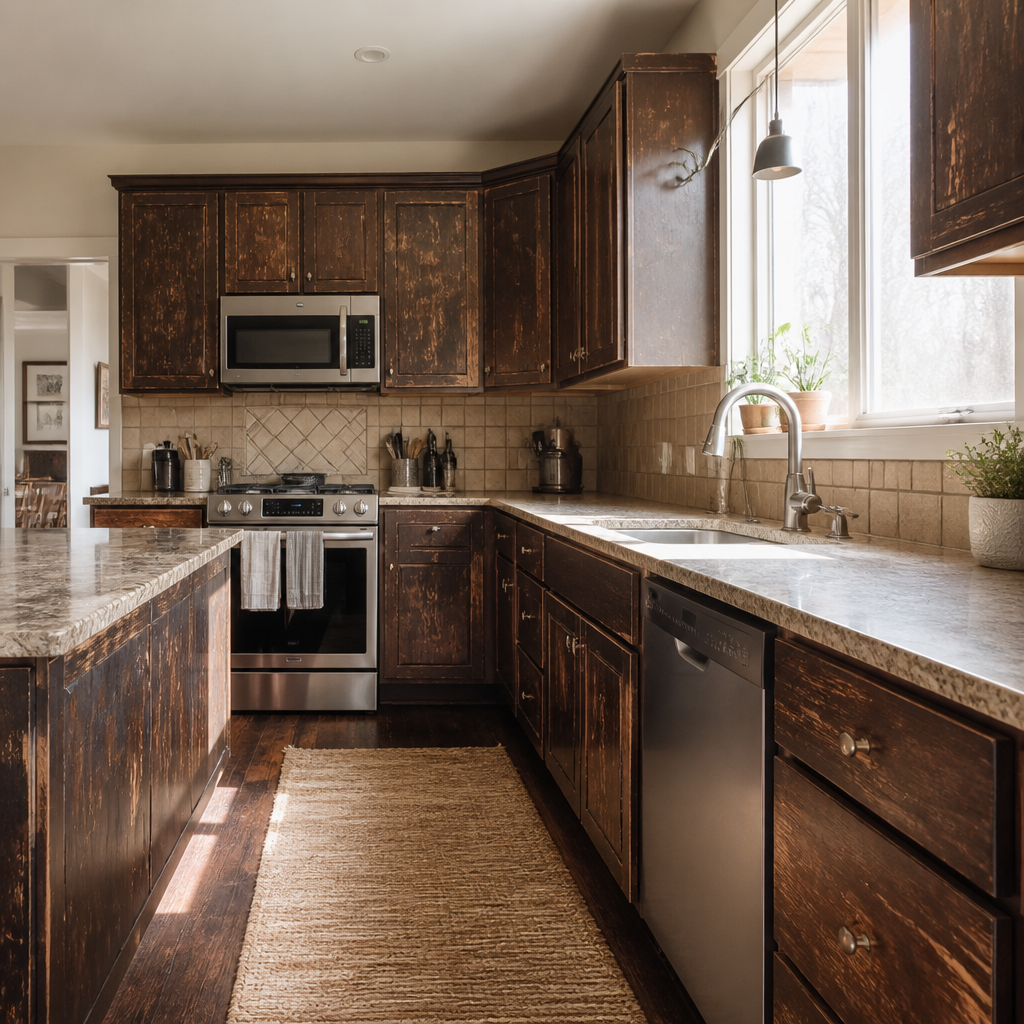
Most Fraser Valley homeowners facing a dated kitchen ask the same question: replace the cabinets entirely or refinish what’s already there? The answer matters more than you might expect, because the cost gap between the two options is enormous, and the right choice depends on factors that a kitchen showroom salesperson has every incentive to ignore. Cabinet refinishing in Fraser Valley is, in the vast majority of cases, the smarter financial decision. But it is not the right call for every kitchen. This guide walks through exactly when to refinish, when to replace, what each path costs in the real Lower Mainland market, and how to avoid the mistakes that lead to disappointing results. Our local pages cover Maple Ridge cabinet painters and cabinet painting in North Vancouver.
Table of Contents
- Quick Takeaways
- The Real Cost Gap: What Fraser Valley Homeowners Actually Pay
- When Cabinet Refinishing Is the Right Call
- When Replacement Actually Makes Sense
- The Cabinet Refinishing Process: What Separates Professional Results from DIY Disappointment
- Refinishing vs. Refacing vs. Full Replacement: Side-by-Side Comparison
- How to Choose a Cabinet Refinishing Contractor in the Lower Mainland
- Frequently Asked Questions
- References
Quick Takeaways
| Key Insight | Explanation |
|---|---|
| Refinishing costs a fraction of replacement | Professional cabinet refinishing in Fraser Valley typically runs $2,500 to $5,500 for a standard kitchen. Full cabinet replacement in the Lower Mainland can cost $15,000 to $50,000 or more when cabinetry, installation, and countertop work are included. |
| Cabinet boxes are usually the last thing to fail | In most kitchens, the plywood or MDF box structure is structurally sound for decades. What looks “worn out” is almost always the finish and the hardware, both of which refinishing addresses directly. |
| Spray finish is non-negotiable for a professional result | Brush or roller application on cabinet doors produces visible texture and lap marks. A professional spray finish, applied with doors removed and finished off-site, delivers the factory-smooth look that makes refinished cabinets indistinguishable from new. |
| Replacement is only clearly justified in specific situations | Water damage to the box structure, a desired layout change, or severely degraded particle board that cannot hold screws are the real reasons to replace. “I want a different door style” alone is not a reason to spend $30,000. |
| Cabinet painting Surrey and Langley adds measurable resale appeal | A clean, modern kitchen finish consistently ranks among the highest-return updates a homeowner can make before listing. Refinishing delivers that result at a cost that preserves the financial margin. |
| Prep work is where professional jobs are won or lost | Cleaning, deglossing, sanding, and priming account for close to half the labour in a proper refinishing job. Contractors who skip or rush prep produce finishes that peel, chip, or yellow within 12 to 18 months. |
| Timeline favours refinishing significantly | A professional cabinet refinishing project on a standard kitchen typically takes three to five days. Full cabinet replacement, including demolition, delivery, installation, and touch-up work, routinely runs three to six weeks. |
The Real Cost Gap: What Fraser Valley Homeowners Actually Pay
The numbers are not close, and that is the most important fact in this entire discussion. A professional cabinet refinishing project for a standard Fraser Valley kitchen, typically with 20 to 35 cabinet doors and drawer fronts, runs between roughly $2,500 and $5,500. Variables that move the price up include door profile complexity, the number of coats required, and whether hardware replacement is bundled into the scope.
Full kitchen cabinet replacement in the Lower Mainland is a fundamentally different financial category. When you include the cabinetry itself, installation labour, and the countertop work that almost always gets triggered by a cabinet swap, the total regularly lands between $15,000 and $50,000. Custom cabinetry or premium finishes push that figure higher still.
For a homeowner in Abbotsford, Langley, or Surrey weighing these two options, the practical question is whether replacement delivers an outcome so dramatically better that it justifies spending eight to ten times more. In most standard kitchens with structurally sound boxes, the honest answer is no.
The single most common mistake homeowners make is deciding to replace cabinets based on the finish rather than the structure. The finish is always fixable. The structure is what determines whether cabinets are worth keeping.
Cabinet painting cost in the Lower Mainland is also considerably more predictable than replacement. Replacement projects routinely encounter surprises: plumbing that needs rerouting, drywall damage revealed during demolition, or tile work that does not match after new cabinet lines are set. Refinishing works within the existing footprint, which eliminates most of the hidden-cost exposure that derails renovation budgets.
When Cabinet Refinishing Is the Right Call
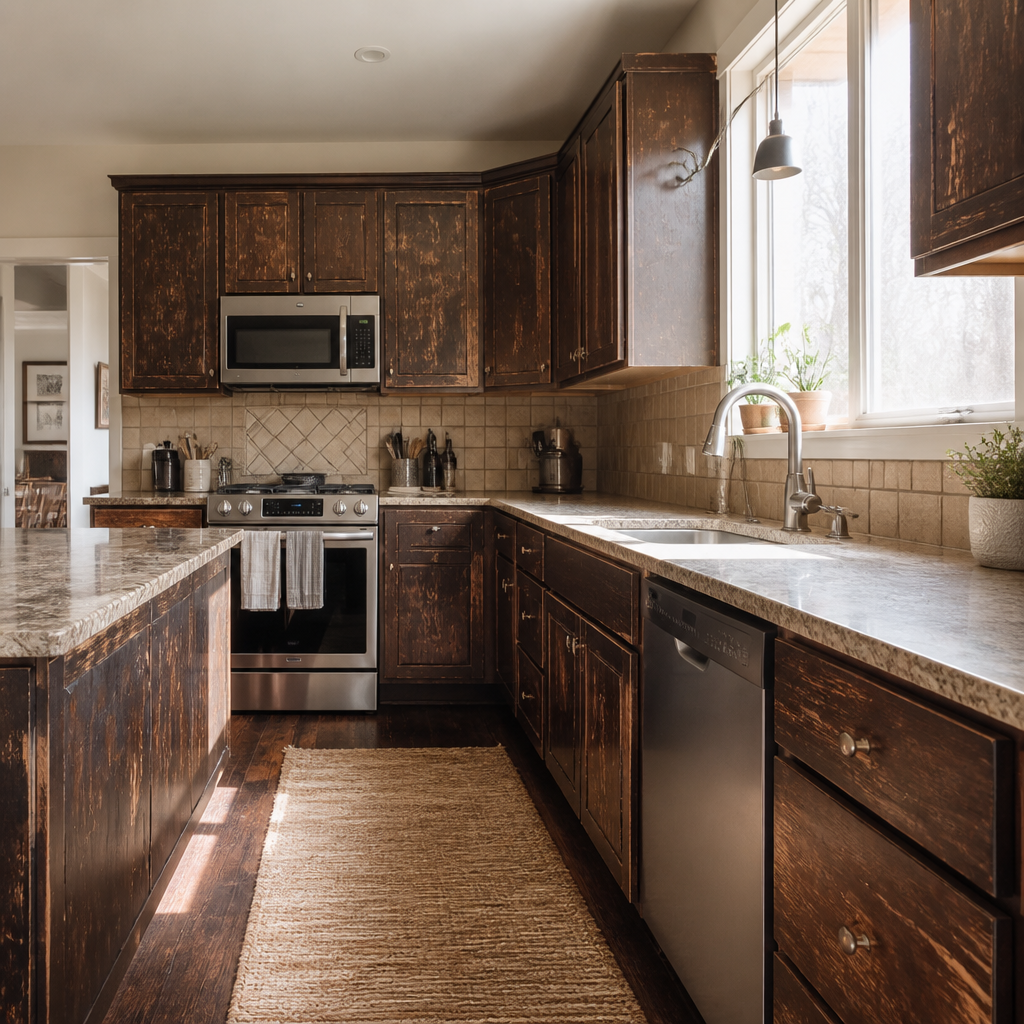
Cabinet refinishing is the right choice when the cabinet boxes, the frames and carcasses mounted to the wall and floor, are structurally intact. Press firmly on the interior sides and base of the lower cabinets. If the material feels solid and does not flex, compress, or crumble, the boxes are sound. That is the single most important structural checkpoint.
Signs Your Cabinets Are Ideal Refinishing Candidates
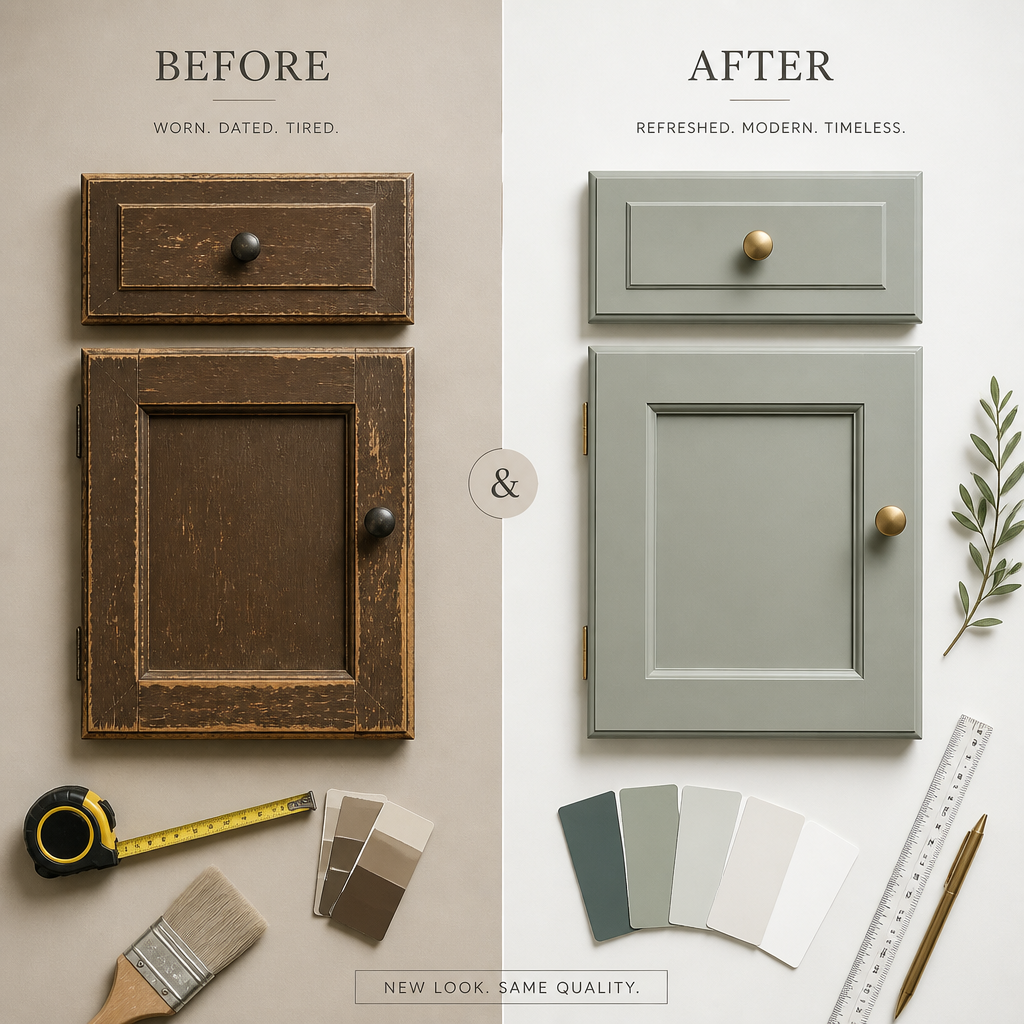
Doors that hang correctly, drawers that operate without binding, and hardware that is simply dated rather than broken are all positive indicators. Discolouration, a yellow or orange cast on previously white or cream cabinets, surface scratches, and worn finish around handles are purely cosmetic problems that refinishing resolves completely.
Kitchen cabinet painting in Langley and Surrey is particularly popular among homeowners preparing to sell, and for good reason. A professionally refinished kitchen reads as a renovated kitchen to a buyer walking through. At a refinishing cost that represents a small fraction of the property’s value, the return on that investment is hard to beat.
Refinishing also makes sense when you want a specific colour or finish that factory cabinets simply do not offer at a reasonable price point. Custom colour matching, two-tone finishes (a dark island with white perimeter cabinets, for example), and specialty sheens are all well within what a skilled painting contractor can execute on existing boxes.
What Refinishing Cannot Fix
Refinishing addresses surface and finish problems. It does not change door profiles. If a shaker-style door is what you want and you currently have a flat slab or a heavily routed traditional door, refinishing will give you a better-looking version of the door you already have, not a different door. That distinction matters, and an honest contractor will make it clear upfront.
Pro tip: Before booking a refinishing quote, open every cabinet door fully and check the interior base corners of lower cabinets for softness or discolouration. Those spots are where dishwasher or sink leaks accumulate first. Soft material in those areas changes the conversation from refinishing to selective replacement.
When Replacement Actually Makes Sense
There are genuine situations where replacement is the right answer. The problem is that those situations are less common than kitchen showrooms and renovation influencers suggest, and the bar for justifying $30,000 to $50,000 in replacement costs should be high.
Structural Damage That Cannot Be Repaired
Water damage is the primary culprit. When the cabinet box material, whether plywood or MDF, has been saturated long enough to warp, delaminate, or develop soft spots that crumble under pressure, the structure cannot support a quality finish and may not safely hold its contents. Screw holes that have blown out and cannot be re-anchored are another indicator of material that has reached the end of its life.
Particle board construction, common in lower-cost cabinets built in the 1980s and 1990s, is more vulnerable to moisture damage than plywood. If particle board boxes have been exposed to repeated moisture, they swell, the veneer peels, and the material loses its ability to hold hardware. Refinishing particle board boxes in this condition is a short-term fix that will not last.
Layout Changes That Require New Cabinet Footprints
If you want to move the kitchen to a different wall, open up a galley to the living area, or add an island that requires structural modifications, refinishing is irrelevant. These are layout decisions, not finish decisions, and they require new cabinetry built to the new configuration.
Partial layout changes, adding a pantry cabinet where there was none or extending a run by one section, can sometimes be handled by combining new cabinet sections with refinished existing ones. A skilled contractor can match the finish closely enough that the new and existing sections read as consistent. This approach is significantly less expensive than a full replacement.
Pro tip: If a contractor tells you your cabinets need full replacement without opening every door, checking the box interiors, and physically pressing on the base and sides of the lower cabinets, get a second opinion. The assessment should take at least 20 minutes on a standard kitchen and involve actual physical inspection, not a glance from the doorway.

The Cabinet Refinishing Process: What Separates Professional Results from DIY Disappointment
Understanding the refinishing process is how you evaluate contractor quality and avoid hiring someone who produces a result that looks fine for six months and then peels, yellows, or chips at every contact point. The process has a correct sequence, and shortcuts at any stage produce predictable failures.
Preparation: The Phase That Determines Everything
Preparation accounts for close to half the total labour in a professional cabinet refinishing job. The sequence is cleaning to remove grease and cooking residue, deglossing the existing finish so the new primer bonds mechanically, light sanding to create surface profile, and spot filling any chips or dings before priming.
Skipping or compressing the deglossing step is the single most common reason painted cabinets peel within the first year. Kitchen cabinet surfaces accumulate airborne grease that is invisible to the eye but catastrophic for paint adhesion. A contractor who goes straight from cleaning to priming without deglossing is setting you up for failure.
Door Removal and Off-Site Finishing
Professional cabinet refinishing involves removing the doors and drawer fronts and finishing them off-site in a controlled environment. This is not optional if you want a factory-quality result. Spraying in-place with the doors on the hinges and surrounding surfaces masked is a compromise technique that produces runs, uneven coverage, and overspray risk on flooring and countertops.
Off-site finishing in a spray booth or dedicated finishing space eliminates airborne dust contamination, allows doors to be finished lying flat for even wet-edge control, and produces the smooth, brush-mark-free surface that makes refinished cabinets look genuinely new. Ask any contractor you are evaluating whether doors are removed and where they are finished. If doors stay on-site and in place, that is important information about the quality ceiling you can expect.
Product Selection for Durability in a Kitchen Environment
Kitchen cabinets face heat, humidity, grease, and constant physical contact. The finish product matters. Alkyd-based paints and primers, which cure to a hard, washable surface, outperform standard latex in this environment. Waterborne alkyds offer the durability of oil-based products with significantly lower VOC content, which matters for indoor air quality during and after the project.
A semi-gloss or satin sheen is the practical choice for most kitchen cabinets. Both sheens are washable and provide enough reflectivity to make the kitchen feel brighter without being so glossy that every minor surface imperfection becomes visible under direct light.
Refinishing vs. Refacing vs. Full Replacement: Side-by-Side Comparison
The three main paths homeowners consider each have a different cost profile, timeline, and scope. This comparison reflects real conditions in the Lower Mainland market.
| Factor | Professional Cabinet Refinishing | Cabinet Refacing | Full Cabinet Replacement |
|---|---|---|---|
| Typical cost (standard kitchen, Lower Mainland) | $2,500 to $5,500 | $8,000 to $15,000 | $15,000 to $50,000+ |
| Project timeline | 3 to 5 days | 1 to 2 weeks | 3 to 6 weeks |
| Kitchen use during project | Partial use possible | Limited use | Full kitchen out of service |
| Changes door profile | No | Yes (new door skins applied) | Yes (complete new cabinetry) |
| Changes layout | No | No | Yes (possible) |
| Addresses structural damage | No | Partial (new door surfaces over existing boxes) | Yes |
| Expected finish life with professional application | 8 to 15 years with proper care | 10 to 20 years | 15 to 25 years |
| Countertop disruption | None | None to minimal | Almost always required |
| Best suited for | Sound boxes, dated finish, resale prep, budget-conscious update | Sound boxes, desire for new door profile, mid-range budget | Structural damage, layout change, full kitchen renovation |
How to Choose a Cabinet Refinishing Contractor in the Lower Mainland
The quality gap between cabinet refinishing contractors in the Fraser Valley is substantial. This is a specialty finish application, not standard wall painting, and the contractors who do it well have invested in spray equipment, a proper finishing environment, and the product knowledge to specify the right primer and topcoat for a kitchen surface.
Questions to Ask Before Signing Any Quote
Ask whether doors are removed and finished off-site. Ask what primer is used and why it was chosen for kitchen cabinets specifically. Ask how long the preparation phase takes relative to the application phase. A contractor who can answer these questions with specifics, not generalities, is demonstrating real process knowledge.
Request to see completed cabinet refinishing projects, not wall painting work. Cabinet finishing is a different discipline, and a portfolio of wall colours does not tell you anything about a contractor’s ability to produce a smooth, durable cabinet finish.
Why Experience in the Lower Mainland Market Matters
Fraser Valley kitchens present specific conditions: older homes in Abbotsford and Langley often have original 1980s and 1990s cabinetry with thick layers of existing finish that require careful deglossing and sometimes chemical stripping before new product can be applied. A contractor who has worked in this market for years understands what is underneath the existing finish and how to prepare for it.
Dreamscape Painting has been completing cabinet refinishing and painting projects across the Lower Mainland and Fraser Valley for over 35 years. That track record reflects accumulated knowledge of local conditions, product performance in this climate, and the preparation requirements specific to the homes in this region. When you are trusting a contractor with a kitchen, experience in the specific market is not a minor detail.
For homeowners in Abbotsford, Langley, Surrey, and surrounding communities considering a kitchen update, the starting point should be a professional assessment of whether the boxes are worth keeping. In most cases, they are, and professional cabinet painting services from an experienced local contractor deliver a result that genuinely transforms the space at a fraction of the replacement cost.
Frequently Asked Questions
How long does professionally refinished cabinets last in a Fraser Valley kitchen?
With proper preparation and a quality alkyd or waterborne alkyd finish applied by a professional, cabinet refinishing should last eight to fifteen years in normal kitchen use. The variables that shorten that lifespan are inadequate prep before application, the use of interior wall paint instead of a cabinet-specific product, and aggressive cleaning with abrasive products on the finish. A contractor who does the prep correctly and specifies the right product will give you a finish that holds up through regular daily use without peeling or chipping at contact points.
Can you refinish cabinets that were previously painted rather than stained?
Yes, and this is actually the most common scenario in Fraser Valley homes. Previously painted cabinets require thorough deglossing and light sanding to give the new primer something to bond to. If the existing paint has chipped significantly or was applied directly over a factory finish without proper prep originally, the contractor may need to remove more of the existing product before starting fresh. A good contractor will assess the adhesion of the existing finish as part of the quoting process and factor any additional prep into the scope.
Is cabinet painting worth it if I’m planning to sell my home in the next one to two years?
Yes, and this is one of the clearest cases where the numbers support refinishing over any alternative. A professionally refinished kitchen consistently helps a listing present better and supports stronger buyer interest. The cost is a small fraction of the home’s value, the improvement is immediately visible and tangible, and you avoid the extended timeline and disruption of full replacement during a period when you likely want the home in showing condition. Cabinet painting in Surrey and Langley has become a standard pre-listing upgrade for exactly this reason.
What colours work best for cabinet refinishing in today’s Lower Mainland market?
White and off-white remain the most requested cabinet colours for refinishing projects in the Fraser Valley, particularly warm whites with a slight grey or beige undertone rather than pure bright white, which can read as stark under kitchen lighting. Two-tone kitchens with a darker island or lower cabinet colour against lighter uppers have been consistently popular. Deep navy, forest green, and warm charcoal on lower cabinets or islands pair well with white or soft grey uppers. Colour selection should account for the kitchen’s natural light and the existing floor and countertop materials, and a good contractor will walk through those considerations before you commit to a colour direction.
How do I know if my cabinets are too damaged to refinish?
The clearest indicators that replacement is necessary rather than refinishing are soft or spongy material in the base of lower cabinets (a sign of water damage), delaminating plywood that no longer holds screws, and drawers or doors that will not close properly because the box frame has warped out of square. Surface damage, including scratches, chips in the finish, discolouration, and worn edges, is cosmetic and does not indicate structural failure. If you are unsure, have a contractor physically inspect the boxes before accepting any recommendation. The inspection should involve pressing on the interior surfaces and checking the corners and bases, not just a visual scan.
Do I need to empty my cabinets before a refinishing project?
Yes. All contents need to be removed from cabinets before the project begins. This is both a practical necessity (doors are removed and taken off-site) and a cleanliness measure that protects your belongings from any dust or overspray. A professional contractor will protect countertops, appliances, and flooring with appropriate coverings. Clearing the kitchen of personal items beforehand is the homeowner’s primary preparation task and makes the project start faster and cleaner.
Have you recently refinished your kitchen cabinets or gone through a full replacement? We would love to hear what the process looked like for you and whether the outcome matched your expectations.
References
- Cabinet painting and refinishing cost guide for Vancouver homeowners
- Kitchen cabinet painting cost breakdown for Vancouver and surrounding areas
- Cabinet refacing options and costs explained for Vancouver homeowners
- When to repair versus replace damaged kitchen cabinets: a practical guide
- Professional cabinet painting and refinishing process overview from a Lower Mainland contractor

