
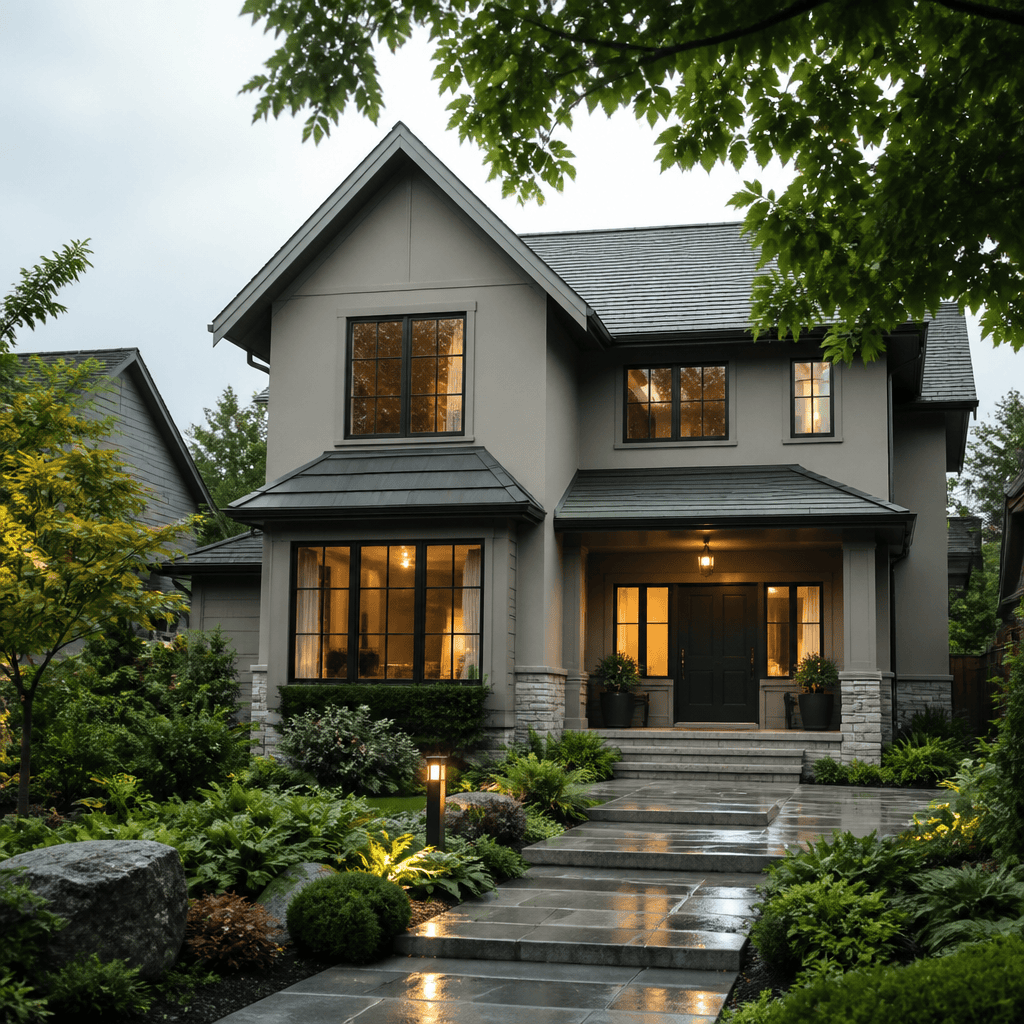
The wrong exterior paint colour does not just look bad. It can quietly cost you thousands when you sell, signal poor upkeep to buyers before they step inside, and fade or mildew within a couple of seasons in British Columbia’s demanding climate. Choosing the right curb appeal exterior paint colours for a Lower Mainland or Fraser Valley home is not a matter of personal taste alone. It is a technical and strategic decision shaped by local weather patterns, surrounding natural landscapes, roofline materials, and neighbourhood character. Get it right, and the return on a quality exterior repaint is among the highest of any home improvement project.
Table of Contents
- Quick Takeaways
- Why Exterior Colour Matters More in BC
- Start With What You Are Not Painting
- Top Curb Appeal Exterior Paint Colours for BC Homes
- Colour Choices by BC Region: Lower Mainland vs. Fraser Valley
- Colour Palette Comparison: Which Approach Suits Your Home
- How Exterior Painting Affects Home Value in BC
- Common Mistakes BC Homeowners Make When Choosing Exterior Colours
- Frequently Asked Questions
- References
Quick Takeaways
| Key Insight | Explanation |
|---|---|
| Warm greys and greige dominate BC exteriors for good reason | These mid-tone neutrals resist showing mildew and dirt in rainy Lower Mainland conditions, and they age well without dating a home. |
| Fix your fixed elements first | Roof shingles, stonework, concrete, and existing brick have undertones that must drive your colour selection before you ever open a paint fan deck. |
| Light colours punish you in high-rain zones | Pale whites and creams show biological staining faster in Surrey, Langley, and Abbotsford than mid-tones do, especially under eaves and near grade. |
| Earthy greens work with BC’s natural surroundings | Deep olive, sage, and muted moss tones connect a home to the forested and mountain landscapes of the region rather than fighting them. |
| Test large samples on multiple elevations | A colour that looks neutral in a showroom can read distinctly blue, violet, or yellow on a north-facing wall in BC’s shifting daylight. Small chips are not enough. |
| Accent colours close the deal on curb appeal | A front door, fascia, and trim colour that contrasts thoughtfully with the body colour creates the composed, intentional look that buyers notice first. |
| Surface preparation determines how long the colour lasts | The best colour choice on a poorly prepared surface will fail within a few seasons. Proper cleaning, priming, and repair work before painting protects your investment. |
Why Exterior Colour Matters More in BC
British Columbia is not a single climate. The Lower Mainland, including Surrey, Langley, and Abbotsford, receives substantial rainfall through most of the year. Coastal moisture, long wet seasons, and temperature swings put exterior paint under real stress. A colour choice that ignores these conditions will fade unevenly, show biological growth sooner, and demand repainting far ahead of schedule.
At the same time, BC neighbourhoods, particularly in the Fraser Valley, sit within landscapes of forests, mountains, and open farmland. The visual relationship between a home’s exterior colour and its natural surroundings matters in ways it simply does not in dense urban environments. A palette that feels sophisticated in Toronto can look jarring against a backdrop of Douglas fir and mountain cedar in Langley.
Homes with updated, thoughtfully chosen exterior paint colours also sell faster and tend to attract more confident buyers. When a buyer approaches a home and the exterior looks clean, current, and well maintained, they arrive at the front door with a fundamentally different mindset than they would if the paint is chalky, faded, or clearly dated. That first impression is almost impossible to undo with what they find inside.
Start With What You Are Not Painting
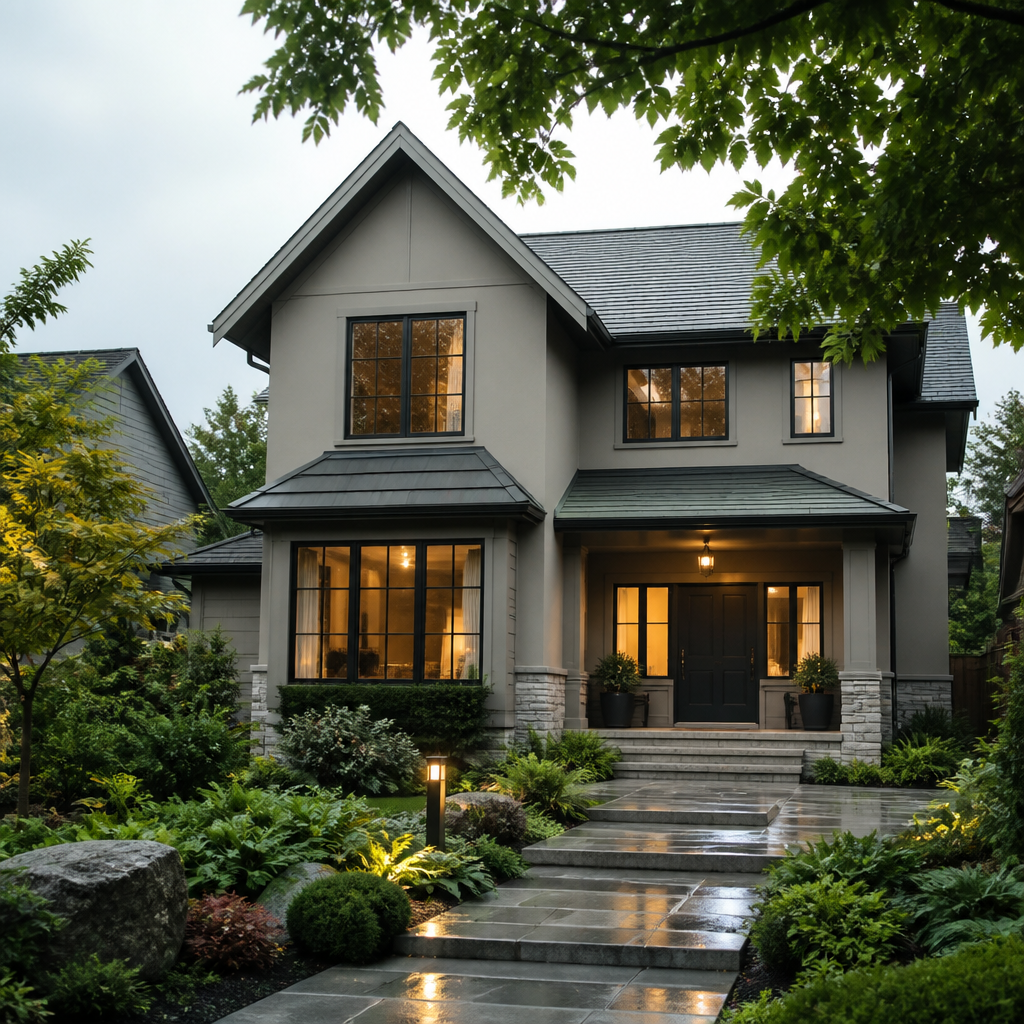
The most reliable exterior colour plans begin with restraint. Before touching a paint fan deck, identify every fixed material on the home that will remain after the project: roofing shingles, brick, stonework, concrete walkways, metal railings, and window frames. Each of these has undertones that will interact with whatever colour goes on the siding and trim.
A roof that reads warm brown generally works well with creamy whites, taupes, olive greens, and warm greys. A charcoal or near-black roof gives more flexibility and can support cooler greys, crisp whites, muted blues, and deep greens. Red or orange brick, which appears on many older Fraser Valley homes, deserves particular attention. Cool grey paint can make warm brick appear more intensely orange, while a soft greige, creamy white, or grounded sage green tends to create a more balanced relationship.
The best exterior colour plans treat the home as a composed whole. The paint colour is not the star. It is the element that makes everything else look intentional.
Look at your fixed materials in actual outdoor light, at different times of day, before making any decision. In Abbotsford and the eastern Fraser Valley, strong summer sun can shift a colour dramatically from its appearance under overcast skies. Testing large painted sample boards on multiple elevations of the home is far more reliable than choosing from a small swatch held up in a hardware store aisle.
Pro tip: Paint two or three large cardboard or sample boards with your shortlisted colours and mount them on different sides of the home for at least three days. Observe them in morning light, midday sun, and late afternoon shade before committing.
Top Curb Appeal Exterior Paint Colours for BC Homes
There is no single colour that works for every BC home, but certain palettes have consistently performed well across the region’s varied climates, architectural styles, and natural settings. These are not trendy choices. They are colours with proven track records in this specific environment.
Warm Greys and Greige
Warm greys and greige tones (a blend of grey and beige) are the most widely requested exterior colours across the Lower Mainland and Fraser Valley. They perform well in rainy climates because mid-tones hide biological staining and everyday grime far better than very light or very dark shades. They are versatile enough to pair with black, white, or natural wood accents, and they do not date a home the way more fashionable colours can.
A common and effective approach is to use a warm mid-tone grey or greige on the main body, a crisper white or off-white on the trim and fascia, and a deeper charcoal or black on the front door and shutters. This three-layer palette reads as polished and deliberate from the street without relying on bold or unconventional choices.
Earthy Greens and Nature-Inspired Tones
BC’s forested surroundings give earthy greens a natural home that they do not have in most other Canadian provinces. Deep olive, sage, and muted moss tones connect a property to its environment rather than competing with it. These colours are particularly effective on homes in Langley and Abbotsford where the visual backdrop includes fields, trees, and mountain ridgelines.
Earthy greens pair well with stone features, cedar soffits, and warm wood accents. They also age gracefully, shifting subtly as they weather rather than fading to a chalky, washed-out version of themselves the way brighter colours often do.
Warm White With Dark Accents
A warm white body paired with near-black or deep charcoal details is one of the cleanest, most architecturally credible choices available, particularly for traditional homes, modern farmhouse styles, and properties with natural stone elements. The key is avoiding a pure, blue-cast white. An off-white with genuine warmth reads as inviting rather than sterile.
This palette demands excellent surface preparation and a high-quality exterior coating because white shows environmental staining more readily than mid-tone colours, especially around eaves and at grade. On a properly prepared and painted surface with a quality product, the result is striking and broadly appealing to buyers.
Colour Choices by BC Region: Lower Mainland vs. Fraser Valley
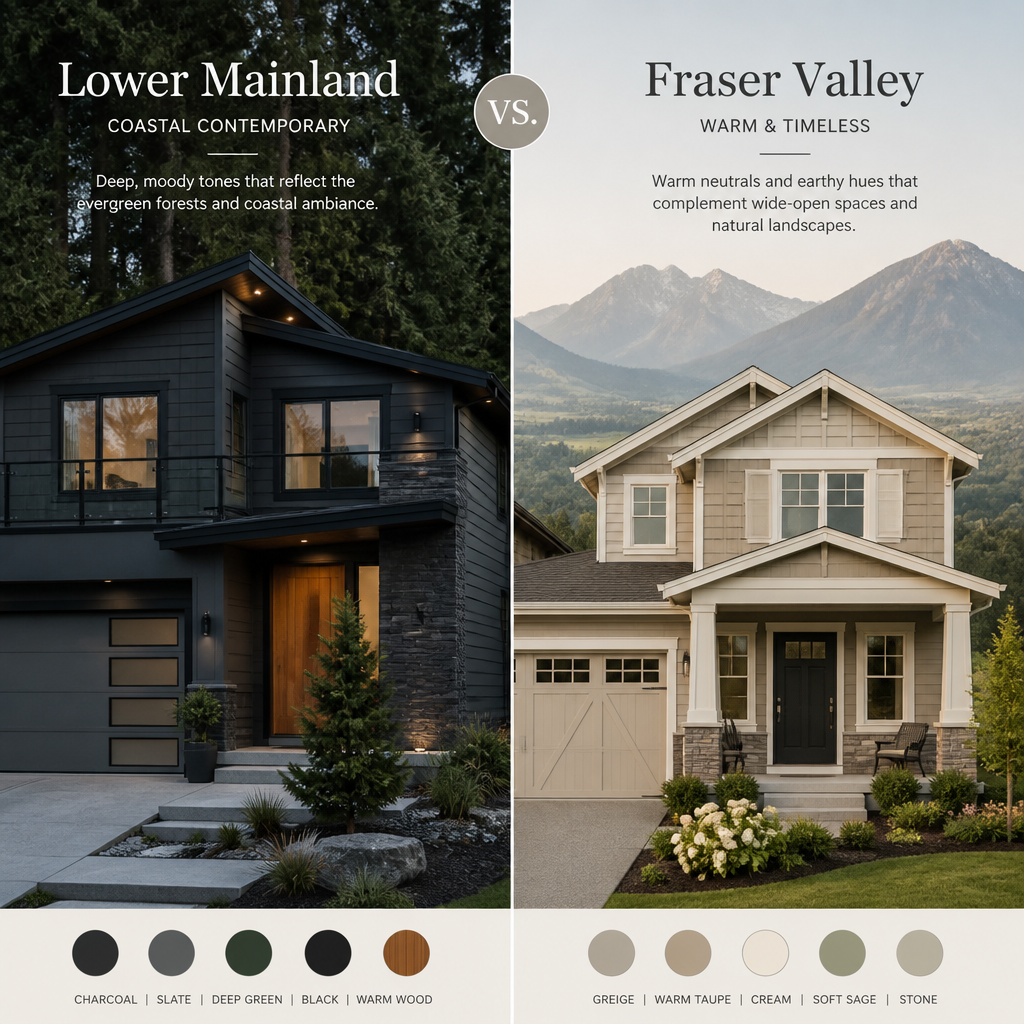
The Lower Mainland, including the City of Surrey and areas closer to the coast, experiences higher annual rainfall and more consistent cloud cover than communities farther east in the Fraser Valley. This distinction has real implications for colour selection.
In higher-rainfall zones, mid-tone neutrals outperform both very light and very dark colours. Very light colours show mildew, algae, and staining faster. Very dark colours can show efflorescence and salt deposits more visibly. The sweet spot is a mid-tone grey, greige, or earthy green that holds its appearance between maintenance cycles.
In Abbotsford and the eastern Fraser Valley, where summers are sunnier and winters bring more freeze-thaw cycling, mid-tones and slightly deeper shades are also the practical choice. Brighter or more saturated colours tend to fade more noticeably in stronger UV exposure, and that fading is rarely even. A colour that looked vibrant in the spring can appear patchy and tired by late summer if it was not suited to high UV conditions.
Pro tip: In any part of the Fraser Valley or Lower Mainland, ask your painting contractor specifically which exterior paint products are formulated for high-moisture and UV-variable climates. The colour is only as good as the product carrying it.
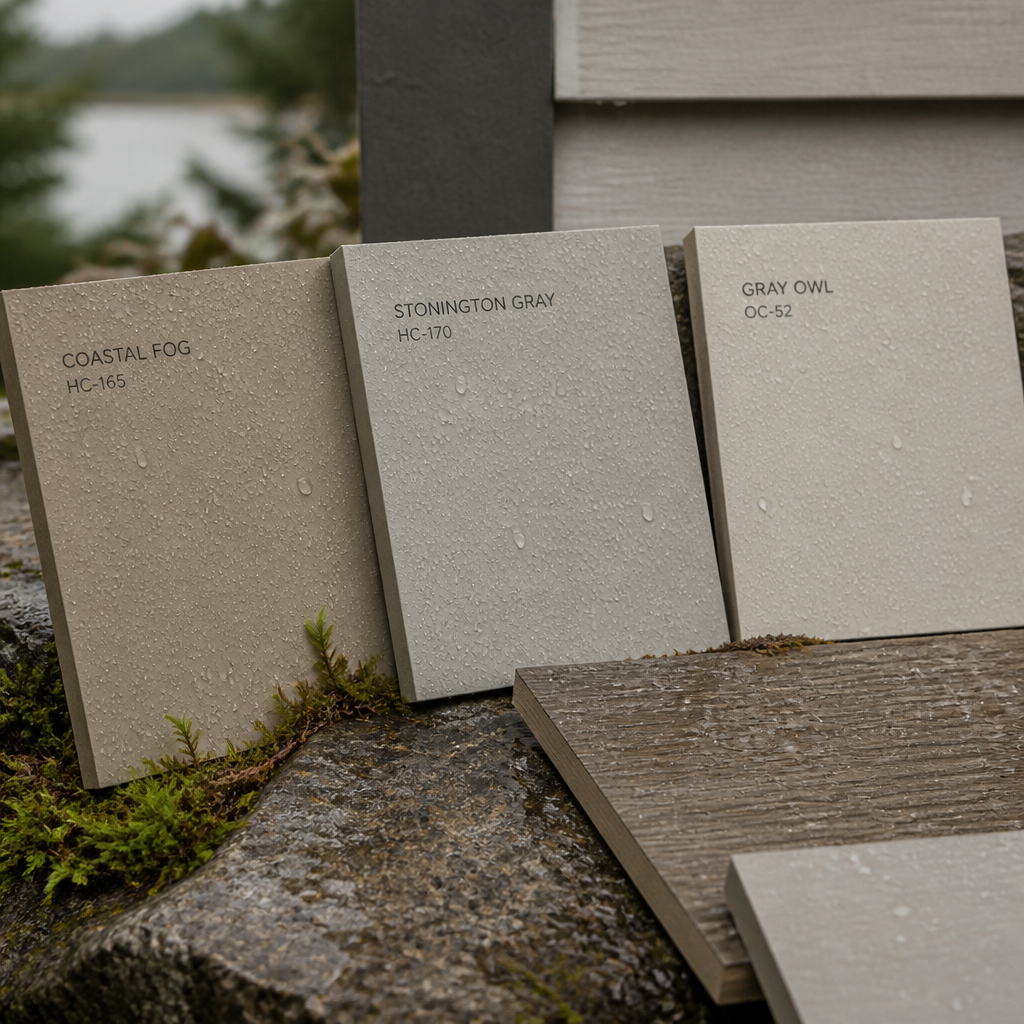
Colour Palette Comparison: Which Approach Suits Your Home
The three most common palette approaches for BC exteriors each have distinct strengths and limitations. Understanding where each works best will save you from a colour regret that lasts a decade.
| Palette Approach | Best Suited For | Limitations to Know |
|---|---|---|
| Warm Grey or Greige Body With White Trim | Ranchers, two-storey colonials, newer builds in suburban Surrey and Langley. Works with almost every roof colour. | Can feel predictable in neighbourhoods where many homes already use this palette. Differentiate with door and accent colour. |
| Earthy Green or Olive Body With Natural Wood or Stone Accents | Homes in Abbotsford, Langley, and rural Fraser Valley settings with significant greenery, stone features, or cedar elements. | Requires a warm-toned roof to complement. Can look dark on north-facing elevations if the shade is too deep. |
| Warm White Body With Near-Black or Deep Charcoal Trim | Traditional, craftsman, or modern farmhouse styles. Properties with dark roofing and natural stone detailing. | Shows environmental staining faster in high-rainfall zones. Demands higher-quality paint and thorough surface preparation to maintain appearance. |
How Exterior Painting Affects Home Value in BC
A professional exterior repaint is one of the highest-return home improvement investments available to BC homeowners, particularly when the property is being prepared for sale. It is not simply about aesthetics. A fresh, well-executed exterior signals to buyers that the home has been actively maintained, which reduces the perceived risk of hidden problems elsewhere in the property.
Homes with dated, peeling, or clearly faded exterior paint face an uphill battle regardless of what is inside. Buyers begin discounting mentally before they reach the front door. In competitive Fraser Valley and Lower Mainland markets, where home value painting in BC is closely tied to presentation, that discount can be significant.
A common mistake is treating exterior painting as a cosmetic afterthought rather than a value-protection measure. The exterior is the first and last thing a buyer sees. Investing in a proper repaint, including thorough preparation, quality product selection, and experienced application, pays dividends in both sale price and time on market.
For homeowners not planning to sell, a quality exterior repaint still protects the underlying structure from moisture ingress, wood rot, and UV degradation. In BC’s climate, that protection is not optional. It is deferred maintenance that compounds into expensive repairs if neglected long enough.
Common Mistakes BC Homeowners Make When Choosing Exterior Colours
After decades of exterior painting across the Lower Mainland and Fraser Valley, the same errors appear repeatedly. They are worth naming directly so you can avoid them.
The first is choosing a colour based entirely on how it looks in a fan deck or on a small chip. Undertones shift dramatically when a colour is applied to a large vertical surface in actual daylight. A beige that looks perfectly neutral in a store reads pink on a west-facing wall in afternoon sun. Always test at scale outdoors.
The second is ignoring the neighbours. You do not need to match surrounding homes, but a colour that clashes violently with every property on the street will stand out for the wrong reasons. Drive the street and look at the palette the neighbourhood uses collectively. Work with it, not against it.
The third is skipping or rushing surface preparation. Caulking gaps, repairing wood damage, pressure washing, and priming bare surfaces are not optional steps. They determine how long the colour lasts and how good it looks in the first place. A beautiful colour choice on a poorly prepared surface is money wasted within two to three seasons.
The fourth is treating the trim, fascia, and front door as afterthoughts. These accent elements are what the eye goes to first from the street. A strong trim and door colour can elevate a perfectly ordinary body colour into something that genuinely stands out and boosts curb appeal.
If you are uncertain about any of these decisions, working with an experienced local painting contractor who knows how colours perform on Lower Mainland and Fraser Valley homes in real conditions is worth far more than any online colour tool. The team at Dreamscape Painting has been helping BC homeowners make confident exterior colour choices and delivering expert application for over 35 years. An in-person consultation with an experienced estimator removes the guesswork entirely.
Frequently Asked Questions
What exterior paint colours add the most curb appeal in the Lower Mainland?
Warm greys, greige tones, earthy greens, and warm white with dark accents consistently perform well across the Lower Mainland. These palettes complement BC’s natural landscapes, hold up in high-rainfall conditions, and appeal to a broad range of buyers. The specific shade that works best depends on your roof colour, fixed materials, and surrounding environment, which is why testing large samples on your actual home matters more than any general recommendation.
How much does exterior painting improve home value in BC?
A professional exterior repaint is widely regarded as one of the highest-return home improvement investments, particularly when a property is being prepared for sale. The precise return varies by market, property condition, and quality of execution. What is consistent across BC markets is that dated or peeling exterior paint creates negative buyer impressions that are difficult to overcome with interior features alone, while fresh, well-executed paint raises perceived property value and reduces time on market.
What colours should I avoid for exterior painting in Surrey or Abbotsford?
Very pale whites and light creams are challenging in high-rainfall areas like Surrey because they show mildew, algae, and environmental staining more visibly and more quickly. Highly saturated or vivid colours tend to fade unevenly in UV-variable climates like Abbotsford, looking patchy and tired faster than mid-tone neutrals. Bold or unconventional colours can also limit buyer appeal if you intend to sell. Staying within a mid-tone neutral range gives you the best performance and the broadest appeal.
How do I choose exterior paint colours that work with my roof shingles?
Start by identifying the undertone in your roof shingles. Warm brown or tan shingles pair well with creamy whites, taupes, warm greys, and olive greens. Charcoal or near-black roofs are the most flexible and work with cooler greys, crisp whites, deep blues, and greens. Red-toned or orange brick as a fixed element calls for warmer body colours, as cool grey paint can amplify the orange cast in brick rather than neutralizing it. Always view your roof and fixed materials in natural outdoor light before finalizing any colour decision.
How often does exterior paint need to be redone on a BC home?
In BC’s climate, a professionally applied exterior repaint on properly prepared surfaces typically lasts between seven and ten years depending on product quality, exposure, and the specific conditions of the home. North-facing elevations with limited sun exposure in wetter parts of the Lower Mainland may show biological growth sooner. South and west-facing surfaces in sunnier Fraser Valley locations may experience more UV-related fading. Regular light maintenance, including washing and spot caulking, extends the lifespan of any exterior paint job significantly.
Should I paint my front door a different colour from the rest of the house?
Yes, and this is one of the highest-impact, lowest-cost decisions you can make for curb appeal. A front door colour that contrasts with the body colour draws the eye to the entry and gives the home a finished, intentional appearance. Deep navy, forest green, classic red, and matte black are all proven front door choices that work well against the neutral body palettes most popular in BC. The door does not need to be dramatic to be effective. It simply needs to be deliberate.
If you have recently repainted your home’s exterior or are currently choosing colours for a project in the Fraser Valley or Lower Mainland, share what worked for you and what you would do differently. Other BC homeowners benefit from real local experience far more than from generalized advice.
We would love your feedback and any insights you would share with others. What perspective would you add?

