
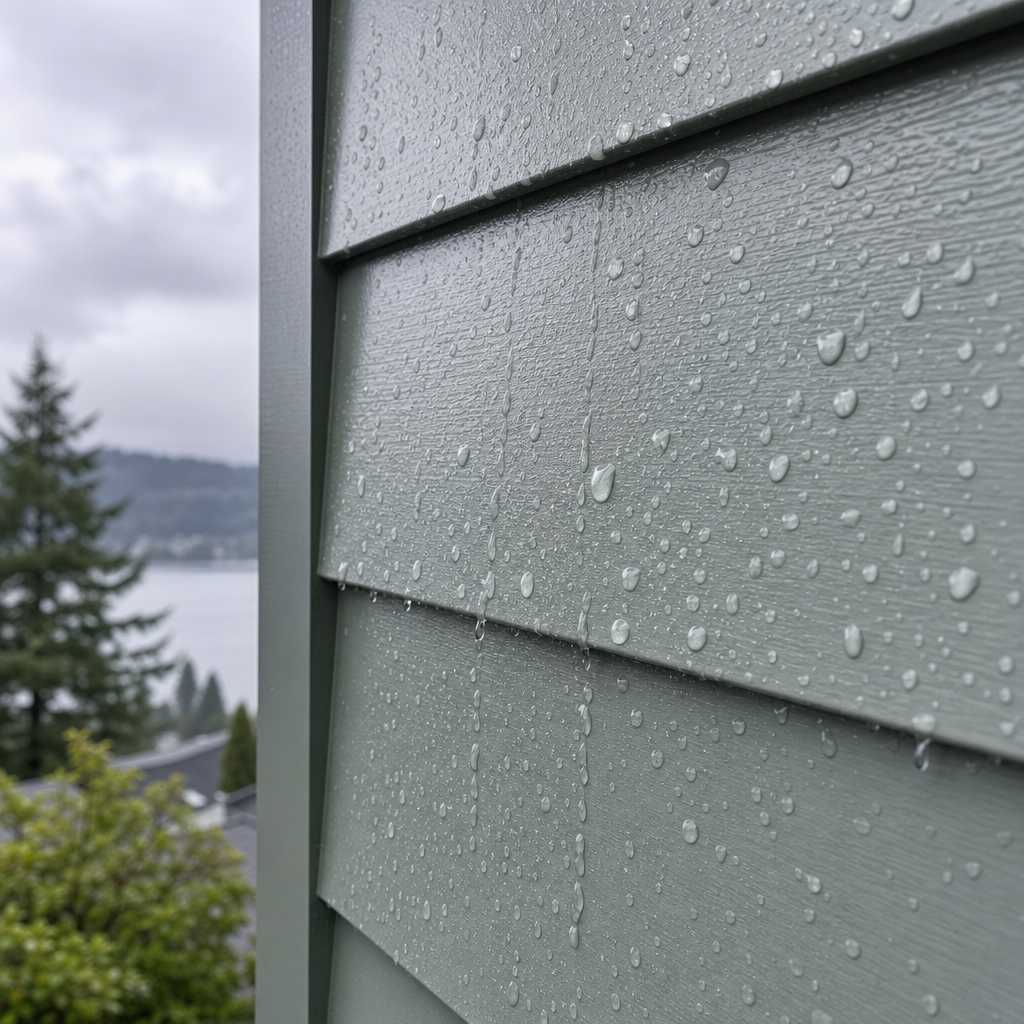
British Columbia’s Lower Mainland averages over 1,150 millimetres of rainfall per year in Metro Vancouver, and Fraser Valley communities like Abbotsford can see significantly more. That is not a mild inconvenience for exterior paint. It is a year-round stress test that cheap or incorrectly applied coatings consistently fail. Choosing the right exterior paint for BC’s rainy climate is one of the highest-value decisions a homeowner can make, because the wrong choice does not just look bad. It leads to wood rot, mould infiltration, and five-figure repair bills. This guide gives you the practical information to make the right call the first time.
Table of Contents
- Quick Takeaways
- Why BC’s Climate Destroys Ordinary Paint
- What Makes a Paint Weather Resistant in Vancouver and the Lower Mainland
- Best Paint Types for Wet Climates: Latex, Acrylic, and Elastomeric
- Paint Sheen and Rain Performance: What Flat Finishes Actually Cost You
- Surface Preparation in BC Conditions: The Step Most Homeowners Skip
- Exterior Paint Type Comparison for BC Homeowners
- Timing Your Exterior Paint Project in the Fraser Valley
- Common Mistakes Lower Mainland Homeowners Make
- Frequently Asked Questions
- References
Quick Takeaways
| Key Insight | Explanation |
|---|---|
| 100% acrylic latex is the baseline minimum for BC exteriors | Oil-based and vinyl-acrylic blends lose adhesion faster in sustained moisture. Pure acrylic expands and contracts with temperature swings without cracking. |
| Elastomeric coatings are worth the premium on stucco and masonry | Elastomeric paint can bridge hairline cracks up to 1.5 mm, preventing water intrusion that conventional paints let through within one rainy season. |
| A satin or semi-gloss sheen outperforms flat in high-moisture zones | Flat paint is porous by design. On siding, soffits, and trim exposed to rain, it absorbs moisture and breaks down in as few as two to three years in Lower Mainland conditions. |
| Surface preparation matters more than paint brand | Even premium paint applied to damp, mouldy, or poorly sanded wood will fail within one to two years. Proper prep accounts for roughly 80% of a coating’s longevity. |
| Mildewcide additives are non-negotiable in shaded or north-facing areas | Areas with limited sun exposure in Abbotsford, Langley, and Surrey stay wet longer. Paint without mildewcide will show black streaking and biological growth within one season. |
| Two coats over a bonding primer beats three coats without primer | A quality bonding primer seals the substrate and creates a mechanical bond that prevents peeling. Skipping primer to save money is the most expensive shortcut in exterior painting. |
| Paint must be applied above 10 degrees Celsius and below 85% humidity | BC’s autumn and winter conditions often violate both thresholds. Painting outside these parameters causes improper film formation, leading to early peeling and adhesion failure. |
Why BC’s Climate Destroys Ordinary Paint
The Lower Mainland does not just receive heavy rainfall. It cycles through freeze-thaw events in the Fraser Valley, persistent coastal humidity near Metro Vancouver, and UV exposure during dry summers that stress the paint film from a completely different angle. Each of these forces acts on exterior coatings differently, and ordinary consumer-grade paint is not engineered to handle all three simultaneously.
Freeze-thaw cycling causes paint to expand and contract repeatedly. Any coating that lacks sufficient flexibility will develop micro-cracks. Those cracks allow liquid water to penetrate the substrate, and when that water freezes, it expands and makes the damage exponentially worse. This is why homeowners in Abbotsford and Langley often see peeling along the bottom third of their siding, where snow accumulation and ground moisture are most concentrated.
Persistent humidity is the other major threat. Relative humidity in the Lower Mainland frequently sits above 80% from October through March. At those levels, a paint film that cannot breathe traps moisture between itself and the substrate, causing blistering, bubbling, and eventually full adhesion failure. This is not a problem you can paint over. The failed sections must be stripped and the substrate assessed before any new coating is applied.
“Wood moisture content above 19% is the threshold at which most paint manufacturers void their warranty. In BC, painting over wet wood is not an edge case. It is the most common cause of premature exterior coating failure we encounter.” – Dreamscape Painting Ltd., field experience across 35 years in the Lower Mainland
What Makes a Paint Weather Resistant in Vancouver and the Lower Mainland
The term weather resistant paint Vancouver gets used loosely by retailers and contractors alike. In practice, a paint earns that label by meeting several specific performance criteria that matter in sustained wet conditions.
Resin Quality and Binder Composition
The resin is the part of the paint that forms the film and holds everything together. In wet climates, 100% acrylic resin is the standard to meet. Styrene-acrylic blends and vinyl-acrylic formulations cost less, but they are more water-permeable and degrade faster under UV. You will see them marketed with terms like “premium latex” but the binder composition tells the real story. Always read the technical data sheet, not just the label.
Brands like Benjamin Moore Aura Exterior, Sherwin-Williams Emerald Exterior, and PPG Timeless all use high-quality 100% acrylic binders specifically formulated for north Pacific coastal conditions. These are not cheap products. A five-gallon pail runs between $120 and $180 CAD at current pricing. The cost difference over a $30-per-pail big-box option is easily recovered in the form of three to five additional years of service life before repainting is needed.
Mildewcide and Algaecide Formulations
Any exterior paint marketed for wet climates should include built-in mildewcide. Some manufacturers allow this to be added as a separate product. Both approaches work, but the formulation must be correct for the concentration of biological growth typical in shaded Lower Mainland environments. North-facing walls and soffits in areas like Surrey’s older residential neighbourhoods can develop visible algae and mildew within a single winter if the paint does not contain adequate biocide content.


Best Paint Types for Wet Climates: Latex, Acrylic, and Elastomeric
Not all paint labelled “exterior” performs equally in BC conditions. The substrate you are painting, the level of existing damage, and the specific exposure conditions of the wall all determine which product type is appropriate.
100% Acrylic Latex for Wood Siding and Trim
For wood siding, which remains the dominant substrate in Fraser Valley residential construction, 100% acrylic latex is the correct answer. It adheres well to wood, allows moisture vapour to pass through the film rather than getting trapped underneath, and retains flexibility through freeze-thaw cycles. This is what Dreamscape Painting’s crews apply on the vast majority of residential exterior projects in Abbotsford, Langley, and Surrey.
A common mistake is applying two coats of topcoat directly to bare or weathered wood without a dedicated primer. Bare wood is absorbent and uneven. The topcoat soaks into the grain unevenly, creating thin spots that fail first. A stain-blocking oil-based primer or a high-build acrylic primer creates the uniform substrate that topcoats need to adhere correctly.
Elastomeric Coatings for Stucco and Masonry
Stucco is extremely common on Lower Mainland homes built between 1970 and 2000. Stucco develops hairline cracks naturally as it ages, and those cracks are water highways into your wall assembly. Standard acrylic paint bridges cracks smaller than about 0.5 mm. Elastomeric coatings stretch to bridge cracks up to 1.5 mm and return to their original shape without tearing.
Elastomeric products like Sherwin-Williams Loxon Elastomeric or Benjamin Moore’s Super Spec Elastomeric are applied at a much higher film thickness than standard paint, typically 10 to 20 mils dry film thickness versus 2 to 4 mils for conventional coatings. Application requires proper technique and specific roller covers. Applied incorrectly, elastomeric coatings trap moisture and create exactly the problem they are meant to prevent.
Pro tip: If you have stucco with visible cracks wider than 2 mm, caulk them with a polyurethane or siliconized acrylic caulk rated for exterior use before applying any elastomeric coating. The coating is not designed to fill structural gaps, only to bridge minor shrinkage cracks.
Paint Sheen and Rain Performance: What Flat Finishes Actually Cost You
Sheen level is not just an aesthetic choice. In the context of exterior painting durability Lower Mainland, it directly affects how water interacts with the painted surface and how long the coating lasts between repainting cycles.
Flat and matte finishes contain a higher ratio of pigment and filler particles relative to binder. This creates a porous surface that holds water rather than shedding it. In BC’s rainy season, a flat exterior finish stays wet for extended periods after rainfall, accelerating the breakdown of the binder and allowing biological growth to establish. The data consistently shows that flat exterior finishes require repainting two to three years sooner than satin finishes on comparable surfaces in wet climates.
Satin sheen (typically 25 to 35 gloss units) is the appropriate choice for most Lower Mainland siding. It sheds water effectively, resists biological growth better than flat, and does not show surface imperfections as harshly as semi-gloss. Semi-gloss should be reserved for trim, doors, and window frames where durability and moisture resistance outweigh the concern about surface visibility.
Pro tip: Never use interior paint on exterior surfaces, even in covered areas like porches or carports. Interior paints are not formulated for UV exposure or moisture cycling and will fail rapidly. The cost saving is not real.

Surface Preparation in BC Conditions: The Step Most Homeowners Skip
In over 35 years of exterior painting across the Lower Mainland, the most consistent predictor of early coating failure is inadequate surface preparation. Not the paint brand, not the number of coats. Prep.
Wood Moisture Content Testing
BC’s wet winters mean wood siding often holds significant moisture well into spring. A professional painter uses a moisture meter to verify that wood is below 15% moisture content before applying any coating. Painting over wet wood is not just ineffective. Most paint manufacturers explicitly void their product warranty if the substrate exceeds 19% moisture at time of application. This is a condition that happens routinely when homeowners rush to paint during a brief dry spell after months of rain.
Mould and Mildew Removal
Painting over mould does not kill it. The mould continues to grow beneath the paint film and eventually lifts it. Affected surfaces must be cleaned with a solution of one part bleach to three parts water, allowed to dwell for at least ten minutes, then rinsed completely and allowed to dry. In many cases, affected wood may also need to be treated with a borate-based wood preservative before priming to prevent reoccurrence from within the substrate.
Caulking and Gap Sealing
Every gap around window frames, door trim, corner boards, and where dissimilar materials meet is a water entry point. Caulk these gaps with a paintable, siliconized acrylic caulk rated for exterior use. Check that existing caulk has not pulled away from the substrate or cracked through. Failed caulk is among the top five causes of water damage in Lower Mainland homes and it costs almost nothing to address at painting time.
Exterior Paint Type Comparison for BC Homeowners
The table below compares the three primary exterior coating options across the criteria that matter most for Lower Mainland conditions. This is not a brand comparison. It is a category comparison based on field performance in sustained wet climates.
| Paint Type | Best Substrate Application | Performance in BC Wet Conditions |
|---|---|---|
| 100% Acrylic Latex | Wood siding, wood trim, primed metal, fibre cement | Excellent. Flexible through freeze-thaw, vapour permeable, UV stable. Industry standard for residential exteriors in wet Pacific climates. Expected service life of 8 to 12 years with proper prep. |
| Elastomeric Coating | Stucco, concrete block, masonry, textured finishes | Superior for crack-prone substrates. Bridges hairline cracks up to 1.5 mm. Must be applied at correct mil thickness or moisture trapping becomes a risk. Service life of 10 to 15 years on suitable substrates. |
| Alkyd (Oil-Based) Paint | Bare or previously oil-painted wood, rusty metal | Good initial adhesion and penetration on problem substrates. Brittle over time in freeze-thaw conditions. Slow drying increases risk of moisture entrapment during BC’s unpredictable shoulder seasons. Being phased out in professional practice in favour of acrylic formulations. |
Timing Your Exterior Paint Project in the Fraser Valley
BC’s exterior painting window is shorter than most homeowners expect. The optimal conditions for exterior painting are air and surface temperatures between 10 and 30 degrees Celsius, relative humidity below 85%, and no rain forecast for at least 24 to 48 hours after application. In the Fraser Valley, this window is reliably available from late May through September, with some years offering workable conditions in early May and October.
The mistake many homeowners make is booking exterior work too early in spring to beat the summer demand. A paint job applied on a 9-degree morning with overnight temperatures dropping back to 4 degrees will not form a proper film. The paint coalescence process requires sustained warmth. Improperly formed films fail within one to two years regardless of product quality.
For homeowners in Abbotsford and Langley, the Sumas Mountain shadow effect and higher inland precipitation averages mean the effective exterior painting window can be a full two to three weeks shorter than in coastal Metro Vancouver. Booking with experienced local contractors like Dreamscape Painting in late winter for a May through August start ensures proper scheduling, proper prep time, and access to the right weather windows.
Experienced estimators can assess your specific project and advise on whether your timing is realistic for the conditions. A rushed exterior job that fails in year two costs far more than waiting four weeks for appropriate weather.
Common Mistakes Lower Mainland Homeowners Make
After 35 years of serving homeowners across the Lower Mainland, certain patterns of avoidable failure repeat consistently. These are not obscure edge cases. They are the most common reasons exterior paint jobs underperform.
Choosing Paint Based on Price Per Litre Alone
A premium exterior paint that costs $60 per litre and lasts 10 years on a properly prepared surface costs less in total than a $25-per-litre product that requires repainting in four years. The arithmetic is straightforward, but the upfront price anchors homeowner decisions strongly. The right way to evaluate exterior paint is cost per year of service life, not cost per litre at purchase.
Skipping the Second Coat to Save Money
A single coat of even the best exterior paint does not provide adequate film thickness in BC conditions. The minimum dry film thickness required for weather resistance is typically 3 to 4 mils per coat. A single coat applied at realistic field conditions often delivers 2 to 2.5 mils. Two coats over primer builds the film thickness that manufacturers test and rate their products for. One coat is a partial job, not a money-saving measure.
Ignoring the Substrate and Painting Over Rot
Soft, punky, or visibly rotted wood cannot be fixed with paint. It must be cut out and replaced, or consolidated with a penetrating epoxy consolidant if the structural integrity remains. Painting over rot seals moisture inside the wood and accelerates the decay process. Rotted sections found during a Dreamscape Painting estimate are flagged and addressed before any coating is applied, which is exactly the kind of detail a 35-year operator knows to look for and less experienced crews often miss.
Pro tip: Ask any painting contractor you are considering how they handle discovered rot during the project. Their answer tells you more about their professionalism than any marketing material they produce.
Frequently Asked Questions
How often should I repaint the exterior of my home in BC?
In Lower Mainland and Fraser Valley conditions, a properly prepared and painted exterior using quality 100% acrylic latex should last 8 to 12 years on wood siding. Trim and high-exposure areas may need attention at 6 to 8 years. Homes in areas with significant tree coverage or north-facing walls often fall on the shorter end of that range due to persistent moisture and reduced UV that inhibits biological growth die-off.
Is it worth hiring a professional painter for exterior work in BC, or can I do it myself?
For most homeowners, professional exterior painting delivers better long-term value. The primary reasons are surface preparation quality, access to commercial-grade products not sold to the public, and the experience to identify substrate issues before they become expensive structural problems. DIY exterior painting in BC is not impossible, but it is a project where shortcuts in prep and product selection are the norm, which is exactly what causes early failure.
What exterior paint brands perform best in BC’s climate?
Benjamin Moore Aura Exterior, Sherwin-Williams Emerald Exterior, and PPG Timeless are consistently the top performers in sustained wet climates like the Lower Mainland. All three use high-quality 100% acrylic binders and include built-in mildewcide. For stucco and masonry, Sherwin-Williams Loxon Elastomeric and Benjamin Moore Super Spec Elastomeric are the professional standard. Brand matters less than correct product category selection and proper application.
Can exterior painting be done in the rain or on wet surfaces in BC?
No. Painting on wet surfaces or during rain is a guarantee of adhesion failure. The surface must be dry, the air humidity must be below 85%, and there must be no rain in the forecast for a minimum of 24 hours, with 48 hours being the safer threshold for film cure. Some professional crews in BC use temporary containment structures to extend the painting season into shoulder months, but this requires experience and specific equipment to execute correctly.
How do I know if my existing exterior paint is failing and needs to be replaced?
Look for peeling that exposes bare wood, bubbling or blistering of the paint film, widespread chalking where the paint surface rubs off as a powder, and visible mould or algae growth that does not clean off easily. Any cracking that follows the wood grain rather than sitting on the surface is a sign of substrate movement and moisture intrusion. One or two of these signs in an isolated area might allow spot repairs. Multiple signs across large areas indicate the coating system has failed and full preparation and repainting is needed.
What is the difference between weather-resistant paint and standard exterior paint?
All exterior paints claim some weather resistance on the label. In practice, the differences come down to binder quality, film flexibility, mildewcide concentration, and the specific climate the product was formulated for. A paint formulated for the dry Southwest United States and marketed as weather resistant will not perform the same way as a product engineered for sustained Pacific coastal moisture. In BC, always specify products tested and recommended for wet, temperate climates and verify the technical data sheet rather than relying on label claims alone.
Have you had an exterior paint job fail prematurely on your Lower Mainland home? Share what you experienced in the comments below so other homeowners can learn from what went wrong and how it was fixed.
References
- National Research Council Canada: building envelope and moisture research for Canadian climate conditions
- United States Environmental Protection Agency: guidance on mould prevention and exterior moisture management in residential construction
- Forbes Home: expert analysis on exterior paint costs, longevity, and return on investment for homeowners
- Natural Resources Canada: Canadian housing climate zones and building material performance standards
- Statista: residential renovation and repainting market data for Canadian homeowners