

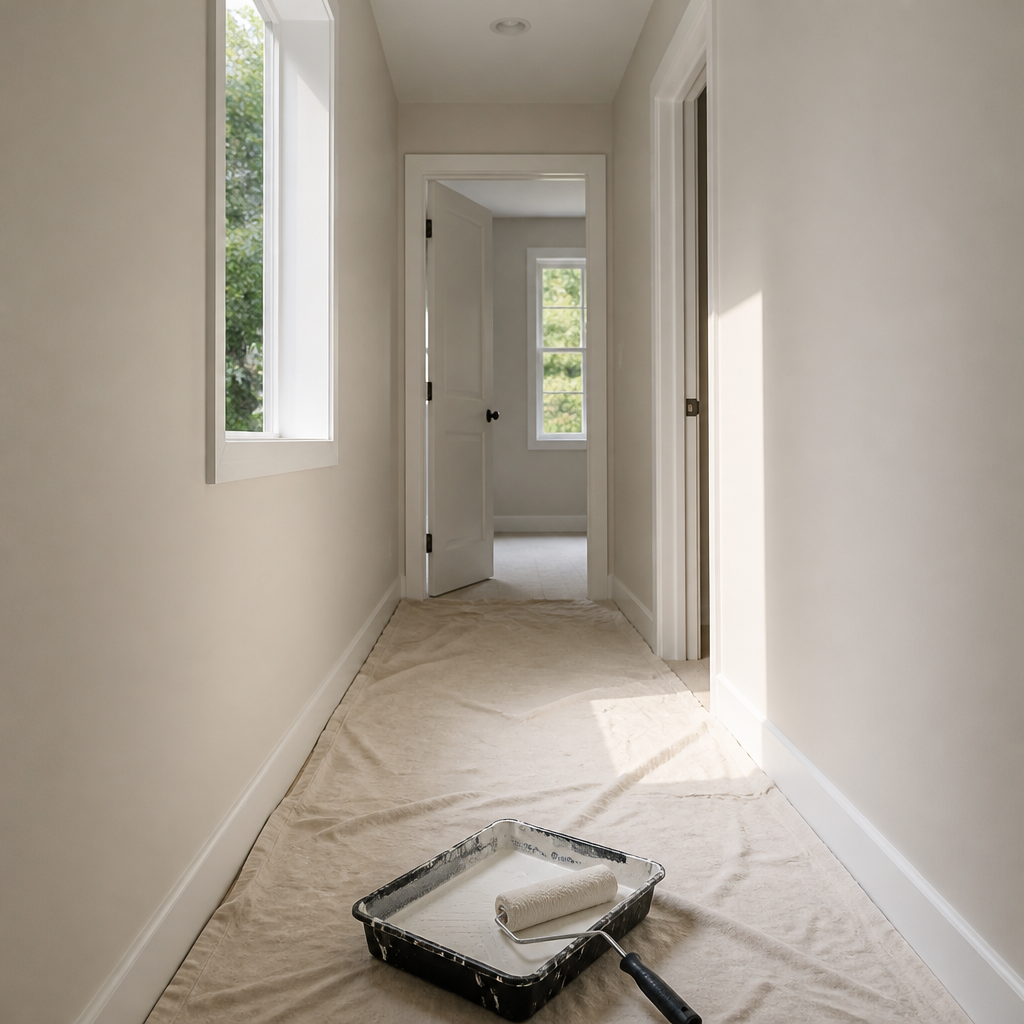
A narrow hallway with a dark wall colour can make an otherwise bright house feel like a tunnel. Staircases add to the problem with a long wall that catches light from one window and a handrail that gets touched every time someone goes up or down. The best hallway painting ideas for BC homes solve two problems at once: they make the space feel brighter, and they use a finish that survives daily wear. Below, we cover the colour and finish decisions we make most often on interior projects across Abbotsford, Langley, Surrey, and the wider Fraser Valley. That includes our work as painters in Maple Ridge.
Table of Contents
- Quick Takeaways
- Why Hallways and Staircases Need a Different Approach
- Fixing a Dark Hallway Without Starting Over
- Staircase Colour: Walls, Risers, and Handrails
- Choosing Paint Finishes for High-Traffic Hallways and Stairs
- Working in Narrow Spaces: Prep and Sequencing
- Comparing Three Hallway and Staircase Approaches
- Maintenance and Touch-Ups in Damp Coastal Winters
- Frequently Asked Questions
- References
Quick Takeaways
| Key Insight | Explanation |
|---|---|
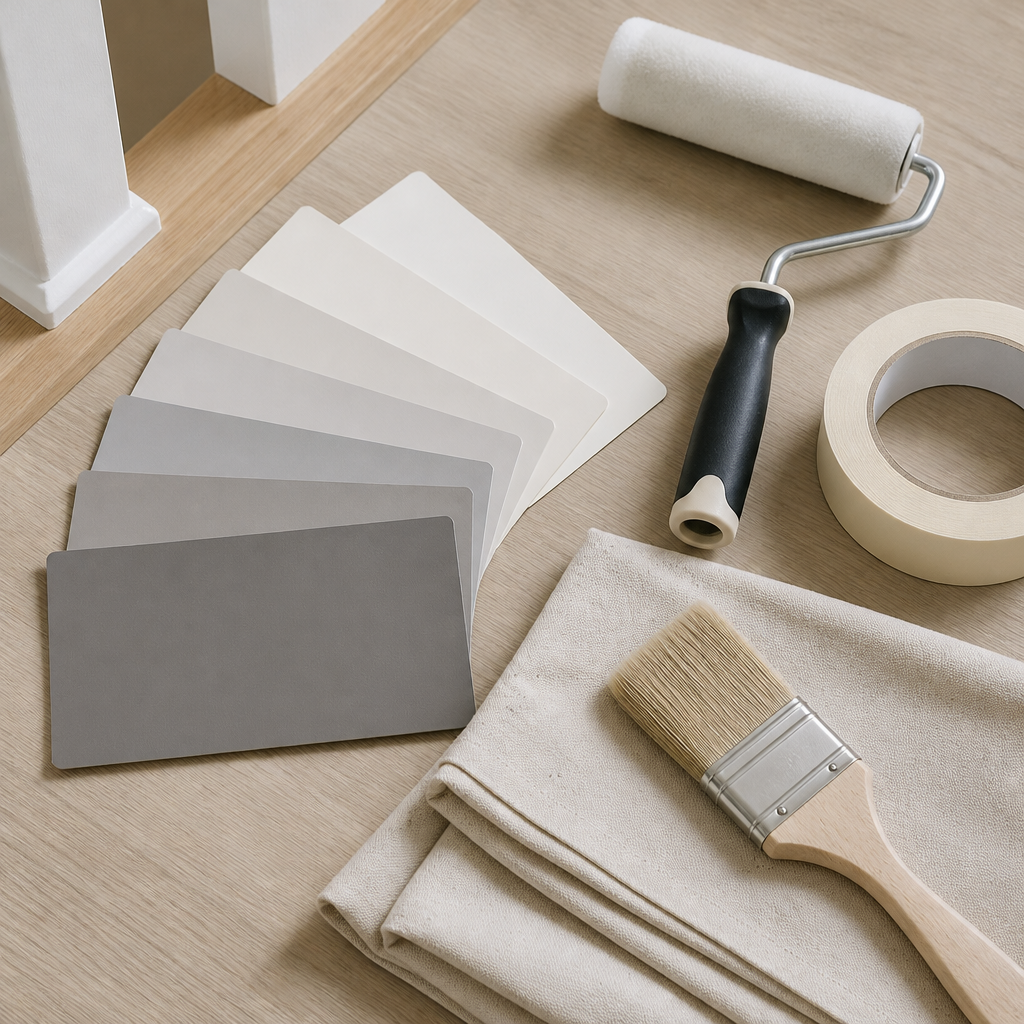
| Light reflectance matters more than the colour name | In a dim hallway, a colour’s ability to bounce light does more work than its label. Compare samples on the actual wall at the hour you walk past it most. |
| Choose a neutral that bridges adjacent rooms | Hallways and stair walls connect other rooms. Pick a neutral that works with the colours visible from the landing, not just the colour you like on its own. |
| Carry one wall colour from the lower hall up the stairwell | Changing colour mid-climb chops a tight, multi-level space into pieces. A shared colour makes the stairs look like part of the house. |
| Match sheen to contact, not to trends | Use eggshell or satin on walls that get brushed daily, and semi-gloss on trim, doors, and handrails that get touched constantly. |
| Test high-contrast trim before committing | A bright white trim over a medium or dark wall can make a narrow room look busier and smaller. Test one door frame before you paint the full run. |
| Plan the sequence before opening the can | Narrow spaces leave little room for ladders, drop cloths, and a clean exit. Decide the order of work, the masking, and where you will stand before you start. |
Why Hallways and Staircases Need a Different Approach
Hallways and staircases are connectors. They sit between rooms that were chosen for their own purpose, and they are rarely the space anyone thinks about first when picking a colour. That is why many of the halls we repaint still carry whatever was on the walls when the house was bought, often a beige or a grey from another decade. Benjamin Moore’s guidance on painted stairs makes a useful point here: neutral colours work well in connector spaces because these areas are often adjacent to rooms painted in other colours.
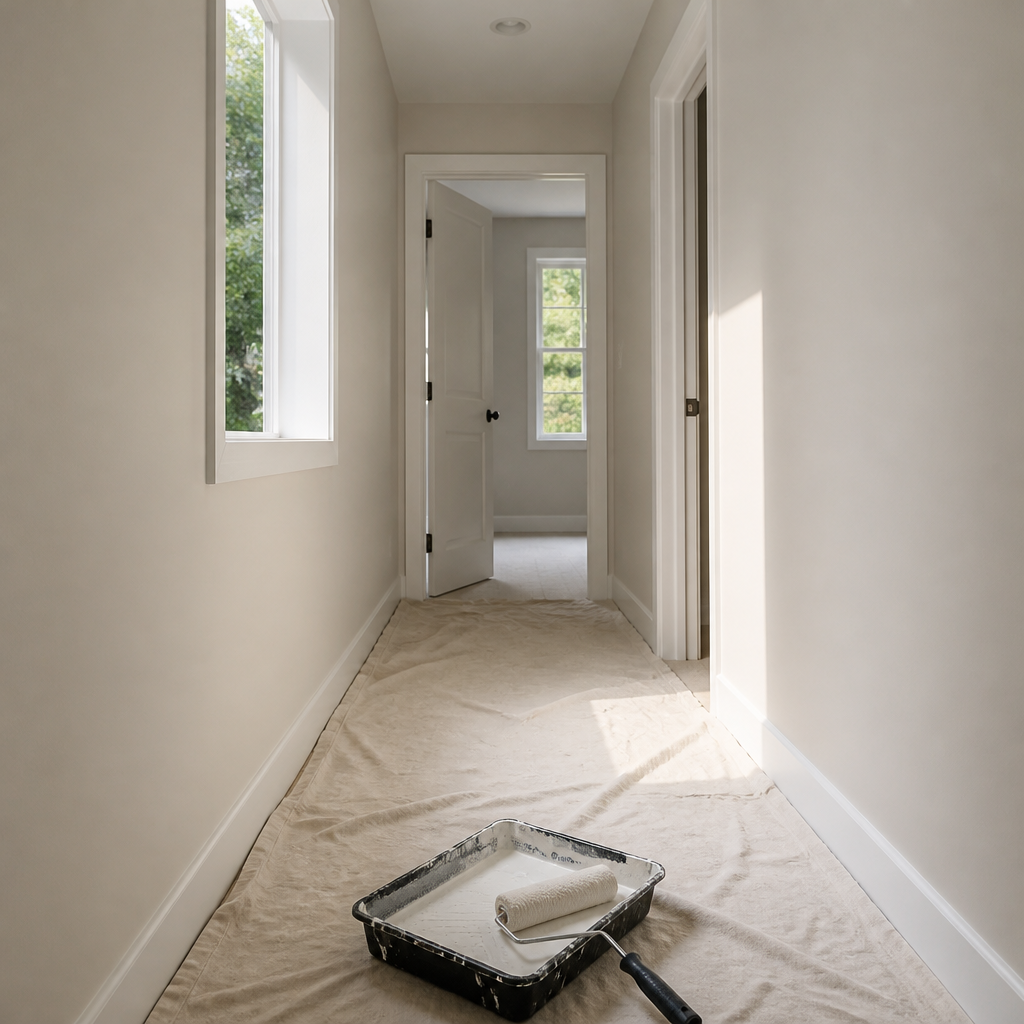
In practice, the trouble usually starts with light. A narrow hallway often has one window at one end, or none at all, and the light that reaches the walls bounces between two close surfaces. A colour that looks warm and soft on a chip under a showroom lamp can turn flat and muddy in that corridor. We ask clients to look at their samples on the real wall in the morning and again in the evening, because a colour that works at midday can go heavy and grey by dinner time. Want a second opinion on samples? See our interior house painting.
How Traffic Patterns Shape the Colour Decision
Hallways take more physical contact than almost any other room. Shoulders brush the same wall height every day, and the bottom metre absorbs backpacks, vacuum cleaners, shoe bumps, and the odd stroller. A colour that hides scuffs well is often more useful than one that looks dramatic in a sample, especially in family homes with children and pets.
This is where a pure white can disappoint. Very bright whites show every mark, and a mid-tone colour can be more forgiving. We often suggest a warm mid-light neutral for the walls, because it reads as calm, handles small marks better, and does not compete with artwork or a runner rug.
The Real Cost of Getting It Wrong
Repainting a hallway twice in three years is an expensive habit. You pay for materials, a day or two of furniture moving, and the patching that comes with taking off a colour that did not work. Spending more time on the decision at the start is almost always cheaper than fixing a wrong choice later, and it is the reason we spend time with a client on samples before we quote a finish.
Fixing a Dark Hallway Without Starting Over
Online renovation forums are full of the same question. Someone has a narrow, dim upstairs hallway, a wall colour they never liked, and no clear idea what to move to next. The honest answer is that the wall colour matters less than how it reflects light, and that the trim and ceiling often matter just as much as the main wall.
Reading Light Reflectance and Undertones
Light reflectance value gives a rough sense of how much light a colour bounces back into a room. Dark colours with low reflectance absorb light, so moving from one dark grey to a slightly deeper grey in a dim hallway is a common mistake. A step lighter, or a colour with more reflectance, usually makes a larger difference than changing the hue.
Undertones are the second trap. A grey with a green or purple undertone can look neutral under cool daylight and turn strange under warm bulbs. Check your samples under the bulbs that are actually installed, and do not assume the lighting will stay the same after you move in.
When a Brighter White Helps and When It Backfires
A brighter white on the ceiling and trim will lift a dark hallway, but a stark white over a medium or dark wall creates high contrast. In a narrow room, that contrast can make the walls look closer and the space feel busier. The approach that tends to work is to keep the wall colour in the light-to-mid range and use a warm white trim that is a step lighter than the wall, not a shock of white.
In a narrow hallway, the ceiling is the largest light source you control. Paint it as deliberately as you paint the walls.
Pro tip: Tape a large sample on the wall beside the light switch rather than on a loose board or the corner of a sheet of drywall. Look at it at the hour you will actually walk past it, with the lights on and off.
Staircase Colour: Walls, Risers, and Handrails
A staircase is several surfaces, and each one gets a different level of contact. The wall beside the stairs is seen from every angle, the risers are seen from below, and the handrail is touched constantly. Treat each surface with its own plan instead of applying one colour to everything and hoping it holds up.
The Stairwell Wall as One Shared Surface
Carrying one colour from the lower hall up the stairwell and onto the landing usually looks more finished than painting each section separately. The stairwell is one of the largest vertical surfaces in most homes, so a colour change halfway up tends to split the space in two. If you want a feature colour, place it on the landing wall or the upper hall, where it reads as a single moment rather than a stripe.
When the stairwell is open to a main living area, check how the wall colour looks from the sofa as well as from the foot of the stairs. The stair wall is often visible from several rooms at once, which is why we treat it as part of the main living palette.
Risers, Treads, and the Two-Tone Staircase
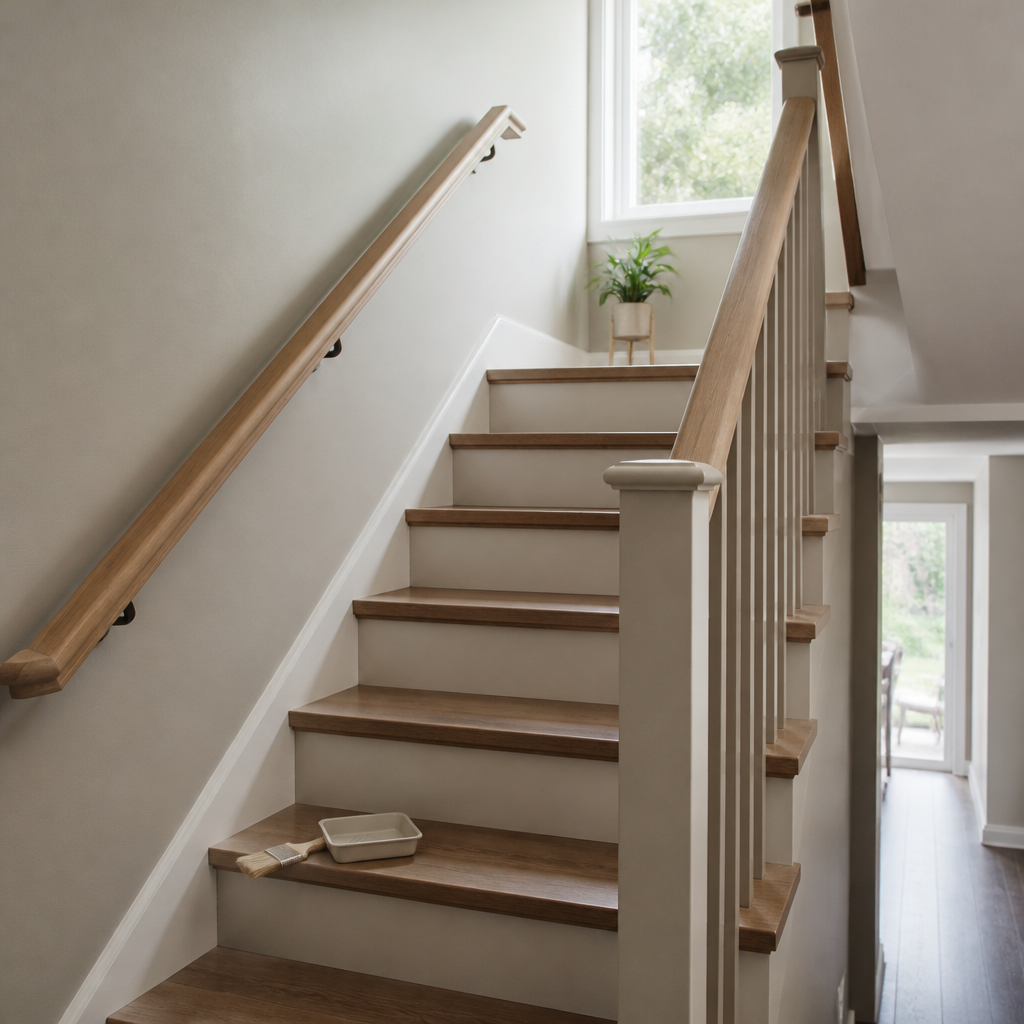
A two-tone staircase, with painted risers in a deeper shade and treads in a lighter one, is one of the most common requests we receive. It works well when the risers are closed and the trim is coordinated. Open-riser stairs with a dark colour can make each step look like a floating block, so keep the contrast gentler on those.
Treads take the most wear of any stair surface. People step on the same spot, scrape shoes on the nosing, and carry things up and down. Use a more durable finish on treads than on the riser, and keep a small tin of touch-up paint for the inevitable scuffs.
Handrails, Spindles, and Newel Posts
Handrails are where hands go, so their finish should be the most durable in the stairwell. Spindles and newel posts collect dust and can be hard to clean if the finish is too porous or too flat. A semi-gloss or satin enamel gives a surface you can wipe without leaving a dull patch, and it avoids the chalky look that flat finishes develop after repeated cleaning.
Avoid painting a handrail in a colour that matches the wall exactly. A subtle step in tone or sheen makes the handrail easier to find in dim light, which matters on a stair you climb at night.
Choosing Paint Finishes for High-Traffic Hallways and Stairs
Paint finish, also called sheen, is the most underrated decision in a hallway. Paint comes in a range from dead flat to high gloss, and the sheen controls how much light the surface reflects, how easily it cleans, and how much a scuff or fingerprint shows. Benjamin Moore’s guide to paint sheen notes that gloss paints were traditionally the default choice for trim and high-traffic areas, which is still a sound starting point.
Walls: Eggshell, Satin, or Something Else
For most hallway walls, we recommend eggshell or satin. Eggshell hides minor surface imperfections well and suits most homes with older plaster or drywall that has been patched several times. Satin cleans more easily and is our usual pick for hallways that see daily contact, especially near the front door.
Flat paint is the wrong choice in a hallway, even if it looks elegant in the showroom. It is harder to wipe down, and repeated cleaning leaves visible shiny patches. If a client wants a flat look, we usually recommend a washable low-sheen finish with the same colour instead.
Trim, Doors, and Handrails: Semi-Gloss Where It Counts
Semi-gloss is the standard for trim and doors in a busy hallway. A hallway paint marketed for busy homes, such as the Latex Emerald product from Sherwin-Williams, is described by its maker as durable enough to wipe messes without water streaking. Manufacturer claims should always be checked on a test board, but the principle holds: choose a washable enamel-type finish for anything that gets touched.
Matching Sheen Across Surfaces
Mixing sheens within the same run of wall is one of the fastest ways to make a hallway look unfinished. Under raking light from a window at the end of the corridor, a satin wall next to an eggshell wall will show lap marks and patchy reflection. Keep one sheen per surface type across the whole run, and use the trim sheen to step the eye from one room to the next.
Pro tip: Stir the paint thoroughly and open all cans for the same surface before you start. Slight differences in pigment or batch can show as stripes on a long, flat wall.
Working in Narrow Spaces: Prep and Sequencing
Narrow spaces take longer than their square footage suggests. There is no room to step back from a wall, and a ladder in a stairwell is a real hazard. Good preparation is the difference between a clean finish and a job that leaves dust and drips on the stair treads for a week afterward.
Sequencing From Ceiling to Floor
Paint the ceiling first, then the walls, then the trim, and leave the stairs for last where you can. This order keeps drips off finished surfaces. In a hallway, work in sections so you can reach a door or a light switch without walking across wet paint, and plan the route out before you start the first wall.
On stairs, we work from the top down and paint the wall before the handrail. That way, each step is painted on a clean surface, and the handrail is masked off only when the wall work is finished.
Protecting Floors, Treads, and Banisters
Tape the edges of skirting boards with a painter’s tape rated for the surface, and lay a protective runner over the stair nosing and the hallway floor. Masking a handrail takes time, but it is far cheaper than repairing a drip on the wood. Keep a second drop cloth ready for the landing, where paint tends to fall first.
Remove or protect any light fittings and door hardware before you start. Swap plates, switch covers, and door handles can be stored in a labelled bag so they go back in the right place.
Ventilation and Drying in Fraser Valley Winters
Fraser Valley winters bring damp, grey days that slow paint drying. Cold, humid air means the coat can stay tacky longer than the can suggests, and a closed hallway with no airflow holds odour and moisture. Run a fan, keep the heating steady, and avoid painting when the wall surface is cold to the touch.
Always read the minimum application temperature on the can before scheduling. If the house is cold overnight, a project planned for the weekend may need to wait for a warmer stretch.
Comparing Three Hallway and Staircase Approaches
Most hallway and staircase projects fall into one of three approaches. Each one has a clear use case and a clear trade-off, and the right choice depends on the light, the layout, and how the space is used day to day.
| Approach | Best for | Main trade-off |
|---|---|---|
| Light neutral throughout the hallway and stairwell | Narrow, dim homes with several connecting rooms | Can look plain if the trim, lighting, and artwork are not considered |
| Two-tone staircase with a deeper lower wall and lighter upper wall | Long stairwells with a clear landing and good natural light | The darker lower wall shows scuffs faster, so it needs a washable finish |
| Feature colour on the landing or upper hallway only | Homes where the hallway is a visible transition into a main living room | The feature colour must work with every room visible from the landing |
For most Lower Mainland homes, our default recommendation is the first approach with one deliberate feature moment on the landing. It keeps the connecting spaces calm, and it gives the owner a single place to express personality without making the stairs feel divided.
The two-tone approach is worth the effort when the stairwell is generous and well lit. In a dim stairwell, a deep lower wall can make the whole space feel smaller, so we only recommend it when the light supports it.
Maintenance and Touch-Ups in Damp Coastal Winters
Lower Mainland homes deal with wet boots, umbrellas, and school bags for much of the year. The hallway near the entry door takes the worst of it, and moisture carried in on shoes and coats can gather at the base of the walls and along the stair nosing.
Entry Hallways and Mudroom Transitions
The first metre inside the front door takes more abuse than the rest of the hallway. Use a more washable finish in that zone, and consider a slightly deeper lower wall that hides marks from shoes and bags. Keep the rest of the hallway in the lighter colour so the entry does not feel like a separate room.
If the entry opens directly into a mudroom or a laundry area, match the finish across the transition. Changing sheen at a doorway is an easy way to make the hallway look patched.
A Simple Touch-Up Schedule
Plan a light clean every spring with a soft cloth and a mild cleaner, and check the stair nosing and handrail once a year for scuffs. Repaint the hallway when marks no longer come off with a damp cloth, which usually happens sooner in households with children or large dogs.
Keep a labelled container of each paint with the colour name, sheen, and date on the lid. When a scuff appears two years later, a matching touch-up is much easier when you know exactly what was used.
Pro tip: Store a small amount of paint in a clean, sealed jar, not the original can, and write the sheen on the lid. Paint that has been in a large can for years can thicken or separate, and a fresh jar is easier to use for small repairs.
Frequently Asked Questions
What colour works best for a narrow, dark hallway in a BC home?
A warm, light-to-mid neutral on the walls usually works best, paired with a ceiling white that has a warm undertone. Trim should be one step lighter than the wall rather than a stark white, which keeps the space bright without making it feel busy. Always test the colour on the real wall under the lights you have installed.
Should the staircase be painted the same colour as the upstairs hallway?
In most homes, yes. A shared wall colour from the lower hall up the stairwell and onto the upper hallway makes the space feel connected and avoids a choppy look. A feature colour can be added on the landing if the owner wants one.
What sheen should I use on hallway walls?
Eggshell or satin is the best choice for most hallway walls. Eggshell suits older walls with minor imperfections, while satin cleans more easily and handles daily contact better. Flat finishes should be avoided in high-traffic hallways because they are harder to wipe clean.
Is semi-gloss too shiny for handrails and trim?
Semi-gloss is the standard choice for handrails, doors, and trim because it can be wiped down without damaging the surface. If the shine feels too strong in your home, a satin enamel gives a softer look while keeping much of the washability. The key is to use an enamel-type finish rather than a standard wall paint on anything that gets touched.
How long should I wait before putting furniture and rugs back in a freshly painted hallway?
Wait until the paint is dry to the touch before moving furniture back against the walls, and wait longer before scrubbing or rubbing the surface. Paint continues to cure after it dries, and a freshly painted wall can mark more easily during that period. Check the manufacturer’s recoat and cure times on the can, since they vary by product and by the temperature and humidity in the house.
Have you painted a narrow hallway or stairwell in your own home, and which finish held up best for your household? Share your experience in the comments below.
References
- Paint colour ideas for brightening a dark hallway or staircase
- Painted staircase ideas and colour inspiration from a paint manufacturer
- Guide to choosing paint sheen and finish levels
- Hallway paint colour ideas and durable hallway paint options

