
Most Vancouver homeowners underestimate how long an interior painting project actually takes. They picture a weekend job and end up with half-painted walls, furniture pushed into hallways, and a week of disruption they never planned for. The truth is that a realistic interior painting timeline in Vancouver depends on far more than brush speed. Prep work, drying time between coats, and the sheer scale of Lower Mainland homes all factor in. This guide breaks down exactly what to expect, room by room and project by project, so you can plan without surprises.
Table of Contents
- Quick Takeaways
- What Drives Painting Project Duration in the Lower Mainland
- Room-by-Room Timeline Breakdown
- DIY vs. Professional Painting: A Realistic Timeline Comparison
- Prep Work: The Part Everyone Ignores
- How Fraser Valley Conditions Affect Drying Time
- Full Home Interior Painting Timeline: What a Real Project Looks Like
- Frequently Asked Questions
- References
Quick Takeaways
| Key Insight | Explanation |
|---|---|
| A single average bedroom takes 4 to 8 hours | This includes two coats of paint plus proper drying time between coats. Most DIYers stretch this to two days. |
| Prep work is 30 to 40 percent of the total job | Filling holes, sanding, taping, and priming take as long as actual painting. Skipping them shows immediately. |
| Professional crews finish 3 to 4 times faster than DIY | Experienced painters work efficiently in teams, reducing a 5-day DIY job to 1 to 2 days in most cases. |
| Lower Mainland humidity can add a full day of drying time | In fall and winter, coastal humidity slows latex paint curing significantly. Ventilation and heating help but cannot fully compensate. |
| Cabinet refinishing takes longer than most walls | Proper cabinet refinishing requires degreasing, sanding, priming, and multiple thin coats. A standard kitchen takes 3 to 5 days minimum. |
| A full home interior repaint averages 5 to 10 business days | For a 2,000 to 2,500 sq ft home in Surrey, Abbotsford, or Langley, a professional team typically completes the project within two working weeks. |
| Color changes and dark-to-light transitions add time | Switching from a deep charcoal to bright white often requires an additional coat of primer and a third finish coat. |
What Drives Painting Project Duration in the Lower Mainland
The single biggest driver of painting project duration is not the size of the room. It is the condition of the surfaces being painted. Homes in Abbotsford and Langley that have not been repainted in eight to twelve years almost always require more prep time than the paint itself. Cracks in drywall, nail pops, and scuffed baseboards all need attention before a brush touches the wall.
The second major factor is the number of coats required. A common mistake homeowners make is assuming one coat of premium paint will do the job. In practice, two coats of finish paint over a properly primed surface is the minimum for a result that holds up and looks professional. Dark color changes typically require three coats total.
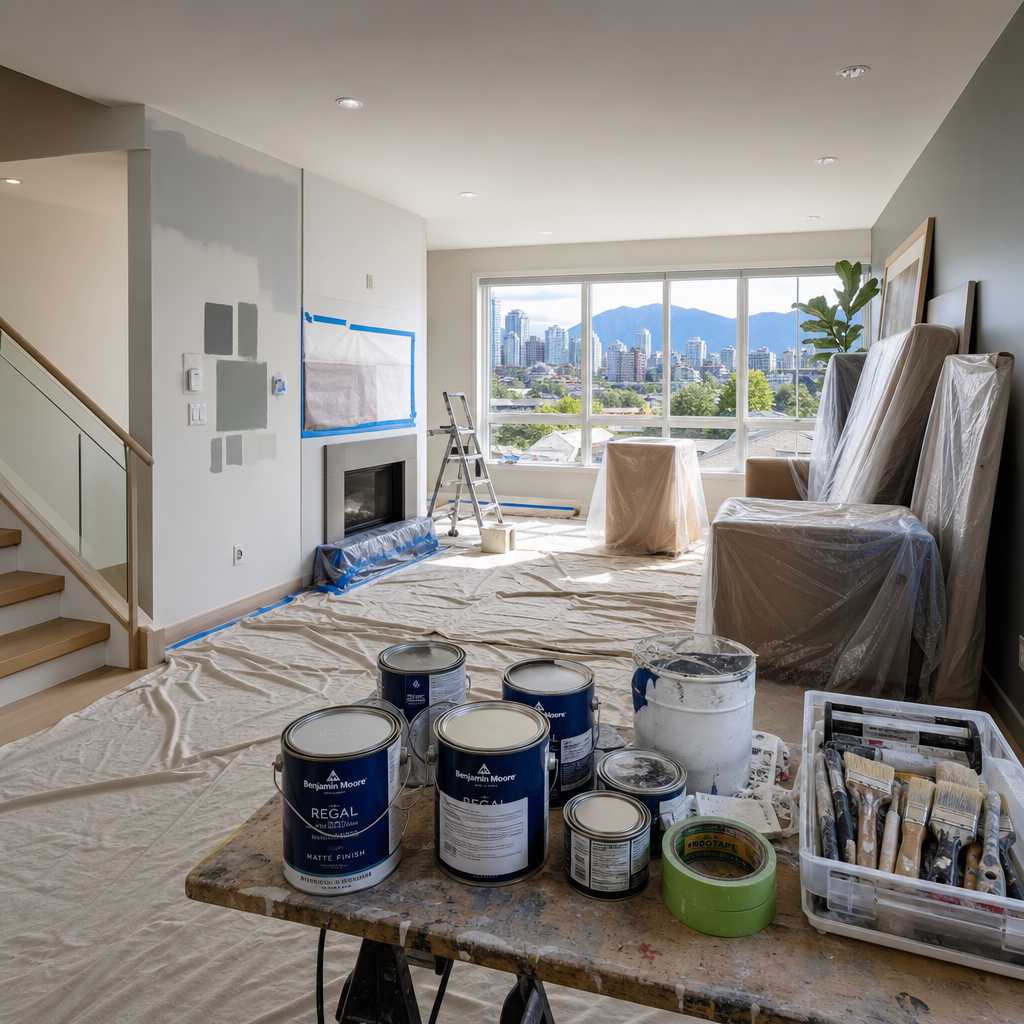
Furniture and room contents also matter more than most people admit. Moving, protecting, and later returning furniture adds hours to any project. A professional crew factors this into their schedule. A DIYer typically does not.
Square Footage vs. Complexity: Which Matters More
A 200 sq ft bedroom with smooth walls and no trim is faster to paint than a 150 sq ft bathroom with intricate wainscoting, a window, and three different surface types. Square footage is a rough guide, but surface complexity is the more accurate predictor of time.
Homes in older Fraser Valley neighborhoods often have textured ceilings, wood paneling, or crown molding that significantly increases cutting-in time. Cutting in around edges is one of the slowest parts of any interior painting job, and it cannot be rushed without visible results.


Room-by-Room Timeline Breakdown
These are realistic time estimates based on professional crews working in standard Lower Mainland homes. DIY timelines should generally be doubled for anyone without significant painting experience.
Bedrooms and Living Rooms
A standard bedroom, roughly 150 to 200 sq ft with one window and a closet, takes a professional painter approximately 4 to 6 hours including two coats and drying time. A master bedroom with a vaulted ceiling or accent wall adds 2 to 3 hours.
Living rooms are consistently the most time-intensive single rooms in a home. Open floor plans common in newer Surrey and Langley builds can have 400 to 600 sq ft of wall surface. Expect 8 to 14 hours for a living room, dining area combination including trim and ceiling work.
Kitchens and Bathrooms
Kitchens without cabinet refinishing take 6 to 10 hours for walls and trim. The challenge is the number of interruptions: tile backsplash edges, appliance gaps, and tight corners around cabinetry all slow the cutting-in process.
Bathrooms are deceptively slow. A small bathroom of 50 sq ft can take 4 to 6 hours because nearly every surface edge requires precise cutting-in. Moisture-resistant primers add a mandatory drying stage as well.
Hallways and Stairwells
Hallways and stairwells are the most underestimated spaces in any home. The awkward angles, height requirements, and continuous trim work make them disproportionately time-consuming. A typical two-story stairwell takes a professional crew 6 to 10 hours depending on ceiling height and trim complexity.
DIY vs. Professional Painting: A Realistic Timeline Comparison
This is where most homeowners get their planning wrong. A DIY interior painting project almost always takes two to three times longer than anticipated, and the quality gap typically means redoing sections during or after the project.
| Project Scope | DIY Estimated Duration | Professional Crew (Dreamscape Painting) |
|---|---|---|
| Single bedroom | 2 to 3 weekends (broken sessions) | 1 day including prep and cleanup |
| Full main floor (kitchen, living, dining) | 2 to 4 weeks | 3 to 5 business days |
| Full home interior (2,000 to 2,500 sq ft) | 6 to 10 weeks of weekends | 7 to 10 business days |
| Kitchen cabinet refinishing | 10 to 14 days (curing included) | 3 to 5 business days |
| Single bathroom | 2 to 4 days | 1 day |
The professional advantage is not just speed. It is also continuity. A professional crew does not stop mid-project because of a workweek or a rainy Saturday. They finish, which means your home returns to normal faster and with less cumulative disruption.
“The real cost of a DIY paint job is not the materials. It is the six weeks of living in a construction zone while the project slowly gets finished.” Based on contractor feedback collected across residential painting markets in British Columbia.
Pro tip: When getting quotes from painting companies in the Lower Mainland, ask specifically how many painters will be on-site each day. A single painter working alone has a dramatically different timeline than a two or three-person crew, even if the quoted price is similar.
Prep Work: The Part Everyone Ignores
In practice, prep work is where quality is either built or lost. Dreamscape Painting has been doing this for over 35 years, and the difference between a five-year finish and a one-year finish almost always comes down to what happened before the paint went on.
A thorough prep process for a standard room includes wiping walls with TSP substitute solution, filling all holes and cracks with the appropriate filler, sanding smooth, spot-priming repaired areas, and applying painter’s tape to all trim, ceilings, and hardware. This alone takes 1.5 to 2.5 hours for a standard bedroom.
Priming: When It Is Not Optional
Many homeowners try to skip priming to save time. This is a false economy. New drywall must be primed, period. Stained walls require stain-blocking primer. Any surface going from a dark color to a light color needs a full coat of high-hide primer or the final result will be uneven and require additional finish coats.
Skipping primer on a dark-to-light color change can add two additional finish coats to achieve even coverage, which actually takes longer than simply priming correctly from the start. Primer also dries significantly faster than finish paint, so it does not add as much time to the project as most homeowners assume.

Surface Repairs and Their Impact on Schedule
Older homes in Abbotsford and the eastern Fraser Valley frequently have settlement cracks, particularly around door frames and window corners. Small hairline cracks fill quickly, but larger structural cracks require mesh tape, compound, drying time, a second coat of compound, more drying, and sanding before paint can go on. This can add a full day to a project that the homeowner did not anticipate.
Water damage stains require a shellac-based or oil-based stain-blocking primer, which takes 45 minutes to an hour to dry before painting over. Identifying and treating these areas at the start of the project rather than discovering them mid-paint is part of what a professional estimate process does correctly.
How Fraser Valley Conditions Affect Drying Time
The Lower Mainland’s climate is one of the most important variables in any interior painting timeline. Between October and March, ambient humidity in homes across Surrey, Langley, and Abbotsford can easily exceed 60 to 70 percent, even indoors. Latex paint requires humidity below 50 percent for ideal curing.
At high humidity, the recoat window for latex paint extends from the standard 2 to 4 hours to 5 to 8 hours. This effectively cuts a crew’s productive painting time in half on a wet winter day without supplemental dehumidification or heating.
What Professional Painters Do Differently in Winter
Experienced painting crews in the Lower Mainland use portable dehumidifiers and supplemental heat in rooms where humidity is elevated. They also sequence their work strategically, painting one room while another dries, rather than treating each room as an isolated project. This parallel sequencing is something a solo DIYer simply cannot replicate.
Pro tip: If you are scheduling a full home repaint in the Fraser Valley, spring and early summer offer the best conditions for fast drying and smooth curing. Scheduling your project between April and June can shave one to two days off the total timeline compared to a November project in the same home.
Full Home Interior Painting Timeline: What a Real Project Looks Like
A realistic interior painting timeline for a 2,200 sq ft home in Langley or Surrey with three bedrooms, two bathrooms, a main floor living and dining area, and a kitchen looks like this when completed by a professional crew of two to three painters.
Day one is dedicated to prep throughout the entire home. All furniture is moved and protected, surfaces are washed, repairs are made, and primer is applied to any areas that require it. This is a full eight-hour day even before paint touches the walls.
Days two and three cover the main floor. The living room, dining room, and kitchen walls receive their first coat, followed by drying time, followed by the second coat. Ceilings are typically completed first to allow any drips onto walls to be covered by the subsequent wall coats.
Days four and five address all bedrooms and hallways. The more bedrooms in the home, the more this phase extends. A five-bedroom home in Abbotsford adds roughly one additional day to this phase.
Days six and seven are reserved for bathrooms, trim, doors, and any detail work throughout the home. Trim and doors are often painted last because they take careful finishing and are easily scuffed during other phases of the project.
Cleanup and final walkthrough happen on the last day. A company like Dreamscape Painting, which has built its reputation over 35 years on cleanliness and attention to detail, treats the final walkthrough as a non-negotiable quality check, not an afterthought.
Frequently Asked Questions
How long does it take to paint a two-bedroom apartment in Vancouver?
A two-bedroom apartment of approximately 800 to 1,000 sq ft takes a professional two-person crew roughly 2 to 3 days including prep, two coats of paint on walls, ceiling, and trim, and cleanup. A solo DIYer should budget 2 to 3 weekends to achieve a comparable result.
Can a professional painter complete a single room in one day?
Yes, in most cases. A professional painter can complete a standard bedroom, including full prep, two coats of wall paint, and touch-ups to trim, within a single 8-hour workday. Rooms with heavy repairs, color changes from dark to light, or complex architectural features may require a partial second day.
How long should I wait between coats of interior paint?
For most latex paints used in residential projects, the recoat window is 2 to 4 hours under ideal conditions (temperature of 18 to 25 degrees Celsius and humidity below 50 percent). In a typical Lower Mainland winter, plan for 4 to 6 hours between coats. Always follow the manufacturer’s specific recoat instructions, as premium paints sometimes require longer windows for full adhesion.
Does cabinet refinishing take longer than repainting walls?
Per square foot, cabinet refinishing takes significantly longer than wall painting. Cabinets require degreasing, scuff-sanding, priming with an adhesion primer, and multiple thin topcoats with sanding between coats for a smooth factory-like finish. A standard kitchen with 15 to 20 cabinet doors and drawer fronts takes 3 to 5 full days when done properly. Shortcuts in cabinet refinishing show immediately and tend to peel within a year.
Will I need to leave my home during interior painting?
For most interior repaints using low-VOC latex paints, you do not need to vacate your home. Rooms being actively painted should be avoided while paint is wet and drying. However, oil-based products, shellac primers, and high-VOC coatings require better ventilation and a temporary absence from the painted area, particularly for households with young children, elderly individuals, or those with respiratory sensitivities.
What is the most common reason an interior painting project takes longer than expected?
Undiscovered surface issues are the single most common cause of project delays. Water stains behind furniture, mold on bathroom ceilings, and drywall damage around windows often only become visible once prep work begins. A thorough in-home estimate by an experienced estimator, like those at Dreamscape Painting, can identify most of these issues in advance and build them into the project timeline and quote.
If you have recently gone through an interior repaint in the Fraser Valley or Lower Mainland, share how long your project actually took versus what you expected. Your experience helps other homeowners plan better.
References
- National Research Council Canada: Building performance and indoor environment standards relevant to painting and coatings
- Health Canada: Guidance on VOC exposure and indoor air quality during home renovation projects
- Forbes Home: Cost and timeline data for residential interior painting projects across North America
- Statista: Canadian home renovation market size and spending trends for painting and decorating services
- New Home Buyer’s Protection Office: British Columbia homeowner renovation standards and contractor expectations

