

Paint sheen cleanability is one of the most practical considerations in a family repaint, yet many households in British Columbia select a finish based on the color swatch alone. In Abbotsford, Langley, Surrey and across the Lower Mainland, homes with young children and pets place constant demands on walls, doors and trim. The finish determines how well those surfaces tolerate fingerprints, scuffs and repeated cleaning. This guide explains how sheen affects cleanability, which finishes perform best in high-contact areas, and where a lower-sheen finish remains the appropriate choice. The recommendations reflect the work Dreamscape Painting Ltd. carries out in family homes throughout the Fraser Valley.
Table of Contents
- Quick Takeaways
- What Paint Sheen Measures and Why It Affects Cleaning
- The Sheen Scale From Flat to High Gloss
- Scrubbability and Cleaning Frequency in Family Homes
- Hallways, Stairwells and Children’s Rooms
- Pet Households: Lower Walls, Doors and Baseboards
- Comparing Finish Options for Family Spaces
- Cleaning Methods and Product Selection
- Application Quality, Priming and Cure Time
- Frequently Asked Questions
- References
Quick Takeaways
| Key Insight | Explanation |
|---|---|
| Sheen controls both durability and visibility | Higher sheen tolerates scrubbing better but also shows fingerprints, roller marks and surface flaws more clearly under daylight and ceiling fixtures. |
| Eggshell suits most living areas | A light sheen offers reasonable washability for living rooms, dining rooms and bedrooms without the glare associated with semi-gloss. |
| Satin or pearl belongs in hallways and kitchens | Walls that receive daily contact from shoulders, backpacks and hands benefit from a finish that withstands repeated cleaning. |
| Flat finishes are limited to low-contact surfaces | Ceilings and rarely touched walls are the appropriate uses. Flat walls near floor level in pet households are difficult to clean without marking the surface. |
| Test the cleaning routine on a sample board | Paint a board, allow the full cure period, and scrub it with the household cleaner before committing an entire room. |
| Check the product data sheet rather than the sheen name | Sheen names are not standardized across manufacturers, so the technical data sheet provides a more reliable basis for comparison. |
What Paint Sheen Measures and Why It Affects Cleaning
Sheen describes how much light a painted surface reflects. Benjamin Moore’s published guidance on paint finishes defines sheen as a measure of how much light reflects off a painted surface, which results in gloss or a lack thereof. That reflectivity is a visual property, but it is closely linked to the physical structure of the paint film, and that structure determines how the surface behaves under cleaning.
Cleanability depends on two properties: how well the film resists abrasion during scrubbing, and how easily soil releases from the surface. Lower-sheen paints contain a higher proportion of pigment and extenders relative to binder. The resulting film is more textured at a microscopic level, which can hold soil and resist vigorous scrubbing. Higher-sheen paints form a denser, smoother film that releases marks more readily.
How Film Density Influences Scrubbing
A denser film generally withstands repeated wiping without losing its surface. In family homes, the practical result is that a finish designed for scrubbing can be cleaned more often before its appearance deteriorates. Cleaning a flat wall too aggressively may leave a dull or polished patch, which is visible under side lighting and is difficult to correct without repainting the area.
The reverse is also true. A smooth, dense finish releases most marks with a damp cloth, but it reveals the underlying wall condition more clearly. Patching, sanding and priming therefore carry more weight on higher-sheen walls.
Why Lighting Changes What Families Notice
Higher sheen reflects more light, so fingerprints, scuffs and handprints are more visible under ceiling fixtures and large windows. A finish that appears clean in the showroom may show marks in a hallway lit by a single window at the end of the day. Assessing sheen under the actual lighting of the room is a more reliable method than judging a sample card under store lighting.
Pro tip: Evaluate a sample board in the room where it will be used, at the time of day when the household is most active. Morning light and evening lamp light produce different results, and marks that are invisible in one may be obvious in the other.
The Sheen Scale From Flat to High Gloss
Benjamin Moore lists seven key interior paint finishes: flat, matte, eggshell, pearl, satin, semi-gloss and high gloss. These finishes range from no shine to high shine, and each sits at a different point on the trade-off between appearance and washability. Understanding where each one falls on that scale makes room-by-room decisions more straightforward.
Sheen is not a standardized measure across all manufacturers. A satin from one product line may differ noticeably from a satin in another. For this reason, the technical data sheet and the manufacturer’s stated scrub performance should be consulted alongside the finish name.
Flat and Matte: Low-Contact Surfaces Only
Flat and matte finishes have the lowest reflectivity and the most limited washability. Benjamin Moore’s guidance places flat finishes on ceilings and walls in low-traffic spaces, and matte finishes on walls in living rooms, dining rooms and bedrooms. In family homes, flat paint is best confined to ceilings and rarely touched walls.
A common mistake is selecting flat paint for a child’s bedroom because it hides wall imperfections. The concealment benefit is real, but the cost appears within months, when crayon, adhesive and hand contact accumulate in the lower wall zone and cannot be removed without affecting the surface.
Eggshell and Pearl: The Practical Middle Ground
Eggshell offers a light sheen that handles routine wiping in living areas. Pearl sits slightly higher on the scale and is listed by Benjamin Moore for high-traffic walls, trim, doors and cabinets. For most family living rooms, eggshell provides an appropriate balance, while pearl is more suitable for walls that receive regular contact.
The difference between these two finishes is most noticeable on busy walls beside stairs and entryways. Pearl tolerates more frequent cleaning, but it also reflects more light, so surface irregularities that were acceptable in eggshell may become apparent.
Satin, Semi-Gloss and High Gloss: Durable but Revealing
Semi-gloss and high-gloss finishes offer the highest washability among interior options. Benjamin Moore recommends semi-gloss for trim, doors, cabinets and wainscoting, and high gloss for trim, doors, cabinets and architectural details. These finishes withstand repeated scrubbing, but they highlight every imperfection in the substrate, including roller texture and patch edges.
These finishes are most effective when the surface is prepared carefully. A high-gloss door with a rough patch will display that patch more clearly than a flat wall would, so surface preparation takes priority over the finish selection.
Scrubbability and Cleaning Frequency in Family Homes
Cleanability has practical meaning only when it is measured against how often a surface must be cleaned. A household with two toddlers and a large dog will clean lower walls far more often than a household with adult occupants and no pets. The appropriate finish is the one that tolerates the actual cleaning frequency of the home without visible deterioration.
In our experience, many families underestimate the frequency of cleaning in the first two years after a repaint. The finish is typically judged on its appearance after application, while its long-term performance depends on the weekly routine that follows. The most reliable approach is to match the finish to the highest-contact area of each room, rather than selecting one sheen for the entire house.
How Often Families Clean Specific Zones
Lower walls beside doorways, light switches and stair rails typically require the most frequent attention. These zones collect handprints, shoe marks and dust that becomes sticky in humid conditions. Upper walls and ceilings require far less cleaning, which is one reason flat finishes perform acceptably in those locations.
Kitchens and bathrooms require a separate assessment. Splash zones near sinks and cooking surfaces need a finish that resists moisture and repeated cleaning, while walls farther from the source may be suitable for a lower sheen.
Stains That Test a Finish
Crayon, marker, juice, tomato sauce and muddy footprints are the stains most often encountered in family homes. A finish that resists these marks is not only easier to clean, but also easier to restore without leaving a shadow or dull patch. Testing these specific stains on a sample board is a more informative exercise than testing with a generic household stain.
Some stains require solvents or more abrasive cleaning. Repeated use of stronger methods can alter the finish, so the test should include the method that would realistically be used on the wall, not only the gentlest option.
Hallways, Stairwells and Children’s Rooms
Entry hallways and stairwells receive the heaviest combined contact in most family homes. Shoulders brush the walls, backpacks and strollers scrape the lower zones, and handprints accumulate near light switches and banisters. These areas are where a durable finish provides the clearest return on investment, and where a flat or matte finish most often fails.
For Fraser Valley homes, rainy seasons increase the amount of tracked-in dirt and wet footwear in entryways. The combination of moisture and soil makes regular cleaning more important, and it also increases the need for a finish that can be wiped without damage.
Entry Hallways and Stairwell Walls
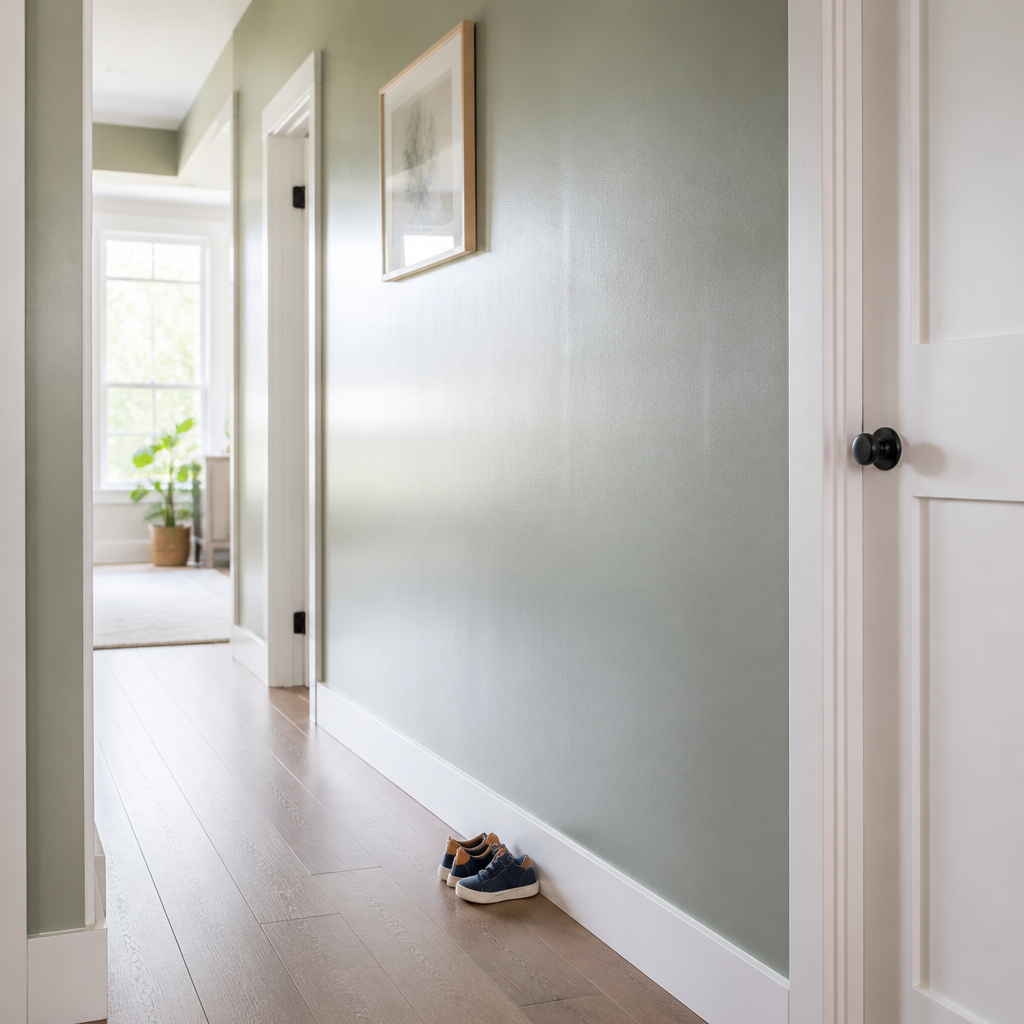
A satin or pearl finish is usually the most practical choice for hallway walls. It resists repeated cleaning and releases most marks with a damp cloth, while remaining less reflective than semi-gloss. Stairwells that feature large open expanses may benefit from a slightly higher sheen where light enters from above, provided the substrate has been prepared carefully.
Corners and wall edges are the most exposed points. Applying a durable finish to the full wall, rather than only to the lower section, produces a more uniform appearance after cleaning and avoids a visible break in sheen.
Children’s Bedrooms and Play Areas
Children’s bedrooms present a different pattern. The main sources of wear are adhesive, sticker residue, crayon and repeated contact with bed frames and toys. Eggshell is suitable for the upper walls of most bedrooms, while pearl or satin is a better option for the lower zone near beds and play furniture.
Play areas that involve paint, glue or craft materials should use a finish that tolerates solvent-free cleaning. Choosing a more durable finish in these rooms reduces the frequency of spot repainting, which is often more disruptive than the original project.
Pet Households: Lower Walls, Doors and Baseboards
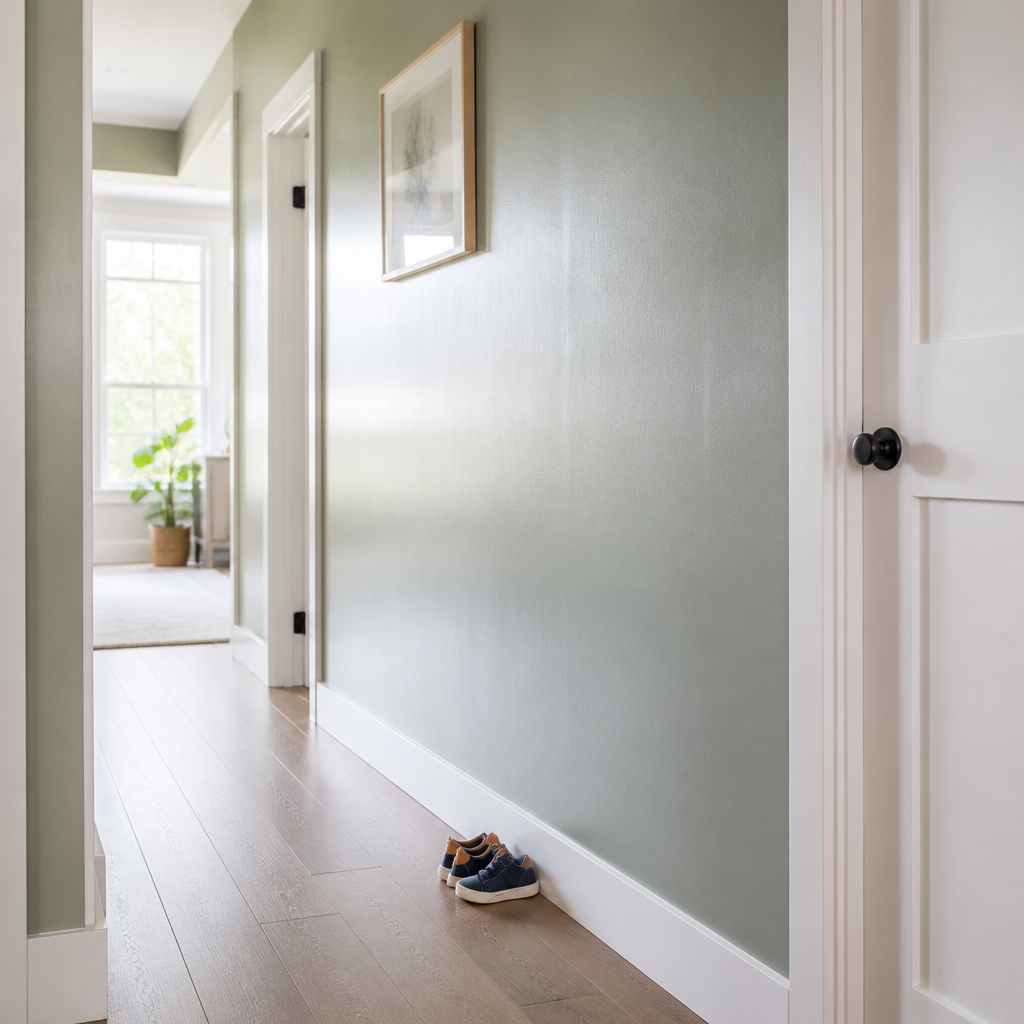
Pets introduce a different set of cleaning challenges. Dogs and cats brush against walls at shoulder and paw height, leave nose prints on doors and produce hair, dander and moisture that settle near baseboards. Finish selection in pet households should focus on the lower half of the room and on frequently touched surfaces such as door frames.
A community discussion on a home painted in flat or matte finish with three young children and a dog illustrates the problem clearly. Flat walls in that setting are quick to look worn in lower zones, even when cleaned carefully. The sheen is not the only factor, but it determines how the surface responds to the cleaning that is inevitable in a pet household.
Lower Wall Zones and Paw Contact
The lower 90 centimetres of a wall in a pet household receives the most contact from paws, tails and the sides of furniture. A satin or pearl finish in this zone tolerates regular wiping and releases hair and dust more readily than a flat finish. Above that zone, eggshell or matte finishes remain appropriate for most rooms.
Some households use a two-sheen approach, applying a more durable finish to the lower wall and a lighter finish above. This method requires careful planning of the transition line, because a visible break in sheen can appear when the wall is viewed from an angle.
Doors, Frames and Baseboards at Nose Height
Doors and frames collect nose prints, hand marks and pet hair. Semi-gloss is commonly used on these surfaces because it withstands frequent cleaning, and Benjamin Moore’s guidance lists semi-gloss and gloss finishes for doors and trim. The trade-off is that these surfaces display every mark, so consistent cleaning is part of the maintenance routine.
Baseboards are often overlooked in planning. They receive scuffs from vacuums, toys and pet bowls, and they are cleaned less frequently than walls. A semi-gloss finish on baseboards provides an effective balance of washability and durability in pet homes.
Pro tip: Ask the painter to finish door edges and frames with the same product as the trim, rather than matching the wall finish. Door edges receive the most contact, and a durable finish on those edges prevents early wear that would otherwise require touch-up work.
Comparing Finish Options for Family Spaces
The three finishes most often recommended for family interiors are eggshell, satin or pearl, and semi-gloss. Each offers a different balance of appearance and cleanability. The table below summarizes how each performs under typical family use and where it is most suitable.
| Finish | Cleaning Performance | Best Placement in Family Homes |
|---|---|---|
| Eggshell | Light sheen that handles routine wiping and gentle cleaning. Less tolerant of aggressive scrubbing. | Living rooms, dining rooms, bedrooms and family rooms with moderate contact |
| Satin or Pearl | Noticeably more durable than eggshell. Tolerates repeated scrubbing and releases most household stains with a damp cloth. | Hallways, high-traffic walls, lower wall zones in pet homes, cabinets and kitchen walls outside splash areas |
| Semi-Gloss | Most scrub-resistant of the three. Reveals surface imperfections and roller texture more clearly. | Trim, doors, door frames, baseboards, cabinets and wainscoting |
Eggshell is the most balanced option for general living areas, but it is not the right choice for every wall in a home with children. Satin or pearl is the most practical default for high-contact walls, while semi-gloss is best reserved for trim and doors where the surface can be prepared to a high standard.
Cleaning Methods and Product Selection
The finish is only part of the cleanability equation. The cleaning method determines whether the surface retains its appearance over time. Abrasive powders, harsh solvents and stiff brushes can dull or burnish even durable finishes, which then show marks more readily.
A mild liquid dish soap diluted in warm water, applied with a soft cloth, is an appropriate starting method for most painted surfaces. Stronger methods should be introduced only when a stain cannot be removed by gentle cleaning, and they should be tested first on an inconspicuous area.
Choosing Cleaners Without Dulling the Surface
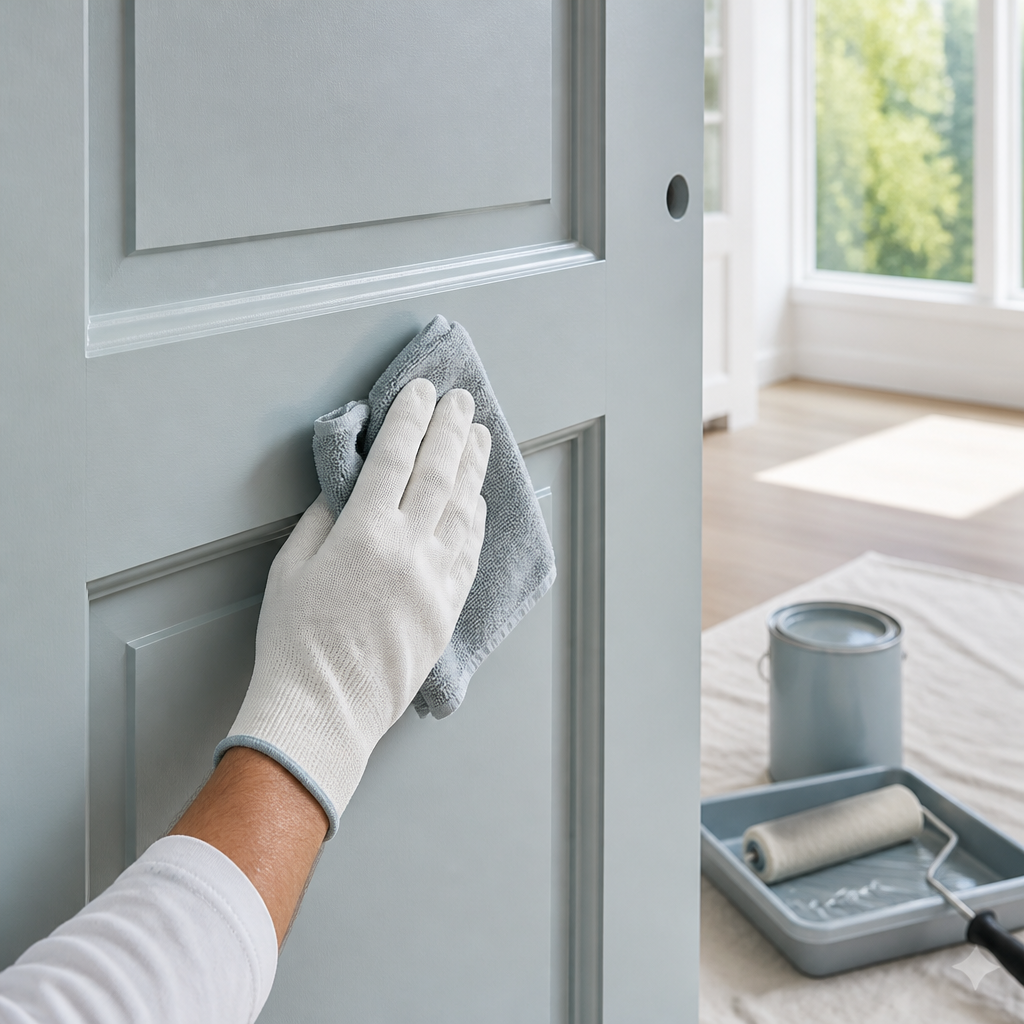
Avoid cleaners that contain abrasive particles or high concentrations of alkaline or solvent ingredients on painted walls. Use a damp microfiber cloth for routine cleaning, and rinse the surface with clean water after applying any cleaner to prevent residue. Clean in straight, light strokes rather than circular scrubbing, which can leave visible patterns on higher-sheen surfaces.
Manufacturers publish cleaning guidance for their products. Following that guidance is the most reliable way to protect the warranty of the finish and to avoid unexpected changes in appearance.
Testing a Cleaning Routine on a Sample Board
A sample board is the most practical way to confirm how a finish will perform. Paint a board with the chosen product, allow the full cure period, and apply the stains common in the home, including crayon, juice and muddy footprints. Clean each stain with the method the household would actually use, then inspect the board in both natural and artificial light.
This test identifies problems that a showroom sample cannot reveal. A finish that appears acceptable when freshly applied may show dull patches after repeated scrubbing, which is the outcome that matters most in a family home.
Application Quality, Priming and Cure Time
A finish performs according to the quality of its application. Uneven coverage, insufficient drying time between coats and poor surface preparation all reduce cleanability, regardless of the sheen selected. Durable finishes depend on a sound substrate, and that substrate depends on priming, patching and sanding.
Cure time is frequently misunderstood. A paint that feels dry to the touch may not have reached full hardness, and cleaning it too early can damage the surface. The manufacturer’s stated cure period should be treated as the minimum before the first serious cleaning.
Priming Patches and Repairs
Patched areas absorb paint differently from the surrounding wall, which produces visible differences in sheen. This effect is more pronounced with higher-sheen finishes. Spot priming patches before the finish coats, and apply the finish to the full wall rather than only to the repaired section, to reduce the risk of a visible break.
Sanding between coats improves smoothness, particularly for satin and semi-gloss finishes. Removing dust thoroughly before each coat also improves the surface and reduces the number of imperfections that will later catch light.
Allowing the Full Cure Period
Paint continues to harden for days or weeks after application. During that period, the film is more susceptible to marking and damage. In family homes, the safest practice is to delay furniture placement against freshly painted walls and to avoid cleaning until the manufacturer’s recommended cure period has passed.
Ventilation and temperature influence drying. Coastal humidity in the Lower Mainland can extend drying time, particularly in autumn and winter, so the cure period should be confirmed for local conditions rather than assumed from summer experience.
Pro tip: Schedule the repaint so that the room is not used heavily during the cure period. Moving children’s furniture or pet beds back into a room too early is one of the most common causes of early marks on new finishes.
A finish that is easy to clean on the day it is applied is not necessarily easy to clean after two years of daily use. Long-term scrub performance is the more meaningful measure for family homes.
Frequently Asked Questions
Is eggshell or satin easier to clean in a home with children?
Satin is generally easier to clean than eggshell because it has a denser film that tolerates repeated scrubbing. Eggshell is suitable for living areas and bedrooms with moderate contact, while satin is the better choice for hallways, lower walls near play areas and other high-contact surfaces.
Can flat paint be used on walls in a home with pets?
Flat paint is generally not recommended for walls in pet households, particularly in the lower wall zone where paws, tails and furniture make contact. It can be used on ceilings and upper walls in low-traffic rooms, but a more durable finish is better suited to lower zones and any area that receives regular cleaning.
How long should a new paint finish cure before cleaning?
The cure period should follow the manufacturer’s published guidance for the specific product. Cleaning before the film has fully hardened can damage the surface, so the safest practice is to avoid scrubbing until the stated period has passed, with extra time allowed in cool or humid conditions.
Does a higher sheen always produce a better cleaning result?
A higher sheen usually improves washability, but it also increases the visibility of surface flaws and marks under light. The best result depends on matching the sheen to the cleaning frequency and lighting of each room, rather than selecting the highest available sheen for the entire home.
Which finish is best for cabinets in a family kitchen?
Satin or pearl is a practical choice for painted cabinets in a family kitchen, as it resists fingerprints and grease while remaining less reflective than semi-gloss. Semi-gloss is also used on cabinets and offers greater scrub resistance, but it reveals imperfections more clearly, so surface preparation should be thorough.
Should an existing room be repainted in a different sheen to improve cleanability?
A change in sheen is worthwhile when the current finish is failing under regular cleaning or when the room has changed use, such as a playroom or entryway. The existing surface must be assessed for condition, because a higher sheen will reveal any defects in the current wall more clearly.
We welcome feedback from Fraser Valley households about the finishes that have performed best in their own homes and the cleaning routines that have held up over time.
We would love your feedback and any insights you would share with others. What perspective would you add?

