


Most homeowners in the Fraser Valley and Lower Mainland have the same experience: they get two or three quotes, feel uncertain about what they’re actually comparing, and end up choosing based on price alone. That is almost always the wrong filter. A painting company FAQ exists precisely because the hiring process is confusing on purpose for bad actors and genuinely complex even for the good ones. Whether you’re weighing interior painting for a full home refresh or planning an exterior repaint before the Lower Mainland rainy season returns, the questions below cover everything you actually need to know before signing anything.
Table of Contents
- Quick Takeaways
- Licensing, Insurance, and WorkSafeBC: The Non-Negotiables
- Quotes and Estimates: What You Are Actually Comparing
- Paint Products, Brands, and Quality
- Preparation and Process: Where Paint Jobs Are Won or Lost
- Project Timelines: What to Realistically Expect
- Warranties and Workmanship Guarantees
- Red Flags to Watch For Before You Sign
- Comparing Your Hiring Options
- Frequently Asked Questions
- References
Quick Takeaways
| Key Insight | Explanation |
|---|---|
| Always verify WorkSafeBC standing before signing | If a contractor is not registered and in good standing with WorkSafeBC, you as the homeowner could be held responsible for unpaid premiums connected to the work performed on your property. |
| The lowest quote is rarely the best value | Significantly lower bids often reflect reduced prep hours, cheaper paint products, or unlicensed labour. Ask the contractor to explain the line items, not just the total. |
| Preparation accounts for most of the quality difference between contractors | Filling cracks, sanding, priming, caulking, and cleaning surfaces takes more time than applying paint. Contractors who skip prep are the ones whose work fails within a year or two. |
| A written warranty is the only warranty that counts | Verbal promises of five or ten years mean nothing if defects emerge and the contractor disputes responsibility. Get scope, duration, and exclusions in writing before work starts. |
| Subcontracting is not automatically a problem, but ask about it | Find out who will actually be on-site daily, whether subcontractors are covered by WorkSafeBC, and who the point of contact is if something goes wrong. |
| Exterior painting in the Lower Mainland has a real seasonal window | Paint applied to damp or cold substrates will fail adhesion. Late spring through early fall is the reliable window for exterior work in the Fraser Valley. |
| Cabinet refinishing requires a different skill set than wall painting | Fine-finish spray work on cabinets demands specific equipment and technique. Ask whether the contractor has dedicated cabinet refinishing experience, not just general painting experience. |
Licensing, Insurance, and WorkSafeBC: The Non-Negotiables
Before you discuss colour palettes or square footage, ask every candidate for two things: proof of liability insurance and a WorkSafeBC clearance letter. These are not formalities. WorkSafeBC recommends that homeowners hiring an independent business verify the contractor is registered and in good standing by requesting a clearance letter. If the contractor is not in good standing, you as the property owner could be held liable for any unpaid premiums connected to work completed on your home.
Liability insurance protects your property if something goes wrong during the job. A painter who drops a ladder through a window or spills product on hardwood floors is a real scenario, and an uninsured contractor leaves you with the bill. Ask to see the certificate of insurance before anyone sets up scaffolding. A professional painting company will have this document ready without hesitation.
Painters also require a municipal business licence for the city or municipality where they are working. This is easy to verify by contacting your local city hall or checking online. It is a basic legitimacy check, and any established company serving Abbotsford, Surrey, Langley, or the broader Lower Mainland should have this sorted without you needing to prompt them.
Pro tip: Ask the contractor for the WorkSafeBC clearance letter specifically for the dates covering your project, not a letter issued six months ago. Standing can change, and a current letter is the only one that counts.


Quotes and Estimates: What You Are Actually Comparing
A painting estimate is only useful if it is detailed enough to compare. A quote that says “$3,800 for interior of main floor” tells you almost nothing about what you are getting. A proper estimate should itemize surfaces to be painted, the number of coats, the specific paint products, how many hours are allocated to preparation versus application, and what protection is included for floors and furniture.
Why the Cheapest Quote Is a Warning Sign, Not a Win
When one estimate comes in significantly lower than the others, the honest question to ask is: where did the cost go? Either the contractor is using cheaper paint, planning fewer prep hours, or cutting labour corners. Sometimes all three. Ask the contractor to break down how many hours are allocated to preparation versus actual painting and which paint brand and sheen they plan to use. That answer will tell you more than the total number.
Interior painting costs in the Vancouver and Lower Mainland area generally range from around $3 to $6 per square foot of paintable surface, depending on ceiling height, trim complexity, and the prep required. Exterior repaints on a two-storey detached home in the Fraser Valley can range considerably based on the size of the home, the level of detail on soffits and trim, and the amount of prep work required. Any estimate that falls dramatically below those ranges should prompt specific questions, not celebration. For room-by-room ranges, see what interior painting costs in Vancouver.
What a Good Estimate Includes
A reliable written estimate should cover: exact surfaces and rooms included, the number of coats for walls, trim, and ceilings, the paint brand and product line, preparation details (filling, sanding, priming, caulking), how furniture and floors will be protected, payment terms, the project start and expected completion dates, and warranty terms. If any of those elements are absent from the document, ask for them in writing before signing.
Pro tip: Never pay the full project cost upfront. A reasonable payment structure for residential painting in BC is a deposit to secure the booking, a progress payment midway through the project, and the balance on satisfactory completion. Any contractor demanding full payment before work begins is a significant warning sign.
Paint Products, Brands, and Quality
The paint your contractor uses matters more than most homeowners realize. Professional-grade paints from reputable manufacturers offer better coverage, more durable finishes, and longer-lasting colour retention than builder-grade or discount products. Ask specifically which brand and product line the contractor plans to use, not just a vague reference to “quality paint.”
Recognized product lines such as those from Benjamin Moore, Sherwin-Williams, and Dulux are common references among professional contractors in BC, and an experienced company will be able to speak confidently about why they choose their preferred product for a given application. Interior kitchens and bathrooms need different finishes than bedroom walls. Exterior siding in the Lower Mainland’s wet climate needs a product with mildew resistance and UV stability. A contractor who cannot explain those distinctions has not thought carefully about your specific project.
Sheen selection is a practical decision, not just an aesthetic one. High-traffic areas benefit from a satin or semi-gloss that wipes clean. Ceilings typically use flat. Trim work usually calls for semi-gloss or gloss for durability. If a contractor is applying the same sheen across every surface without discussion, that is a sign they are not paying attention to the details of the job.
Preparation and Process: Where Paint Jobs Are Won or Lost
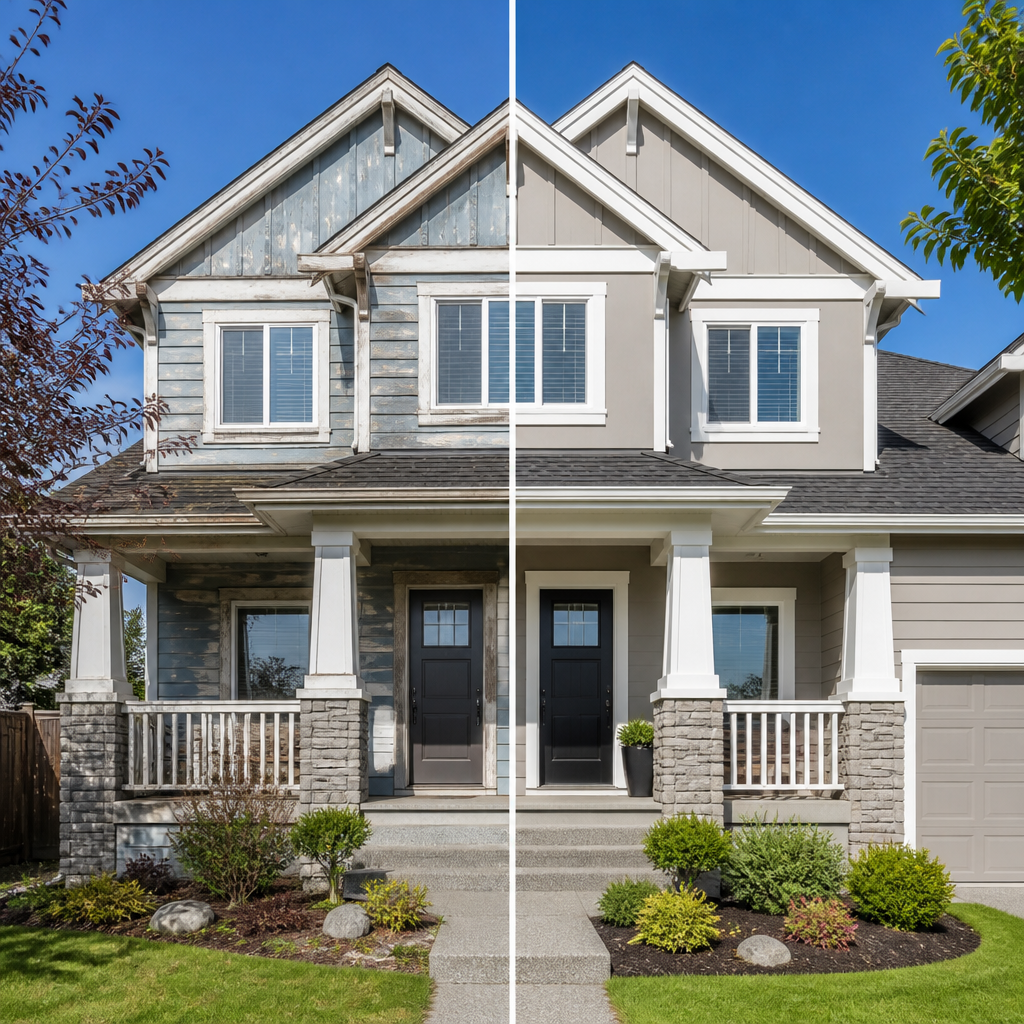
The visible result of any paint job is almost entirely determined by what happens before the first coat is applied. A contractor who skips preparation is not giving you a paint job. They are giving you a temporary colour change that will start failing within a year or two.
Interior Preparation: What to Expect
For interior work, proper preparation includes filling and sanding holes and cracks, cleaning surfaces to remove grease and dust, applying primer to any bare patches or previously glossy surfaces, masking trim and edges, and protecting floors and furniture. Skipping primer on previously painted glossy surfaces is one of the most common causes of peeling interior walls. A professional who genuinely understands adhesion will not skip this step regardless of how it affects their labour hours.
Exterior Preparation in the Fraser Valley Climate
Exterior preparation in the Lower Mainland is more physically demanding and more critical than many homeowners expect. Proper exterior prep includes pressure washing the entire surface, scraping and sanding any peeling or flaking areas, caulking all penetrations around windows, doors, and trim, spot-priming bare wood, and allowing everything to fully dry before topcoats are applied. Paint applied to damp or inadequately prepared substrates fails adhesion, sometimes within a single wet Lower Mainland winter. A contractor who wants to skip the pressure wash or start painting immediately after it is a contractor to avoid.
The difference between a paint job that lasts three years and one that lasts twelve is almost never the paint itself. It is the surface preparation done before the first coat ever touched the wall.
Cleanliness During and After the Job
A professional painting crew protects what is not being painted. Floors are covered with drop cloths, hardware and fixtures are masked, and daily cleanup is part of the job, not an optional extra. Before the project is complete, the crew should do a full walkthrough with the homeowner to catch any missed spots, drips, or touch-ups. Reputable painters inspect their own work rather than waiting for clients to point out every deficiency.
Project Timelines: What to Realistically Expect
Homeowners frequently underestimate how long a professional paint job takes, and some contractors underquote the timeline to win the bid. Understanding what drives timeline helps you hold a contractor to a realistic schedule.
A single interior room can be completed in a day with proper preparation. A full interior for a two-storey home, including ceilings, trim, doors, and closets, typically takes anywhere from three to seven business days depending on the scope and the number of painters on site. Exterior projects vary more widely: a standard two-storey home in good condition might take five to eight days, while a home with significant prep requirements, complex trim detail, or multiple storeys can run considerably longer.
For exterior work in the Fraser Valley, timing around weather is not optional. Exterior painting should not be done in rain, in temperatures below about 10 degrees Celsius, or on surfaces that are still wet from recent rain. A contractor who commits to an exterior start date in October without acknowledging weather risk is either inexperienced or overpromising to get the deposit. Late May through September is the reliable exterior painting window for the Lower Mainland and Fraser Valley.
Pro tip: Ask the contractor how many active projects they are managing simultaneously and how many painters will be assigned to your job. A crew that is stretched across too many sites is a crew that will be inconsistent about when they show up and how much progress happens each day.
Warranties and Workmanship Guarantees
A warranty is only as useful as its specific terms. Vague verbal promises about “standing behind the work” are not warranties. Before signing any painting contract in BC, ask the contractor to define their warranty in writing, covering exactly what is included, how long it lasts, what is excluded, and what the process is for making a claim.
Workmanship Versus Product Warranties
There are two separate types of warranties that apply to a paint job. The workmanship warranty is provided by the contractor and covers defects caused by improper application, inadequate preparation, or technique errors. The product warranty is provided by the paint manufacturer and covers product failures like premature fading or manufacturing defects. These are not the same thing, and a contractor who quotes a paint manufacturer’s warranty as their own workmanship guarantee is conflating two different documents to appear more generous than they are.
For residential painting in BC, a written workmanship warranty of two to three years is a reasonable baseline expectation from a professional contractor. Any warranty significantly longer than that should be examined carefully: read the exclusions, because what is left out often makes a long warranty far less valuable than it sounds on first mention.
Common Warranty Exclusions to Watch For
Most painting warranties exclude horizontal surfaces like decks and steps that collect standing water, surfaces that develop moisture damage from underlying structural issues, and existing coatings that were failing before the work started. These exclusions are legitimate, but you need to know about them before signing, not after you file a claim. A contractor who hides the exclusion language in fine print or refuses to discuss them in plain terms before you sign is not someone you want on your property.
Red Flags to Watch For Before You Sign
There are specific patterns that appear repeatedly with painting contractors who deliver poor results. Recognizing them before you sign protects you from a project that costs more to redo than the original job.
No written contract or estimate. Any contractor working without a written scope of work is leaving themselves free to deliver whatever they feel like and bill you for whatever they want. Full stop.
Unusually low price with no explanation. A price that is dramatically below other quotes did not appear by accident. Something was removed from the scope, whether that is prep time, primer coats, the number of topcoats, or the quality of product used. Ask for the explanation in detail.
Demand for full payment upfront. A legitimate painting contractor does not need you to pay the entire job before they have done any work. A deposit is normal and reasonable. Full prepayment is not.
Cannot or will not provide proof of insurance and WorkSafeBC standing. This is not an optional nicety. A contractor who avoids or delays providing these documents either does not have them or knows that what they have is not current. Walk away.
Vague or verbal-only warranty. If the contractor will not put the warranty terms in writing in the contract, the warranty does not exist in any meaningful way.
No references from comparable projects. An experienced contractor serving homeowners in Surrey, Langley, Abbotsford, or the broader Fraser Valley should have no trouble pointing you toward references from recent jobs of similar scope and quality to yours.
Comparing Your Hiring Options
Not all painting contractors are structured the same way. Understanding the differences helps you ask better questions and set appropriate expectations for your project.
| Contractor Type | Typical Characteristics | Best Suited For |
|---|---|---|
| Established family-owned painting company | Consistent crew, reputation built over years or decades, experienced estimators, direct owner accountability, deep knowledge of local climate and conditions | Full residential repaints, exterior work requiring sound judgment on timing and prep, clients who value a long-term relationship and follow-up service |
| Solo independent painter | Lower overhead may translate to lower price, single point of contact, but limited capacity and potentially limited insurance coverage | Small single-room jobs, touch-up work, situations where scheduling flexibility matters more than speed |
| Large franchise operation | Standardized processes and branding, but work is frequently subcontracted to crews with variable experience, and the franchise mark-up may not reflect on-site quality | Volume-driven projects where speed is the priority and the client is comfortable with a less personal service experience |
For most homeowners in the Lower Mainland and Fraser Valley, an established local painting company with a documented track record offers the best combination of accountability, skill, and familiarity with regional conditions. Dreamscape Painting has been serving this region since 1990, and that kind of history translates directly into practical knowledge about what works and what fails in BC’s climate. You can explore the full range of services, including cabinet refinishing and commercial painting, to understand exactly what an experienced regional contractor brings to each project type.
Frequently Asked Questions
How do I know if a painting company is legitimate and safe to hire in BC?
Request a current WorkSafeBC clearance letter, a certificate of general liability insurance, and their municipal business licence. All three should be available immediately from any professional contractor. Cross-reference the company’s Google reviews and ask for references from recent projects in your area. A company with a verifiable track record in your region is the safest starting point.
How many quotes should I get before choosing a painting contractor?
Three is the practical minimum. Two quotes give you too little range to spot an outlier, and more than four starts producing diminishing returns on your time. When reviewing the quotes, focus on what each one includes rather than the total number. A detailed estimate from a slightly higher-priced contractor often represents better value than a vague low quote that hides what has been left out.
What is included in a professional exterior paint job in the Lower Mainland?
A professional exterior paint job should include pressure washing the entire surface, scraping and sanding any failing paint, caulking gaps around windows, doors, and trim, priming bare wood or previously failing areas, applying two coats of a quality exterior topcoat, and a final walkthrough inspection. In the Fraser Valley, the timing and drying conditions during the process are as important as the materials used, so a professional contractor will monitor weather windows and will not start work on wet or cold surfaces.
How long should a professional interior paint job last?
With proper surface preparation and a quality paint product, interior paint jobs typically last anywhere from five to ten years before they need refreshing. High-traffic areas like hallways, kitchens, and laundry rooms tend to show wear sooner than bedrooms or formal living areas. The lifespan is primarily determined by the quality of preparation and the paint product used, not by how quickly the job was completed.
Is cabinet refinishing the same as repainting cabinets?
Not exactly. Cabinet refinishing is a fine-finish process that typically involves proper cleaning and degreasing of all cabinet surfaces, light sanding, priming with a product formulated for cabinetry, and applying a topcoat with a sprayer rather than a brush or roller. The result is a smooth factory-like finish that a standard wall-painting approach cannot replicate. It requires different equipment, different products, and significantly more precision than general interior painting. Ask specifically whether the contractor has dedicated cabinet refinishing experience before letting anyone touch your kitchen. Our cabinet refinishing is done in a dedicated spray shop.
Can I stay in my home while interior painting is being done?
In most cases, yes. A professional crew will protect furniture and floors, maintain ventilation, and work systematically through the home so that disruption is minimized. For rooms that absolutely need to be usable, such as kitchens and main bathrooms, communicate that requirement during the estimating process so the schedule can be arranged accordingly. The main exception is if heavy solvent-based products are being used in enclosed areas, in which case your contractor should advise you on ventilation requirements.
What should I do to prepare my home before the painters arrive?
Remove small decorative items, family photos, and fragile objects from the rooms being painted. Clear space around walls by moving furniture toward the centre of the room. A professional crew will handle the heavier furniture protection and floor covering, but the more you clear the surfaces and the easier you make access, the faster and cleaner the job will go. For exterior work, move patio furniture, planters, and outdoor equipment away from the walls being painted, and let the contractor know about any irrigation systems or landscape features close to the house.
Have a question about your specific project, or want to share what you wish you had known before hiring a painting contractor? Leave a comment below and help other Fraser Valley homeowners make a more informed decision.
References
- Painter hiring checklist for Vancouver covering WorkSafeBC, insurance, contracts, and warranty language
- Five key questions to ask before hiring a painting contractor including insurance and warranty guidance
- House painting cost guide for Vancouver and the Lower Mainland covering interior and exterior price ranges
- Ten questions to ask a paint contractor before hiring, specific to the Vancouver and Lower Mainland market
- Essential questions to ask before hiring a painting contractor covering subcontracting, warranties, and red flags

