

If your kitchen cabinets look tired, dated, or just plain wrong for the home you live in now, you are probably weighing two options: refinish or replace. For most homeowners in Langley and Surrey, that decision should not take long. Cabinet refinishing in Langley and across the Fraser Valley delivers 85 to 90 percent of the visual impact of a full kitchen renovation at a fraction of the cost, and the results, when the work is done properly, are indistinguishable from factory-finished cabinetry. This guide covers the entire process, from what refinishing actually involves to what it costs, what to expect from a professional crew, and how to avoid the mistakes that turn a good investment into a repaint in two years. For local details, see cabinet painting in Langley and cabinet refinishing in Surrey.
Table of Contents
- Quick Takeaways
- What Is Cabinet Refinishing, and What Is It Not?
- Is Your Kitchen a Candidate for Refinishing?
- The Professional Refinishing Process, Step by Step
- Cost of Cabinet Refinishing in Langley and Surrey
- Cabinet Painting Surrey: Colour Choices That Actually Work
- Refinishing vs. Refacing vs. Replacement: A Clear Comparison
- Kitchen Refresh Fraser Valley: What the ROI Looks Like
- What to Look for in a Refinishing Contractor
- Frequently Asked Questions
- References
Quick Takeaways
| Key Insight | Explanation |
|---|---|
| Refinishing costs a fraction of replacement | A professional cabinet refinish in Langley or Surrey typically runs between $1,800 and $6,500 for a full kitchen, compared to $15,000 to $50,000 or more for full replacement in the Lower Mainland. |
| Preparation is everything | The difference between a refinish that lasts a decade and one that chips in two years is almost entirely in the prep work: degreasing, sanding, and the right primer applied to the right substrate. |
| Structurally sound cabinets are the green light | If your cabinet boxes are solid, doors hang without binding, and the problems are purely cosmetic (outdated colour, worn finish, yellowed paint), refinishing is the right call. |
| Colour choice matters more than most homeowners realize | In the Surrey and Fraser Valley resale market, classic neutrals and soft whites consistently outperform trendy colours when it comes to broad buyer appeal. |
| Refinishing and refacing are not the same thing | Refinishing works at the coating level. Refacing wraps existing boxes with veneer or installs new doors. Each has its place, but they solve different problems at different price points. |
| Fraser Valley homeowners selling within 3 to 7 years get the best ROI | A professionally refinished kitchen reads as a renovated kitchen to buyers. At a cost that represents a small fraction of the property’s value, the return is hard to beat. |
| Not every painter is qualified to refinish cabinets | Cabinet refinishing is a fine finish trade. It requires specific primers, proper film thickness, and controlled spray environments. Ask detailed questions before hiring anyone. |
What Is Cabinet Refinishing, and What Is It Not?
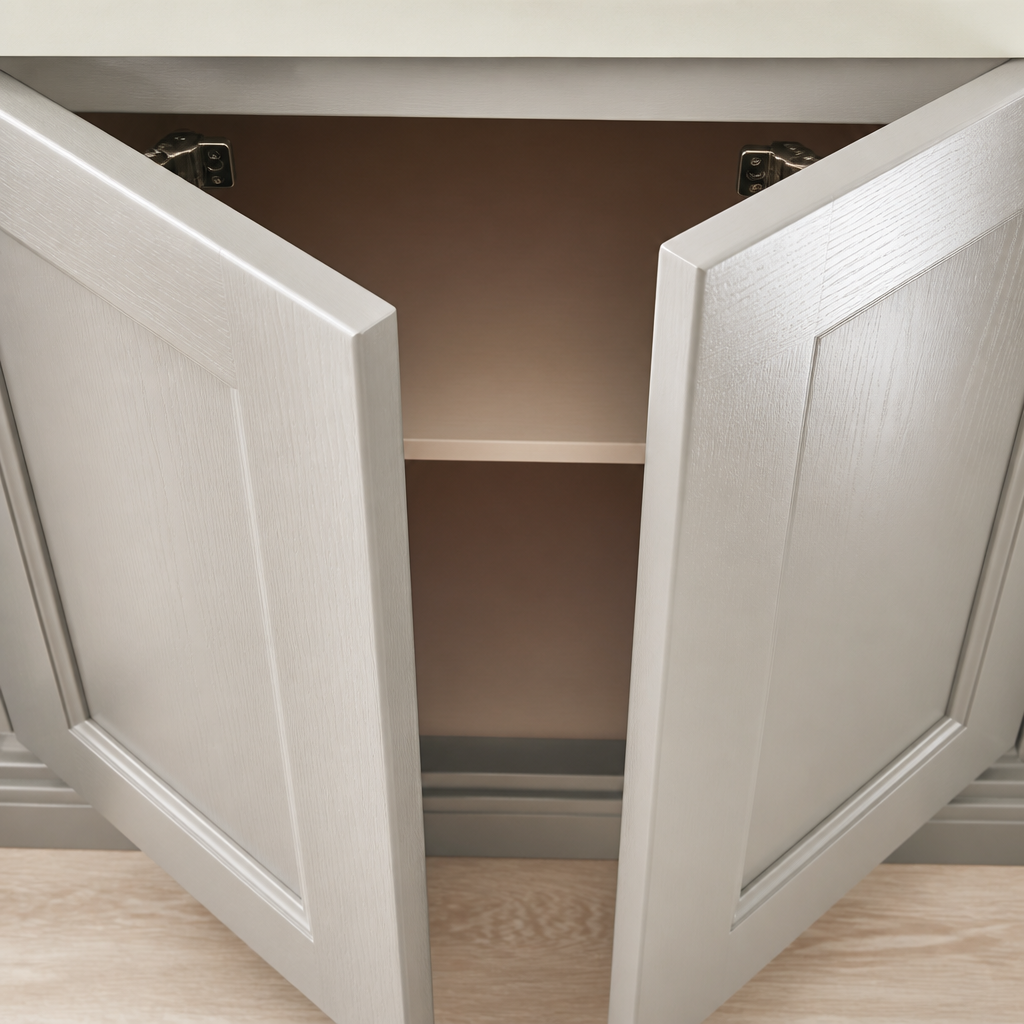
Cabinet refinishing refers specifically to the process of thoroughly cleaning and sanding the existing finish from cabinet surfaces, applying a high-adhesion primer suited to the substrate, and then coating with a durable topcoat product designed for cabinetry. Done correctly, the final result is a hard, factory-quality surface that handles heat, grease, humidity, and daily contact without peeling or chipping prematurely.
What refinishing is not: it is not a coat of wall paint brushed over dusty cabinet fronts. It is not a DIY spray-can job. And it is not the same as refacing, which involves wrapping existing boxes with veneer or laminate and installing new doors and drawer fronts. Refinishing works at the coating level. The structure stays exactly as it is, which is precisely why the process is so cost-effective when the cabinets underneath are structurally sound.
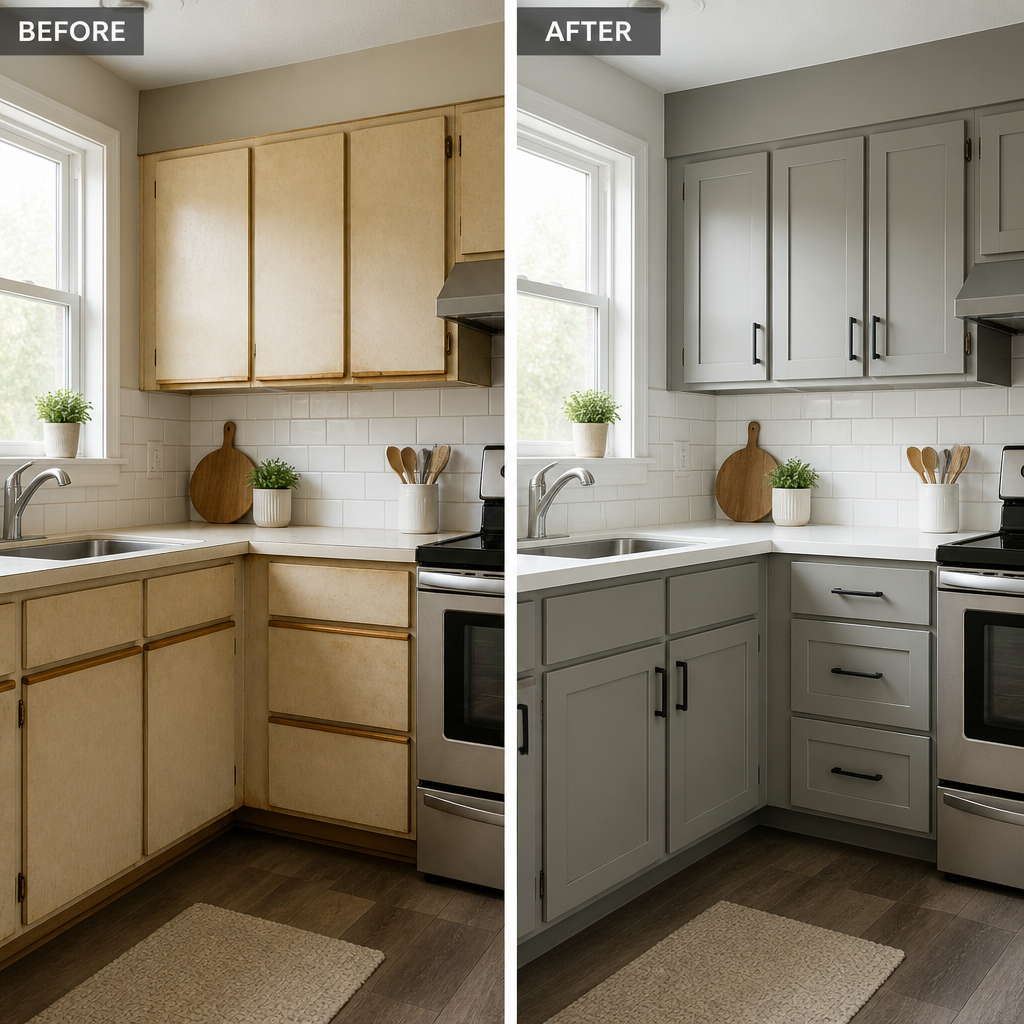
For homeowners across Langley, Surrey, Abbotsford, and the broader Fraser Valley, this distinction matters because the local housing stock includes enormous numbers of kitchens built between the mid-1980s and early 2000s. The bones in those kitchens are often excellent. Solid plywood or MDF boxes, well-built frames, functional hardware. What ages is the finish: the honey oak stain, the builder-grade white that has yellowed, the 1990s forest green that was stylish for about three years. Refinishing fixes exactly that problem, and nothing more, which is exactly what most kitchens in this region actually need. We do the same work for cabinet refinishing in Abbotsford.
Is Your Kitchen a Candidate for Refinishing?
The honest answer for most Fraser Valley kitchens: yes. But there are clear disqualifying conditions that a professional estimator will identify during a proper site visit.
Signs Refinishing Will Work
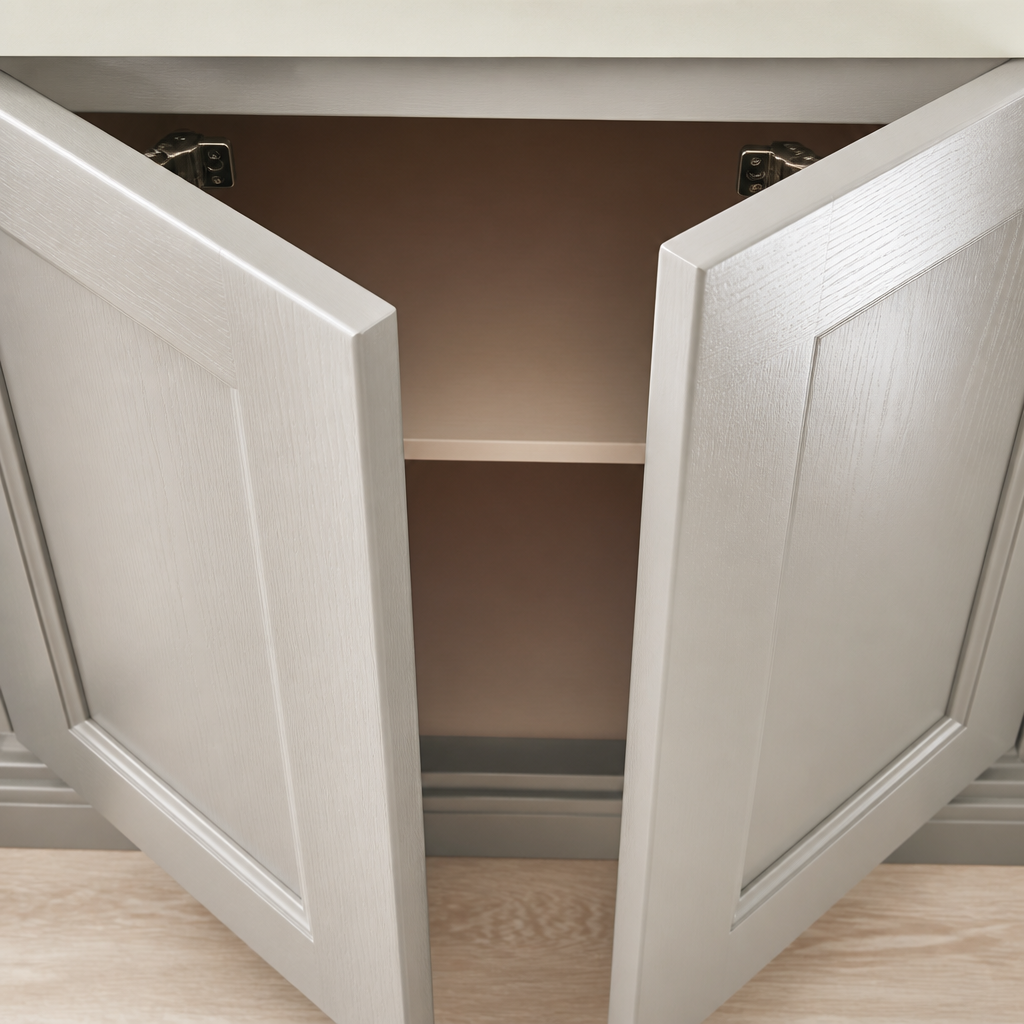
Doors and drawer fronts that hang correctly and operate without binding are a strong positive indicator. Surface discolouration, a yellow or orange cast on previously white cabinets, visible wear around hardware, and an outdated finish are all purely cosmetic problems that refinishing resolves completely. These are the kitchens that benefit most from cabinet painting in Surrey and Langley.
Cabinet boxes built from solid plywood or MDF hold primer and topcoat extremely well. Homes built throughout Surrey, Langley, and the Fraser Valley between the mid-1980s and early 2000s very commonly have this type of construction, which makes them excellent refinishing candidates.
When Refinishing Is the Wrong Tool
Refinishing will not fix structural problems. Boxes that have water damage, swollen MDF at the base of a sink cabinet, warped doors that cannot be squared, or frames that are delaminating need either targeted repairs or full replacement before any coating work makes sense. A good contractor will tell you this clearly during the estimate. Anyone who tries to talk you into refinishing over obvious structural damage is either not looking closely enough or prioritizing the sale over the result.
Thermofoil cabinets with lifting or peeling film are also poor candidates for a standard refinish. The film needs to be stripped entirely before any coating adheres properly, which adds cost and time. This is a separate conversation from a standard wood or MDF refinish job.
Pro tip: Run your hand firmly along the inside edges of your cabinet doors and the bottom of your sink base cabinet. Soft spots, swelling, or delamination tell you immediately whether the structure is sound enough for refinishing. If it feels solid, it almost certainly is.
The Professional Refinishing Process, Step by Step
Understanding what a proper refinish involves helps you evaluate any contractor’s quote with confidence. The steps are not negotiable. Every shortcut taken in preparation shows up in the final product, usually within the first year.
Step 1: Complete Teardown
Every door comes off its hinges. Every drawer front is removed. All hardware, handles, and hinges are pulled. This is non-negotiable for a proper finish because it allows every surface to be worked on fully and allows doors to be finished flat in a controlled environment rather than vertically on the wall where gravity works against a wet coating.
Step 2: Degreasing
Kitchen cabinet surfaces accumulate years of grease, cooking oil, and cleaning product residue. This layer is invisible once it dries but it will defeat primer adhesion completely if it is not removed before any sanding begins. Professional crews use a combination of TSP substitute solutions and denatured alcohol to strip this layer thoroughly. Skipping or rushing this step is the single most common reason refinish jobs fail.
Step 3: Sanding and Surface Prep
Sanding scuffs the existing finish to give the primer mechanical adhesion. It is not about removing the entire old finish in most cases. It is about creating a surface profile that the primer can grip. After sanding, all dust is vacuumed and tack-wiped before any coating is applied. Any remaining dust trapped under the primer layer will telegraph through every coat above it.
Step 4: Primer Application
The primer is where the job is either set up to last or set up to fail. A high-adhesion primer formulated for cabinetry, applied at the correct film thickness, is what creates a stable foundation for the topcoat. On dark substrates being converted to a lighter colour, a stain-blocking primer prevents bleed-through that no topcoat can fix after the fact.
Pro tip: If a contractor quotes your cabinet refinishing project without specifying which primer they plan to use and why, that is a warning sign. A professional should be able to name the product and explain why it is appropriate for your specific cabinet material and current finish.
Step 5: Topcoat Application
Professional cabinet finishes are typically applied by spray using HVLP equipment, which delivers a smooth, even film thickness that a brush or roller simply cannot replicate. Two-component polyurethane or waterborne alkyd topcoats are the industry standard for durability on cabinetry. These coatings cure to a hard film that handles the thermal cycling, moisture, and repeated contact that kitchen cabinets face every day.
Step 6: Cure Time and Reinstallation
Topcoats need adequate cure time before doors are rehung and hardware is reattached. Rushing reinstallation when the coating is still soft leads to surface marks and damage that cannot be fixed without stripping and recoating. Professional crews schedule cure time into the project timeline. A kitchen that is taken apart for two to four days and comes back looking factory-finished is a better outcome than one rushed back together in a day with marks already in the finish.

Cost of Cabinet Refinishing in Langley and Surrey
Cost is the first question most homeowners ask, and it is a reasonable one. For a mid-sized kitchen with 15 to 25 cabinet doors and drawer fronts in Langley or Surrey, a professional refinish from a qualified Lower Mainland painting company typically runs between $2,800 and $6,500. Smaller kitchens with fewer doors can come in under $2,000. Larger kitchens with complex layouts, additional prep requirements, or specialty finishes can push the upper end further.
For comparison, full cabinet replacement in the Lower Mainland runs anywhere from $15,000 for stock cabinetry on the lower end to $50,000 or more for semi-custom or custom millwork. That is a difference of $10,000 to $40,000 for a kitchen that, in the majority of cases, looks equally refreshed after a quality refinish. The savings are real and they are substantial.
What Affects the Price
The number of doors and drawer fronts is the primary cost driver. A kitchen with 12 doors costs meaningfully less than one with 30. The condition of the existing finish matters too: cabinets with heavy buildup, extensive damage, or multiple previous paint layers require more prep time, which adds cost. Specialty finishes such as two-tone colour schemes or glazed finishes add labour. Hardware replacement, if you are updating hinges and handles at the same time, is typically priced separately.
A proper on-site estimate from an experienced contractor is the only reliable way to get an accurate number for your specific kitchen. Anyone quoting a cabinet refinish job without a site visit is guessing, and their number will change when they actually see what the project involves.
A professionally refinished kitchen reads as a renovated kitchen to a buyer walking through. At a refinishing cost that represents a small fraction of the property’s value, the return on that investment is difficult to match with any other single home improvement project.
Cabinet Painting Surrey: Colour Choices That Actually Work
Cabinet painting in Surrey opens up a colour range that factory cabinets simply cannot match at a reasonable price point. Custom millwork in any specific colour costs significantly more than standard stock cabinetry. Refinishing lets you specify exactly the colour, sheen, and finish type you want, applied to cabinet boxes that are already sized and fitted perfectly to your kitchen.
Neutral and White Tones
In the Surrey and Fraser Valley resale market, soft whites, warm whites, and greige tones consistently perform well with broad buyer appeal. These colours read as clean, bright, and current regardless of when the kitchen was originally built. Benjamin Moore’s White Dove and Chantilly Lace, as well as Sherwin-Williams’ Alabaster, are commonly specified for Fraser Valley kitchens and remain popular for good reason: they work with almost any countertop material and floor finish already in the home.
Two-Tone Combinations
Upper cabinets in a soft white or warm greige paired with lower cabinets in a muted navy, deep sage, or charcoal creates contrast without committing fully to a bold statement. This approach is particularly popular in Langley and South Surrey, where homeowners are updating kitchens for personal enjoyment rather than immediate resale. Done well, a two-tone cabinet finish looks intentional and current rather than dated.
What to Avoid
Highly saturated or very dark single-colour schemes on all cabinets are a harder sell in the Fraser Valley market if resale is a consideration within the next few years. They can be stunning in the right kitchen, but they narrow your buyer pool. The smarter approach, if you love a bold colour, is to apply it to the island or lower cabinets only, with neutrals above.
Refinishing vs. Refacing vs. Replacement: A Clear Comparison
These three options are often confused, and the confusion leads homeowners to either overspend on replacement when refinishing would do the job, or to choose refacing for a problem that refinishing handles at lower cost. Here is a direct side-by-side comparison.
| Option | What Changes | Typical Cost Range (Lower Mainland) |
|---|---|---|
| Cabinet Refinishing | Surface coating only. Existing doors, boxes, and frames stay. Colour and finish are completely transformed. Best for structurally sound cabinets with cosmetic issues only. | $1,800 to $6,500 for a full kitchen, depending on size and prep requirements. |
| Cabinet Refacing | New doors and drawer fronts installed. Existing boxes wrapped with veneer or laminate. Layout stays the same. Best when existing doors are damaged or the wrong style. | $8,000 to $15,000 for a full kitchen in the Lower Mainland. |
| Full Cabinet Replacement | Everything removed and replaced. New boxes, doors, hardware, and often countertops. Layout can change. Best when boxes are damaged, layout needs to change, or a full kitchen renovation is underway. | $15,000 to $50,000 or more, depending on scope and cabinet quality. |
For the majority of kitchens in Langley and Surrey, refinishing is the right starting point. The decision moves to refacing when the door style itself needs to change, not just the colour. Full replacement only makes sense when the boxes are structurally compromised, the layout needs to change, or a complete renovation is already underway and cabinets are coming out regardless.
Kitchen Refresh Fraser Valley: What the ROI Looks Like
A kitchen refresh in the Fraser Valley is one of the highest-return home improvement projects available to homeowners preparing to sell. Kitchen renovations consistently rank among the highest-cost home improvement categories, but also among the highest-return ones when managed appropriately. The key is spending on what buyers see, not on infrastructure they never notice.
A refinished kitchen, paired with updated hardware and perhaps new countertops, presents as a renovated kitchen during showings. Buyers respond to clean, modern cabinetry without necessarily knowing or caring that the boxes behind those freshly painted fronts are the same ones that were there in 1998. The investment is in presentation, and presentation drives offers.
For homeowners in Langley, Surrey, and across the Fraser Valley who are planning to sell within three to seven years, the math is straightforward. Spend $3,000 to $6,000 on a professional refinish, replace the hardware for a few hundred dollars, and you have a kitchen that competes with fully renovated kitchens in your price range. The savings versus full replacement stay in your pocket or go toward other improvements that increase the property’s value further.
Even homeowners with no intention of selling benefit from the same math. A kitchen that looks and functions like a renovated space, achieved without demo and contractor disruption that stretches over weeks, is simply a better place to spend time every day.
Pro tip: If you are refinishing cabinets as part of a pre-sale preparation, coordinate the work with your realtor’s timeline. Cabinet refinishing takes two to four days in most kitchens. Factor in cure time before the kitchen is back in full use, and plan the project at least three weeks before your listing date to allow for any touch-ups.
What to Look for in a Refinishing Contractor
Cabinet refinishing is a fine finish trade. It is not standard wall painting, and not every painting company has the equipment, products, or technique to do it well. Hiring the wrong contractor for this work means a repaint within two years, and the cost of stripping and redoing a poor refinish often approaches the cost of the original job.
Questions to Ask Before Signing Anything
Ask which primer they plan to use and why it is appropriate for your specific substrate. Ask whether they spray doors flat or hang them vertically. Ask how long they allow for cure time before reinstallation. Ask what topcoat product they use and whether it is a one-component or two-component system. Professionals answer these questions without hesitation because they think about them for every job. Vague answers or generic responses are a signal to keep looking.
Experience With Fine Finish Work
A company with a track record in interior fine finish painting, trim work, and cabinetry is a fundamentally different proposition from one that primarily does exterior or commercial volume work. Ask to see examples of completed cabinet projects, preferably in kitchens similar in size and material to your own. A contractor with over three decades of fine finish experience in the Lower Mainland has seen every substrate, every condition, and every common failure mode. That history matters in a project where the margin for error is small.
Cleanliness and Professionalism On-Site
Cabinet refinishing requires masking and containment of the surrounding kitchen. Spray application means overspray is a real concern if the crew is not meticulous about masking. A professional crew protects floors, appliances, countertops, and adjacent rooms before any spraying begins. If cleanliness and protection are not discussed during the estimate, that is worth raising before the job starts.
Dreamscape Painting has served Langley, Surrey, Abbotsford, and the broader Fraser Valley and Lower Mainland for over 35 years. Our estimators visit every project in person, our painters are experienced in fine finish cabinetry work, and we treat your kitchen with the care and attention to detail that 35 years of professional service demands. Contact us for a free estimate and find out what a professional cabinet refinish can do for your kitchen.
Frequently Asked Questions
How long does cabinet refinishing take in a typical Langley or Surrey kitchen?
Most mid-sized kitchens with 15 to 25 doors and drawer fronts take two to four days for the full process, including teardown, prep, primer, topcoat, and reinstallation. You should also allow two to three additional days for the coating to fully cure before the kitchen returns to heavy daily use. Total disruption from start to full use is typically about one week, which is significantly shorter than a full kitchen renovation.
Will refinished cabinets hold up to the wear of a busy kitchen?
Yes, when the work is done properly. A professionally applied two-component polyurethane or waterborne alkyd topcoat cures to a very hard film that handles heat, grease, humidity, and repeated contact without chipping or peeling under normal use. The durability of the final coating is directly tied to the quality of the preparation and the product used. Cabinets refinished by experienced professionals with the right products routinely last ten or more years before any touch-up is needed.
Can any colour be used for cabinet painting in Surrey?
Virtually any colour from any major paint brand can be matched and applied as a cabinet finish. The practical consideration is substrate: going from a very dark existing colour to a very light one requires additional prep and a stain-blocking primer to prevent bleed-through. Dark-to-light conversions are entirely achievable but require more time and product. Your contractor should account for this in the quote if it applies to your kitchen.
Is cabinet refinishing worth it if I am planning to sell my home in the Fraser Valley?
For most homeowners planning to sell within three to seven years, yes, it is worth it. A professionally refinished kitchen presents as a renovated kitchen to buyers during showings. The cost of a professional refinish represents a small fraction of the property’s value, and the return in buyer perception and competitive positioning in the Fraser Valley market is consistently strong. Refinishing redirects budget toward the highest-impact visual change in the kitchen without the cost and timeline of full replacement.
What is the difference between cabinet refinishing and cabinet refacing?
Refinishing works at the coating level: the existing surfaces are stripped or sanded, primed, and recoated. The doors, boxes, and frames all stay exactly as they are. Refacing installs new doors and drawer fronts and wraps existing cabinet boxes with a veneer or laminate. Refacing is the right choice when the door style needs to change or existing doors are damaged beyond what refinishing can address. For kitchens where the structure and door style are fine but the finish is dated, refinishing delivers the same visual result at significantly lower cost.
Do I need to move out during cabinet refinishing?
In most cases, no. The kitchen will be out of use during the project, and the spray work requires ventilation and containment of the immediate area. Most homeowners stay in the home and use other rooms normally while the work is in progress. Your contractor should discuss the ventilation requirements and containment plan before the project begins so you know exactly what to expect.
Have you recently had your kitchen cabinets refinished in Langley, Surrey, or anywhere in the Fraser Valley? Share what the experience was like and what made the biggest difference in the final result.
References
- Dreamscape Painting: Cabinet Refinishing vs. Replacement in Surrey, including real cost comparisons for the Lower Mainland market
- Dreamscape Painting: How Cabinet Refinishing Transforms a Kitchen Without Full Demolition
- Reno-Stars: Cabinet Resurfacing Cost Guide for Langley, covering painting vs. refacing vs. replacement price ranges
- Reno-Stars: Cabinet Refinishing Cost Guide for Surrey, with detailed cost breakdowns for professional painting and refacing
- This Old House: Professional Tips and Techniques for Refinishing Kitchen Cabinets

